
I had a choice this year. I could spend Thanksgiving with my camera at the soggy bog:
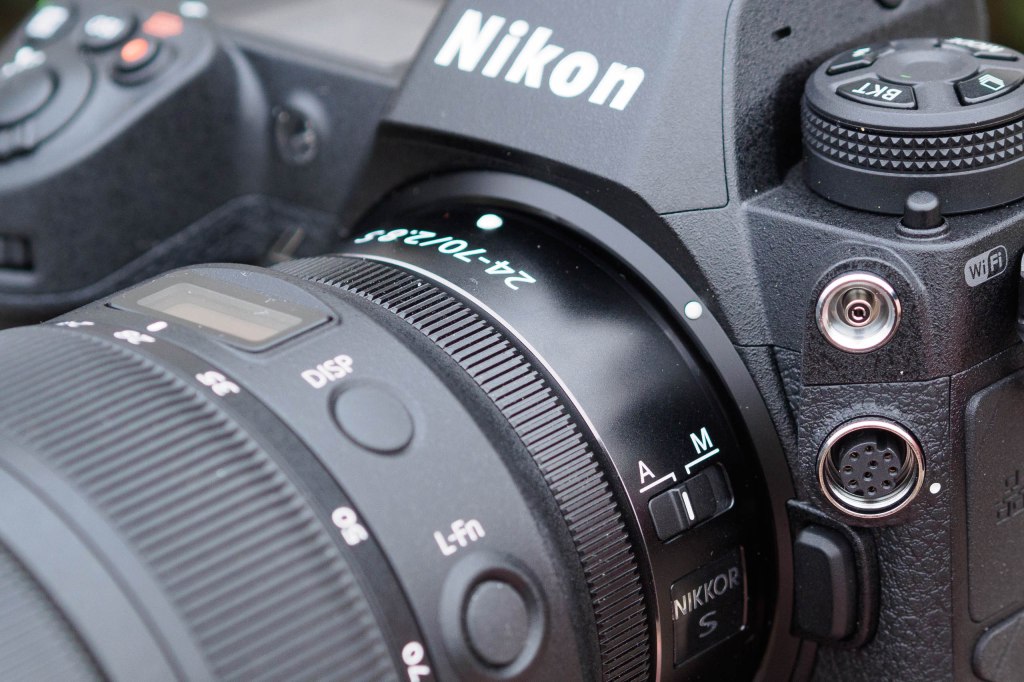
Or I could force my way into the ubiquitous family dinner, which would, of course, require an additional wardrobe purchase:
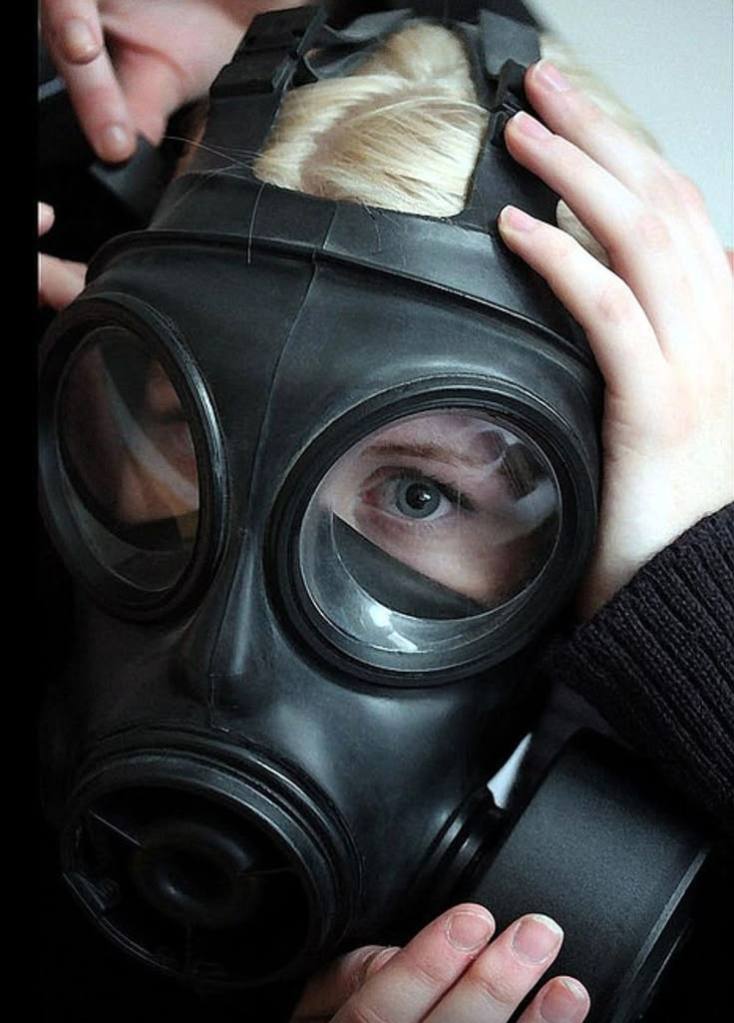
(Is this a trick question?)
The choice was a no-brainer.
Armed with my camera, lenses, and a lunch consisting of a Pink Lady apple, a piece of homemade cheesecake, and a bottle of Ice carbonated beverage, I headed towards the soggy bog.
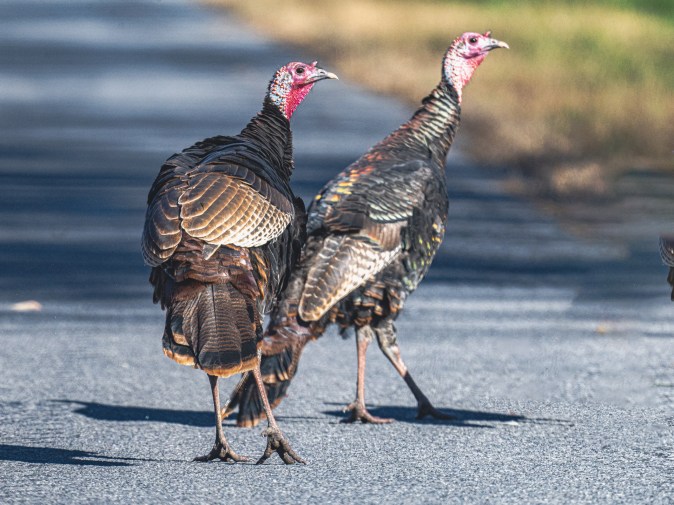
And look what I found on the way! A couple of wary survivors of the Western New York Thanksgiving Massacre!
Upon arriving at the bog, I found that *someone* had already had their dinner. . .

. . .and by now they were probably lounging at home, watching the Eagles game (always a lot of complaining from the sidelines at those games):

This furry friend was still at the table. Forget the turkey, s/he was eating all the salad s/he could find:

Others were resting after a long search for their slippery, wiggly holiday dinner:
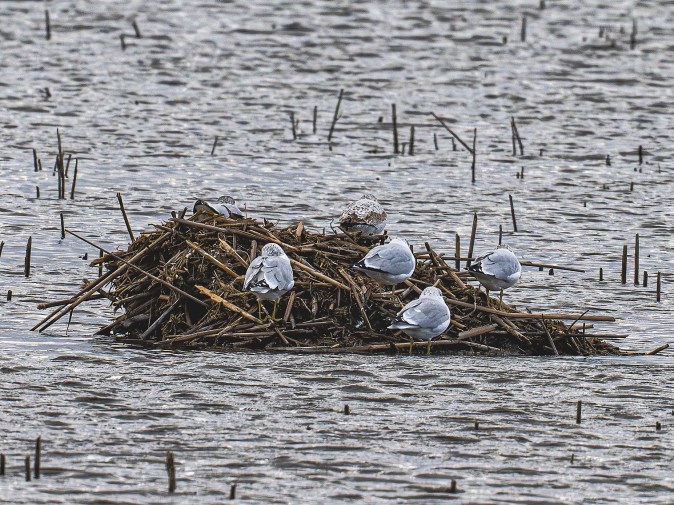
There were LOTS of gulls here today. Not much fishing, though, most were resting:

There were also lots of Canada geese — what would western NY be without flocks of Canada geese? (Answer: Cleaner and a lot quieter!)

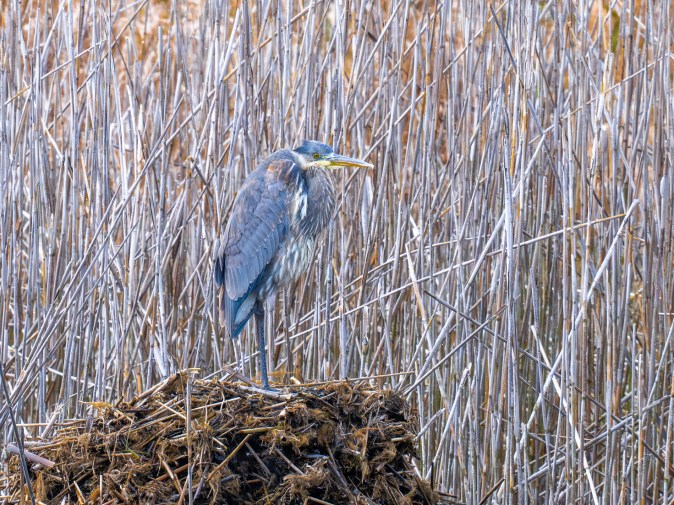
Some of the residents were just hanging around, keeping an eye on things (there are actually two of these great blue herons who chose to remain here rather than migrate south. . .the heron equivalent of Iron Man. . .):
Today I decided to travel down the wooded dirt road leading to some nearby soybean fields. Glad I did, because look what I found!
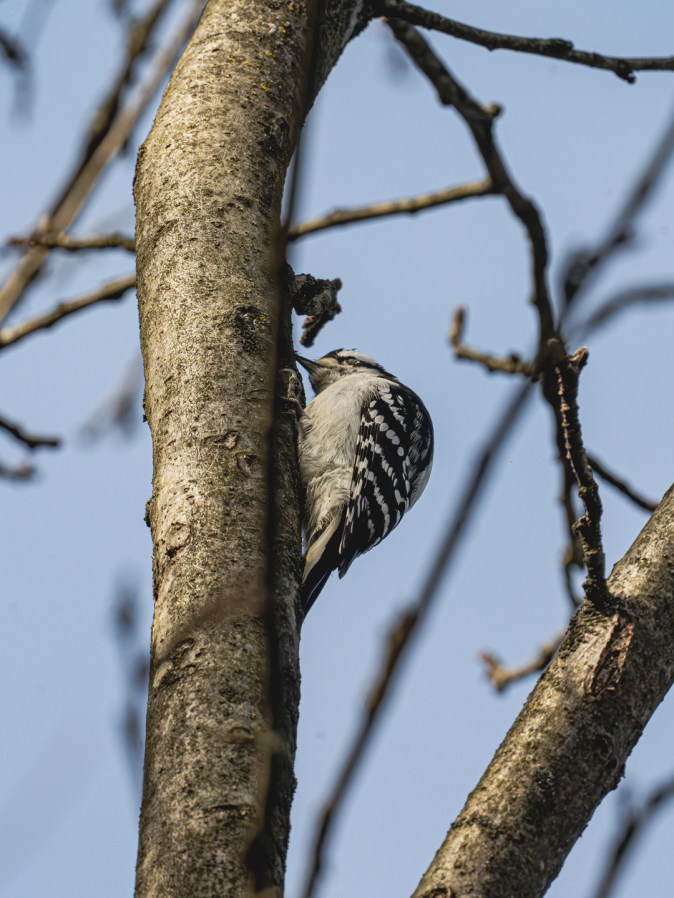
A hungry downy woodpecker tapping the tree for insects (check out the nictitating membrane protecting his eye from airborne wood chips):
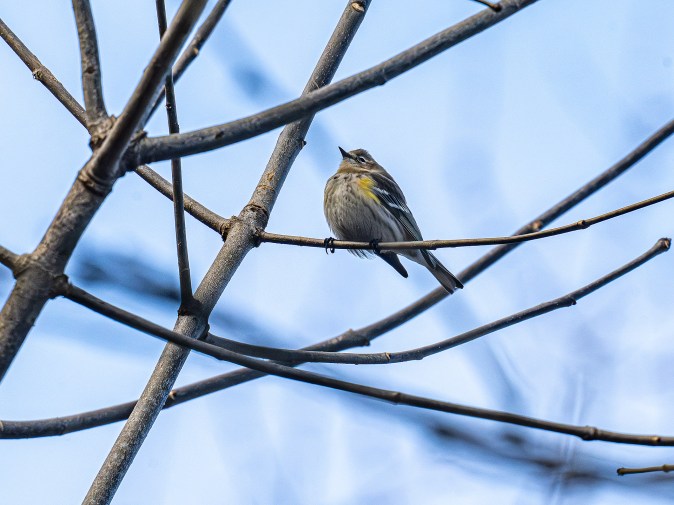
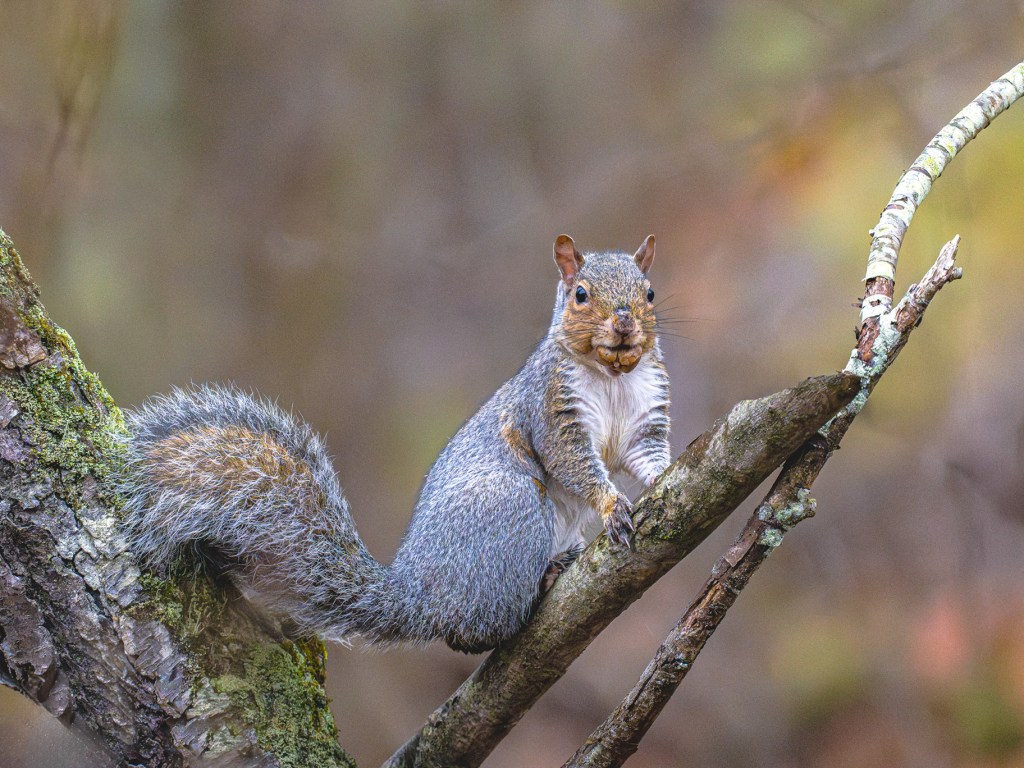
Observed the whole time by me, a myrtle warbler, and a gray squirrel:
The ducks, however, had had enough and decided to get a head start on the incoming snowstorm:

Photographers generally avoid “bird on a stick” photos, considering them dull and uninteresting. They would never win a prize at a contest.
But then they would have missed this shot of a beautiful American Kestrel, a small falcon (in fact, the smallest of the falcons) common to North America:

There is absolutely no hope for me. None of these photos would win a prize because none of them exhibit the technical quality and artistic talent required by a contest winner — well, the beavers had some talent, but they’re not photographers so they don’t count. In any event, the mundanity I managed to capture with my camera is more valuable to me than an honorable mention in some contest. It serves as a pleasant reminder of a Thanksgiving holiday spent in solitude and quiet reflection without the self-doubt, anxiety, and stress of spending it with a bunch of squabbling, hypercritical family members.
I hope their holiday went as well as mine.
THIS is why the managers at Montezuma National Wildlife Refuge drain the marshes every spring. Once reduced to mudflats, the lands lie fallow over the summer, producing lush, duck-friendly vegetation. By refilling the marshes in late September/early October, there is enough water and vegetation to attract ducks to the refuge.
Just in time for fall migration.
And New York’s duck-hunting season.
This guy was parked on Wildlife Drive on Sunday, November 9. The Drive remains open to the public until November 30. It is my understanding that public access is why hunting is never allowed on Wildlife Drive. . .but apparently I understand wrong.
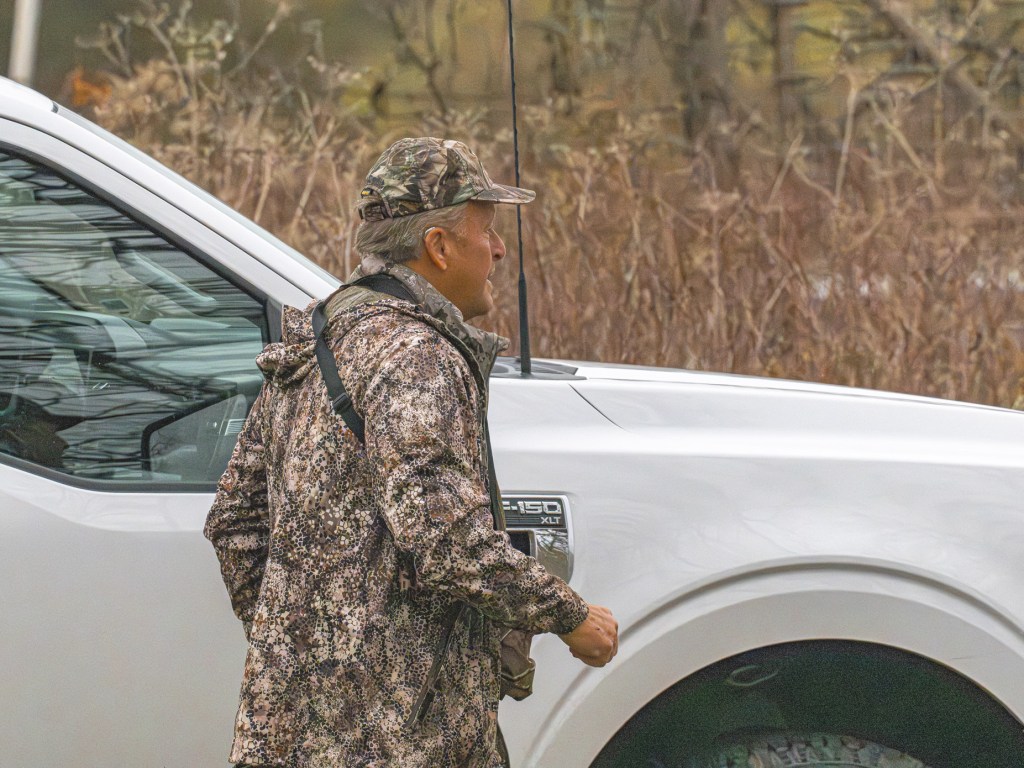
This entire dilemma is unnecessary. While drainage does “refresh the marsh,” such refreshment is rarely required, since the weather cycle in this region of NY provides natural drought every 5-7 years, sufficient to sustain the marshes. But even on those rare occasions when nature fails and the water table must be lowered, it needn’t be drained dry. In fact, too-frequent drainage, whether induced or natural, hastens the growth of shrubbery, which in turn hastens the demise of the marsh and creation of meadowlands. (This is what is happening at Knox-Marcellus.)
Clearly this photo (above) proves that the varied explanations MNWR offers for its frequent distortion of the food web consist of “alternate facts” designed to convince us that killing off the resident water dwellers and driving away dependent wildlife dependent each (or nearly each) spring serves some kind of lofty environmental purpose. . .and that hunting is a byproduct of negligible importance.
It doesn’t, except on rare occasions, and it’s not. . .especially if you’re a duck.
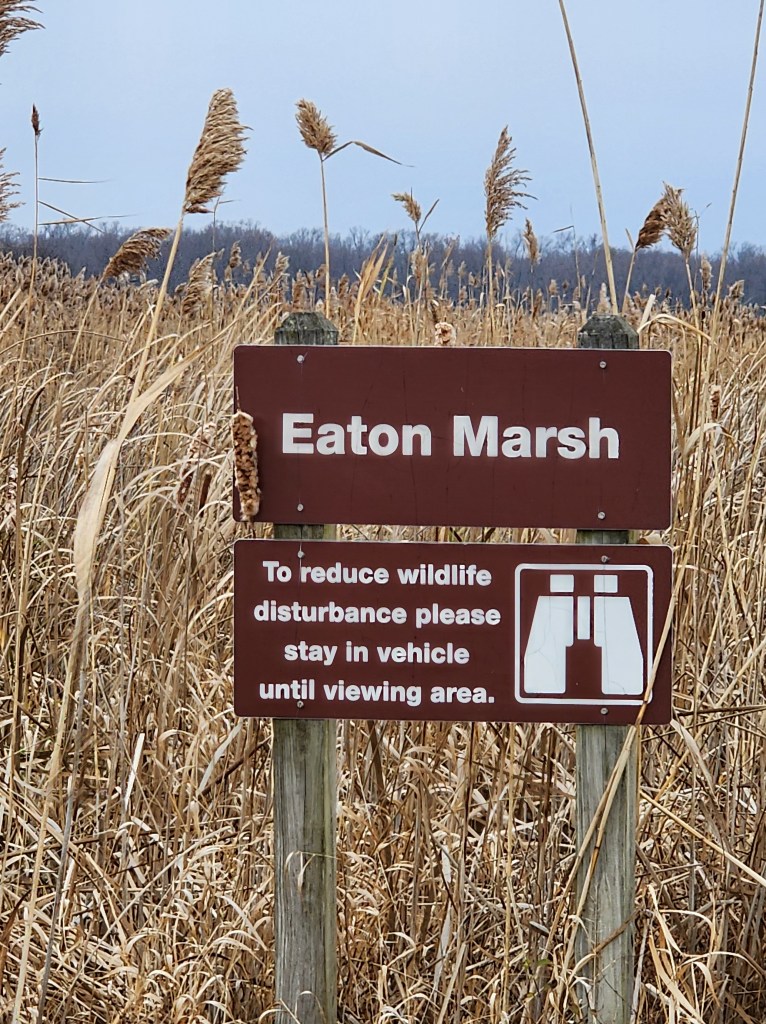
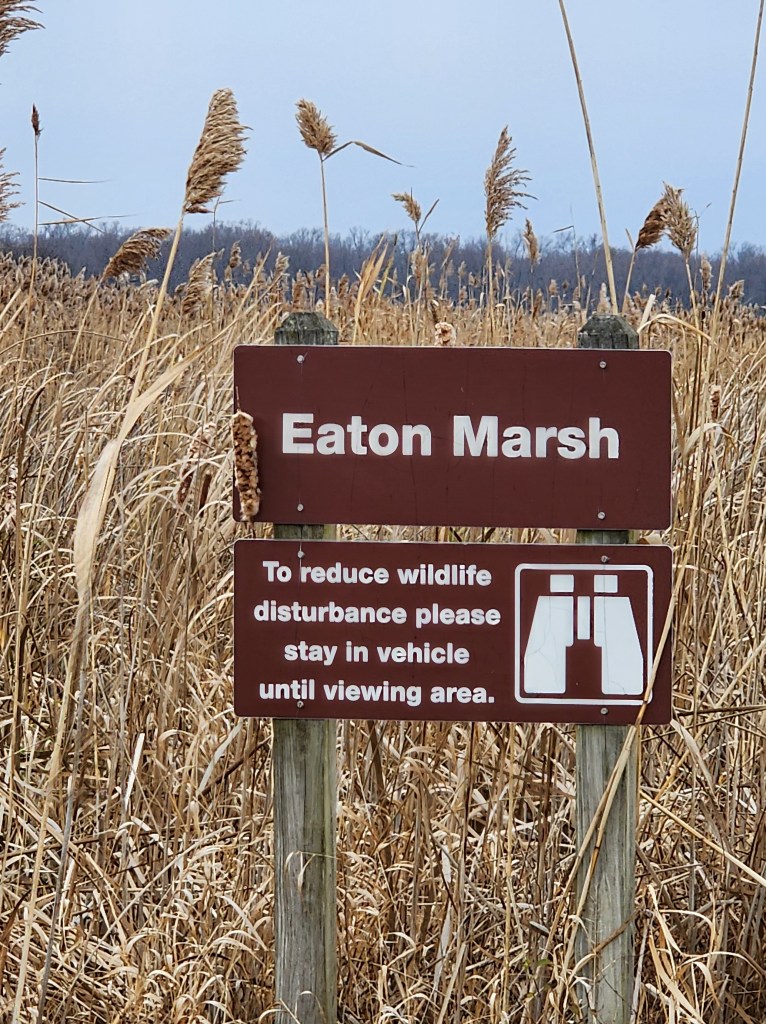
According to one MNWR rep I spoke to, this year’s drainage was intended inter alia to control invasive species such as the phragmites grass. . .judging from this photo (above), that proved to be an epic fail. (This sign always makes me LOL — if getting out of our cars creates a “wildlife disturbance,” I’d like to know what MNWR creates with their annual (or nearly annual) destruction of the entire the food web. . .)
Anyway, it’s politics, not financial quid pro quo, that spares us from most of this year’s propaganda. Mike (“the Little”) Johnson’s House shutdown and the bumbling, ineffective, and corrupt government that produced it has protected the wetlands from further harm . . .except, now that the BBB is “law,” the marsh managers are once again controlling the (barely) wetlands. . .<sigh>
Their return won’t stop me, though, from trying to enjoy the little bits of wildlife that survive despite their destructive and disastrous summer of 2025:
Rarely do we find a feral muscovy duck in the wetlands, but I found one foraging disturbance-free at the Sandhill Crane Unit, where water levels are much better than those at Seneca Falls. (Bad photo, taken from a distance my 500 mm lens could not handle.)

Until the hunters arrived, that is. Haven’t seen her since. . . 😦
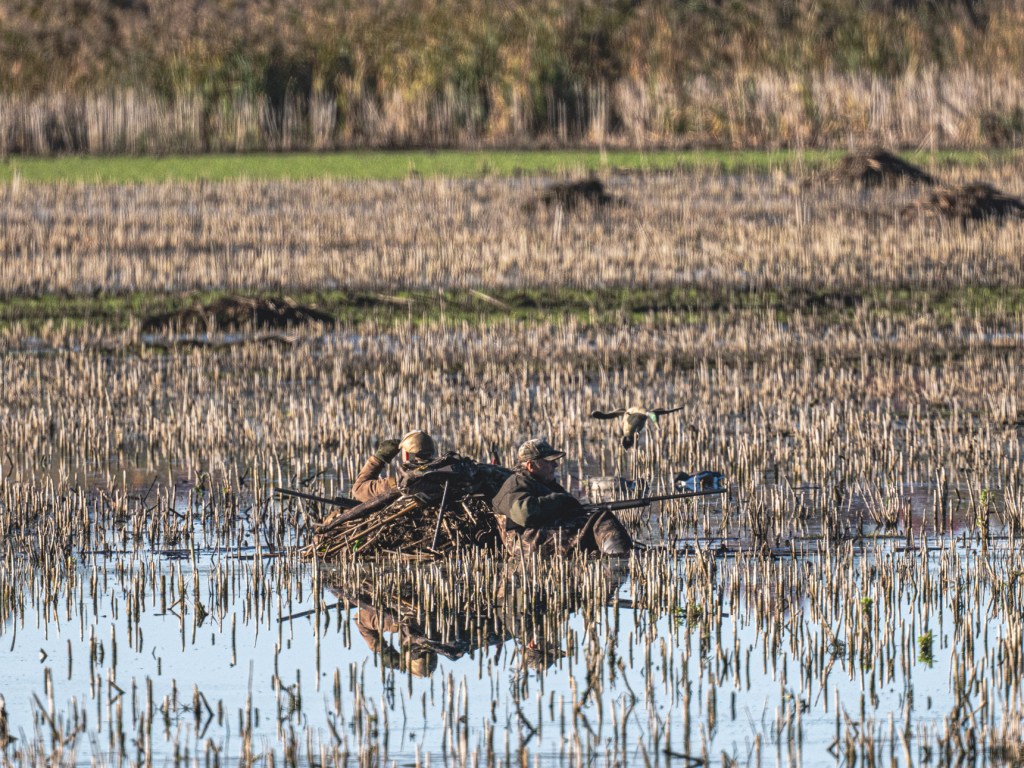
When I saw these guys up in the Sandhill Crane Unit, where hunting is prohibited (except on adjacent private LAND), I turned my radio up all the way, knowing how easily sound carries over water. They did turn and look. And then I drove up and down the roadway several times, hoping to save a few ducks.
It’s one thing to allow hunting. . .but it’s another to allow hunting after luring wildlife to a refuge. . . with acres of bait. . .
. . .but wildlife aren’t stupid. They know there are safer habitats elsewhere.

Dancing (male) mallard, Sodus Bay.
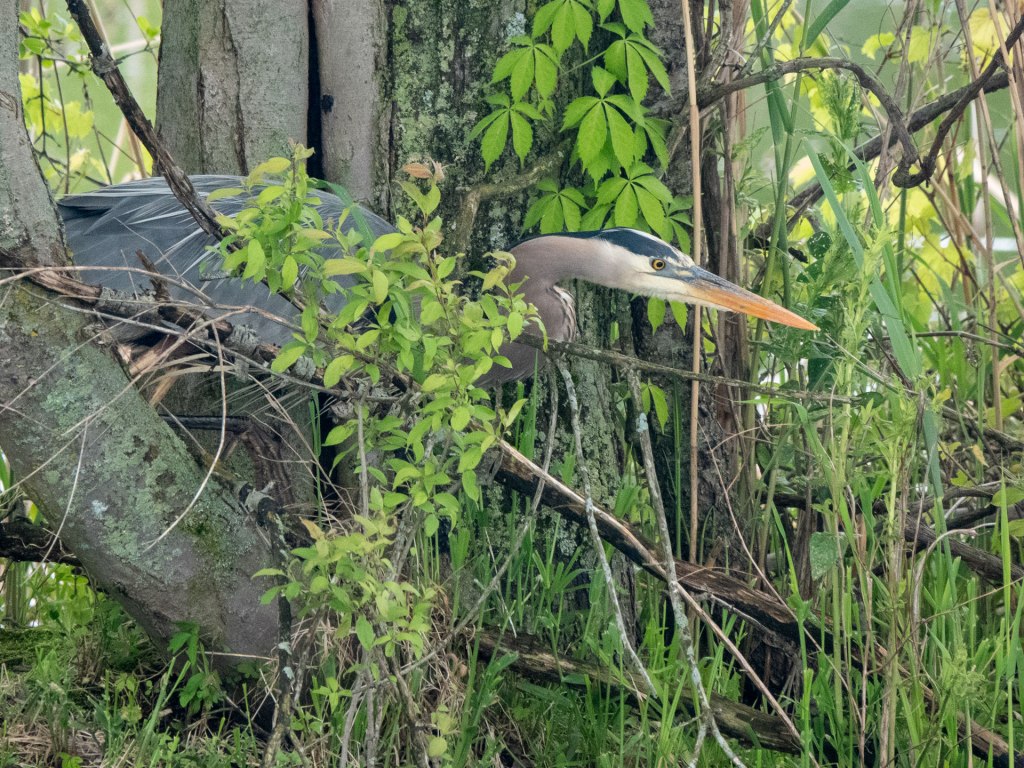
Iroquois National Wildlife Refuge. They don’t financially partner with Ducks Unlimited, so they don’t worry about artificially increasing their duck population. By not tampering with the natural food web, INWR attracts the full gamut of wildlife, something that apparently conflicts with the MNWR business plan.

Sterling Nature Center, another wildlife-friendly refuge.
Hoping for better days next spring! But until then,

https://www.ducks.org/hunting/waterfowl-hunting-destinations/montezumas-magnificent-muck-ducks
I’ve been photographing for several years now, but I still feel like a novice. It’s not that I haven’t learned anything — I certainly have — but I don’t feel like I’ve learned enough of the right stuff.
Recently I’ve noticed the difference between photography and good photography. Photography — anyone can do that (just ask Aunt Doris to show you her cellphone photos), but good photography requires a technical understanding and an artistic appreciation for both the process and the result.
I think there is a stage in between these concepts, which is where I’ve been stuck for a while. I’ve been doing mostly plain old Aunt Doris photography, but it’s quite depressing. I hate wasting my batteries (and my time) on far too many “only if” images (you know, “this photo would have been good ONLY IF _____________ was better” (fill in the blank with what bothers you the most — the exposure, the ISO, a fuzzy focus, a composition that just didn’t work out, or maybe (my favorite) capturing just the feet of a heron or egret taking off). It’s enough to make you want to sell your gear and take up crocheting or something. . .
However, lately I’ve been able to recognize the little bursts of good photography that pop through once in a while. Coming across a real keeper shows that I am capable of doing everything right! I just don’t seem to be able to do it consistently.
I call this hit-or-miss photography.
My Aunt Doris photos reveal several problems, but I am going to tackle them one at a time, starting with light.
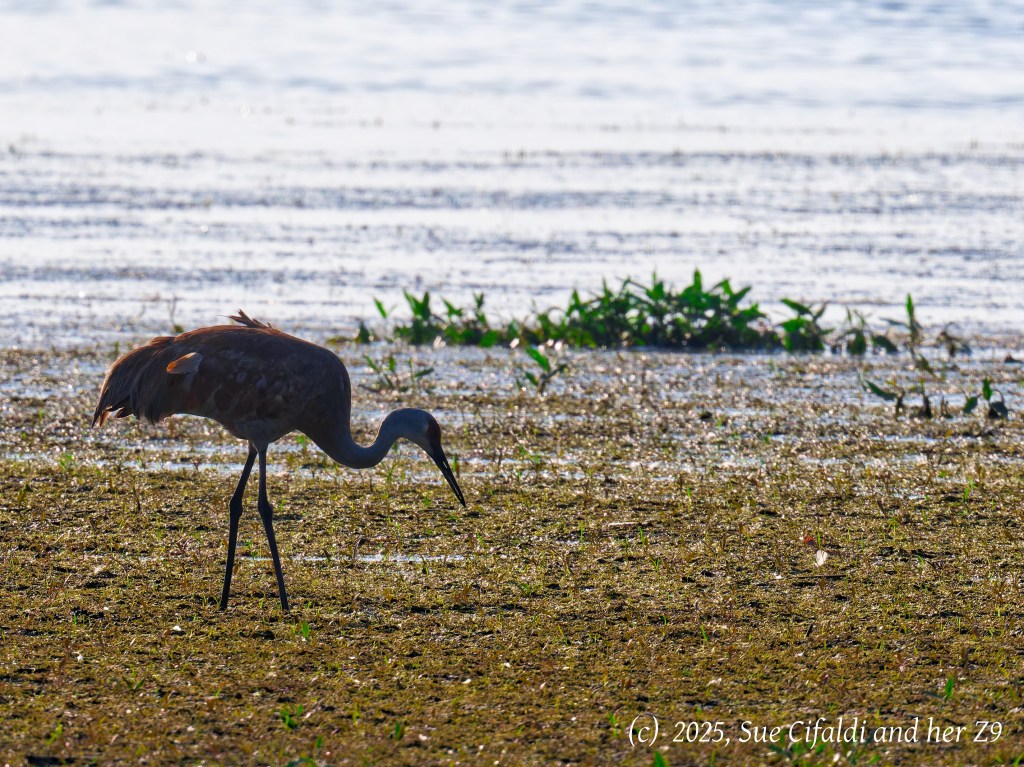
I can’t always tell where the light is coming from, not until I see a terribly backlit muskrat family. Or that the light is harsh, until I see the focus on my sandhill crane virtually melting in the too-bright light.
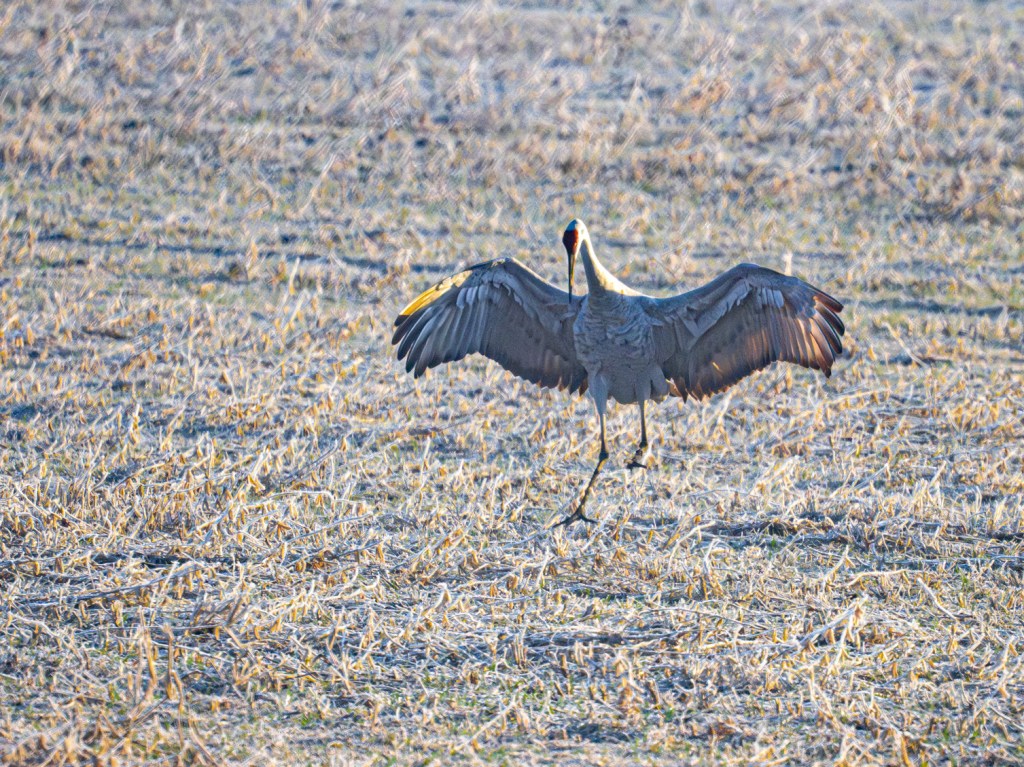
MISS: Ugh, it wasn’t even 8:00 a.m., but the light was BRIGHT.
(If you ever tell anyone that I took that photo, I’m gonna say you lied like a Republican press secretary)
Sometimes it’s hard for me to tell whether there’s even enough light. That’s when I have to slide the exposure in post all the way to the right — well, maybe not all the way, but certainly beyond what I feel comfortable doing.
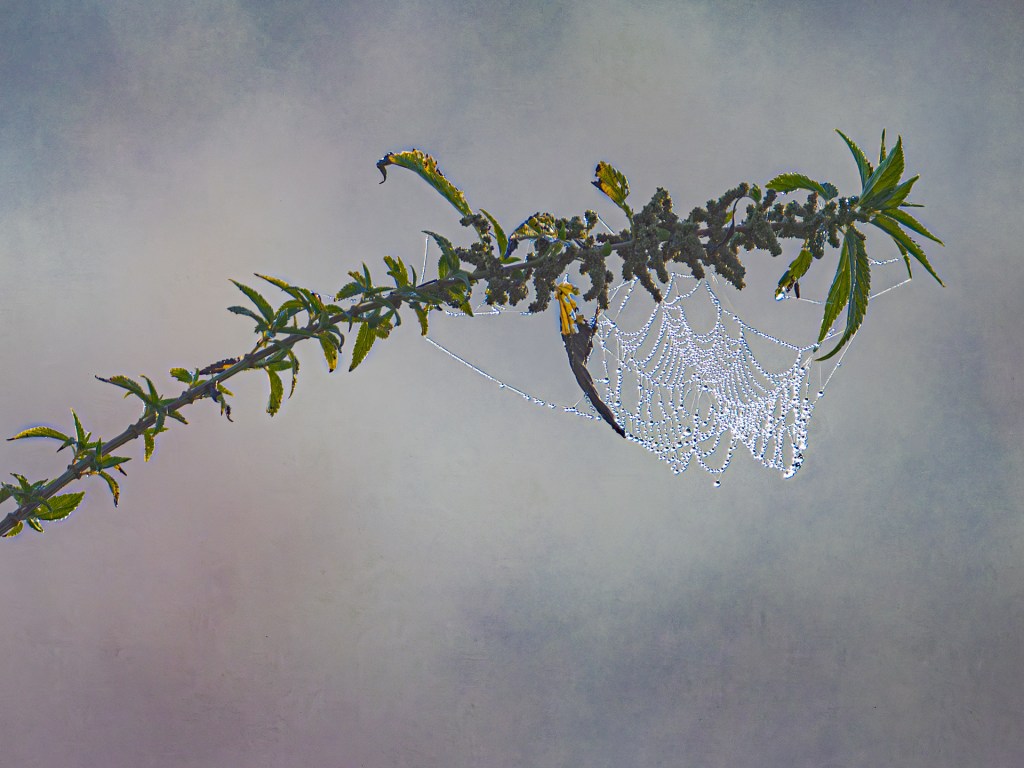
MISS: That spider web should pop against that dark background. . .but it doesn’t 😦
And sometimes (my latest disaster) I ruin a great composition, like that of two playful juvie red foxes, by failing to understand reflected light — there was good exposure in the entire photo except for the white around their mouths. Reflected light blew out all the highlights so severely that even Aunt Doris would gasp.

(Not putting that photo up here, it’s so bad, just sayin)
So, I’m studying light. . .which means for now I am confining my excursions to either early in the morning or late in the day, when the sun is at a low angle and provides that golden light that highlights (but doesn’t clip) the bright areas of my subjects. Once I master good light, I will see if I can handle light that’s not-so-good.
I think I had some success recently. Take these great blue herons, for example. They aren’t just big, pretty birds with a predominance of blue and white feathers, which is what most of my miss photos show. Using the light to its best advantage, in this case oblique and backlight, makes these photos a hit rather than a miss:
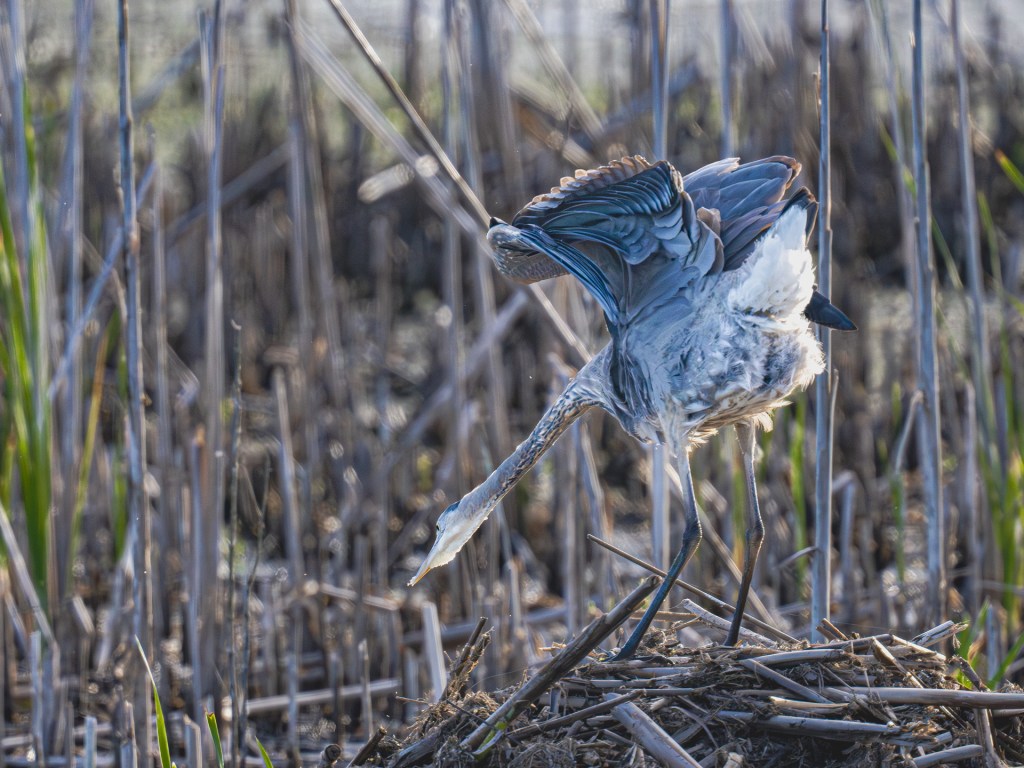
MISS, albeit a slight one: The focus is good, composition tells the story of a hungry GBH searching for lunch, and the colors are good — would have qualified as a hit were it not for the just-barely-blown-out butt feathers taking the brunt of the late afternoon sun (if you enlarge it, you will see what I mean).
Had I seen the problem on the EVF (Nikon z9), I would have dialed in a stop or two of negative exposure compensation. Or I might have moved more to the right to see if a different angle would have reduced the glare. Or maybe fooled with the ISO. . .but I didn’t see this on the EVF.
I would have if I had the <zebra> function enabled. Does the Z9 even show zebras? Yes it does, and I see I have mine all set up — but in the <video> menu only. According to a DPReview blog thread on this very subject, “there is no zebra in photo mode.” Maybe Nikon thinks that if you can afford a Z9, you should be skilled enough to not have to rely on a zebra function. Well, I could barely afford even a used one, so <zebra> would be right up my alley.
Stupid Nikon!
But I can work with the histogram. . .if I can get it to show up in the EVF. Seeing it in the <preview> (which is really a post-view) is after the fact. A true preview definitely would have helped here, but it would be useless with BIF or any other fast-moving subject.
Anyway,
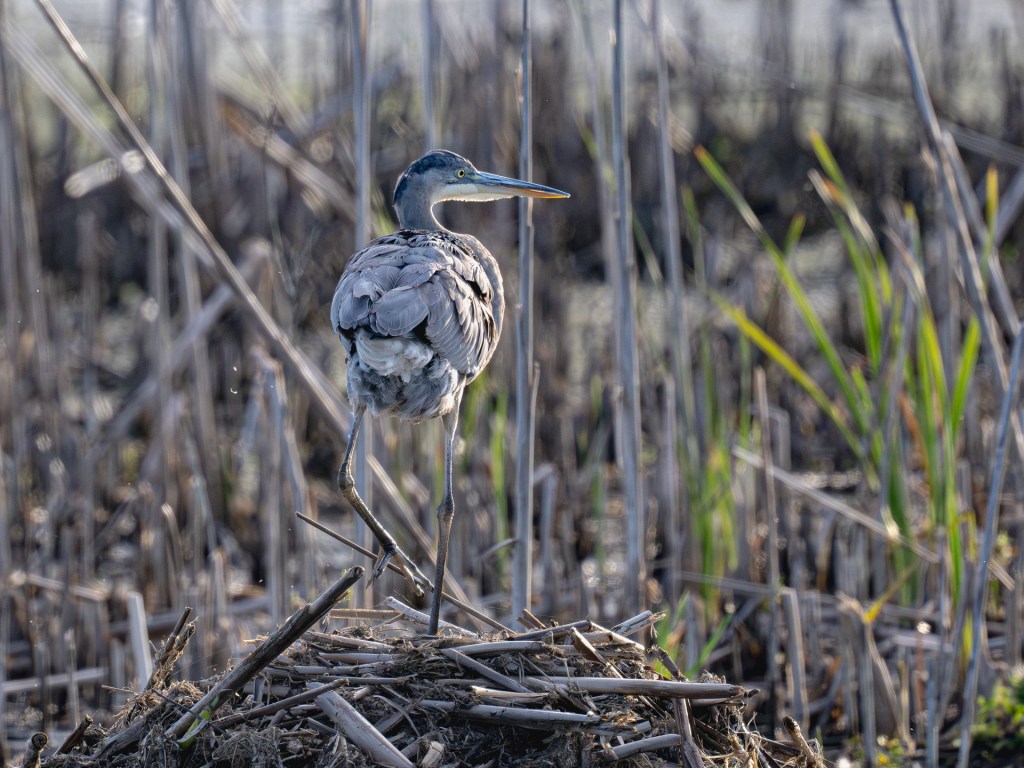
HIT: Now, that is one cooperative great blue heron, and for that I thank him/her very much. The sun is still angling from the right, but now it’s hitting the blue feathers head-on rather than the white ones. Composition, focus, exposure are all okay with me. It’s a butt shot, which most photographers avoid, but this guy (or gal) turned its head very nicely so I could get a sharp eye (yay me!), telling a story of an alert bird scanning the environment for danger. Or for food lurking in the rushes, perhaps.
These next several are an action series! 😉

Eh, I’m calling it a HIT: Composition — check, focus — check, exposure – check, highlights – There is a sliver of clipped whites around the backside (again, worse on an enlarged view), but I’m gonna call it “rimlight” and therefore give it a check. It’s more than an amusing image — is there no privacy?? — because it lets us know that s/he’s getting ready for action.
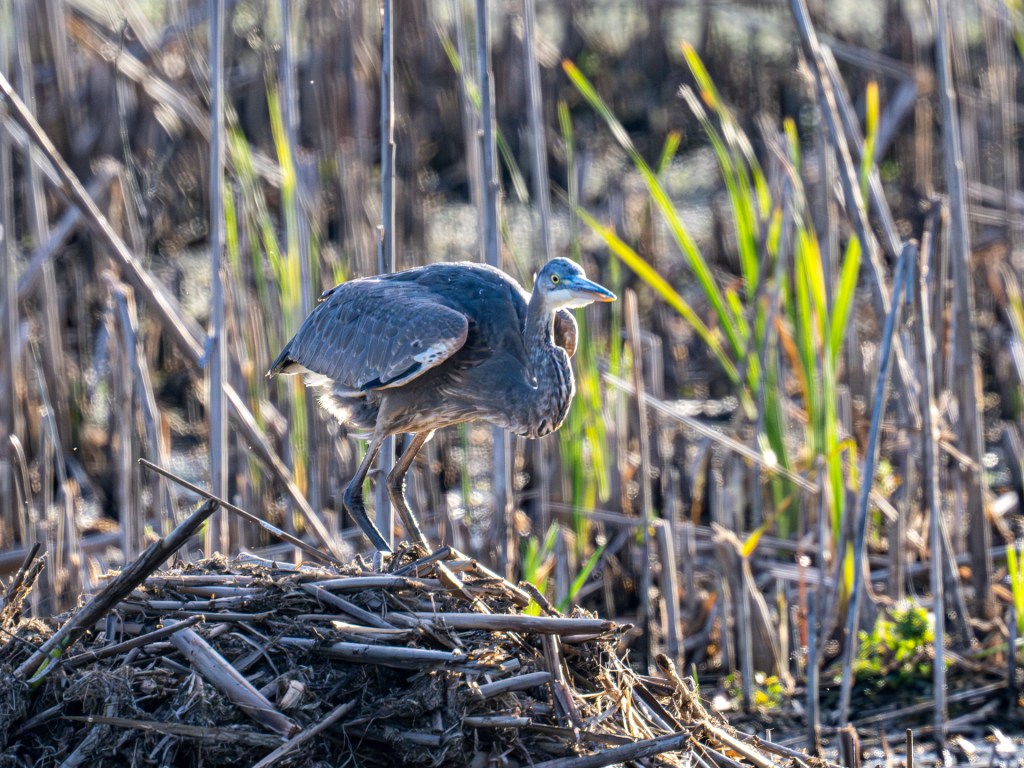
HIT: Good light hitting at an angle that keeps details clean without clipping (so happy!). Everything else is good, too. The story is getting clearer — if this were a cat I’d be expecting a leap, but it’s a heron who just offloaded extra weight, so the next two images will complete the story.
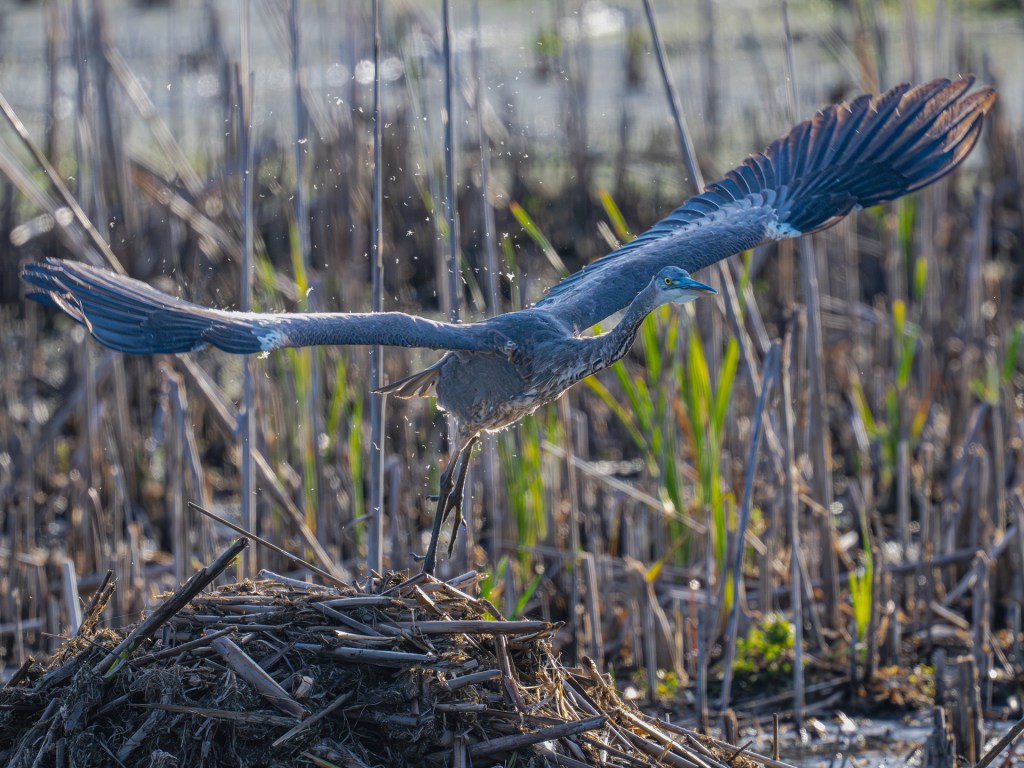
HIT: Satisfied with everything — exposure with nothing clipped, a little bit of rimlight, focus without fuzz, composition showing some action, maybe just a bit too dark but who cares. Houston, we have liftoff!
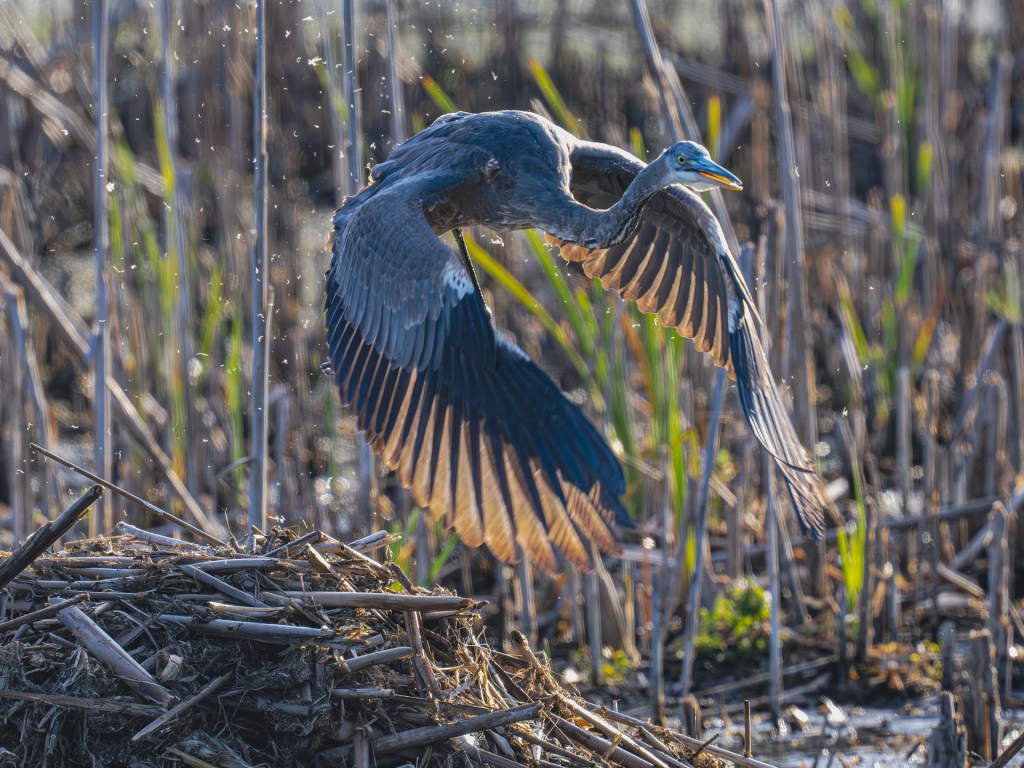
HIT! HIT! HIT! I really hit it with the light. The backlit primaries actually glow with the setting sunlight, and the feathery down that exploded into the air on take-off reveals how powerful those wings are.
All in all, a good day at the soggy bog bottom.
There is more criticism that I did not consider, such as the background. Some might say a dark background would be less distracting, and I could achieve that with a little Photoshop, masking the background and darkening it without affecting the subject. And some of those dead gray rush stems could be removed, too, making the subject stand out more. But, you know what? The title of this blog is “Straight From the Camera,” not “Fixed by Photoshop.” This is what I saw, so this is how it stays. Oh, I did a little bit of denoising and sharpening, but just a little. And I did dehazing, too, but these are adjustments, not changes. That is what allowed me to preserve these images as WYSISYG (remember the good old days of DOS and Lotus 1-2-3?).
Just for fun: Here are some bad guys
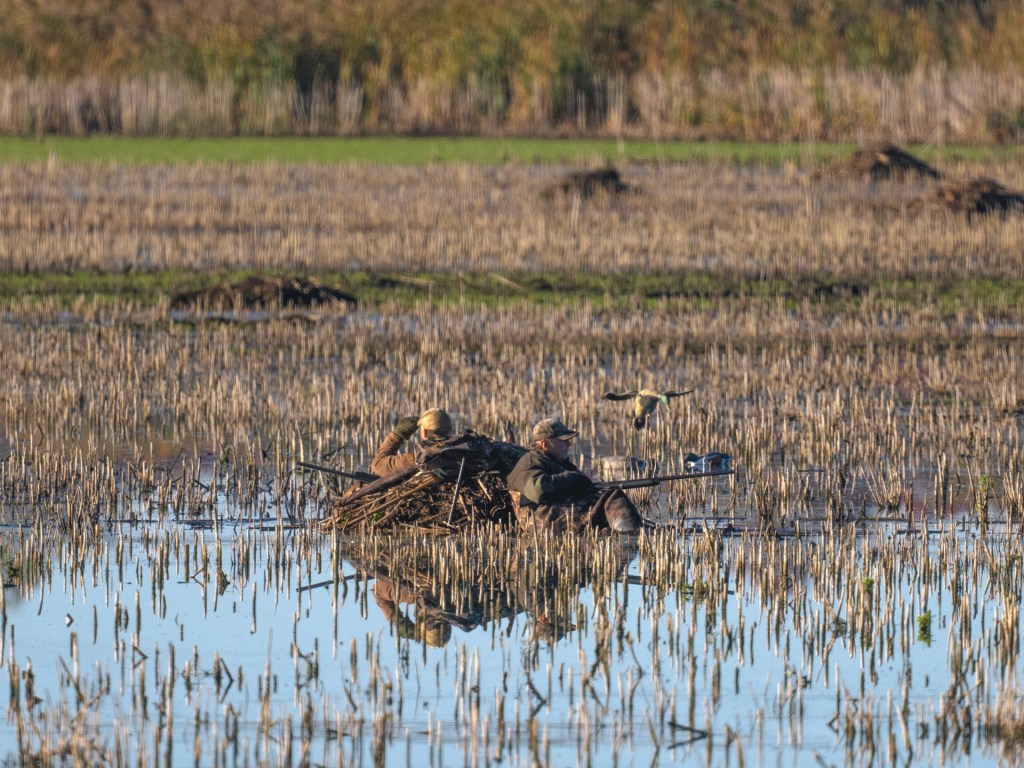
. . .and some ducks escaping the bad guys:

. . .while a few others watch the show:

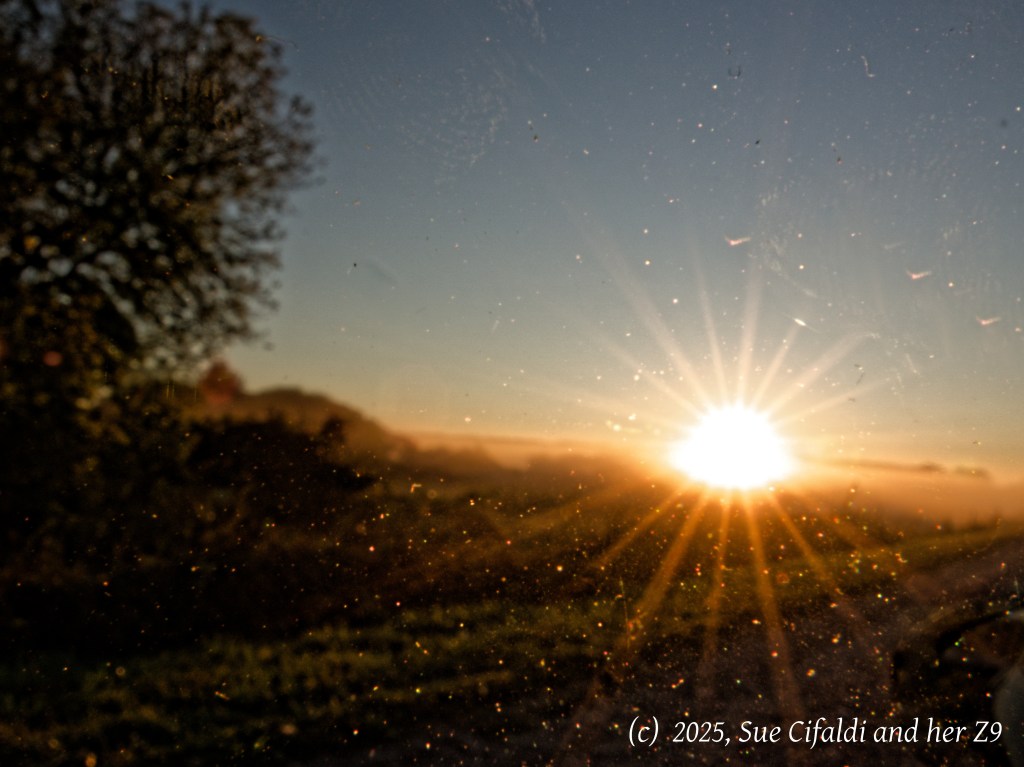
Finally, if you want to make the sun explode, hit it with f16 on a 1-inch sensor (don’t believe the watermark, it lied and said it was a Z9 sensor) — you’ll get instantly bombarded with tiny glary bokeh balls:
+ bridge camera, Coots, Crane, Ducks, eagles, Fish, gear, Geese, grebes, heron, Migration, mirrorless, Montezuma, muskrat, natural, swans, Uncategorized
Carnage Continued: Montezuma National Wildlife…Place
by Susan
Apparently little has changed since 2017, when the Montezuma National Wildlife Refuge thought it might be a good idea to devote each spring and summer to cultivating duck-friendly vegetation, hoping to attract large numbers of the waterfowl during the fall migration. Sounds good on paper perhaps, but in practice this creates a wildlife nightmare. In order to provide sufficient acreage for their duck-food garden, the wetlands are drained down to mudflats, killing off the water-dwelling fish, amphibians, and reptiles in the process. With the aquatic food chain destroyed, both the migratory and resident wildlife that depend on on it are starved or otherwise driven away. The number of ducks lured to the refuge by this tactic will vary by year, but those that do show up arrive just in time for New York’s duck-hunting season.
I wrote about this in some detail back in 2021 and despite the uproar it created, MNWR continues their frequent duck-food gardening; however, now they attempt to minimize the backlash with a forewarning posted to their page on the USFWS website. Here we are told that draining the wetlands down to mudflats is not cruel, it’s a harmless “draw down” that “refreshes the marsh.” This is “done every 5-7 years” (despite my personal observation of its annual occurrence for the most part of the past 7). “We only drain one large pool at a time in order to maintain habitat for migratory birds and other wildlife.” Finally, “[w]hile it may inconvenience wildlife observation opportunities,” the animals are never really in danger because “we have over 10,000 acres and neighboring state land also has about 10,000 acres,” where “[w]ildlife will find suitable habitat” (not an option, though, for the animals they kill as the marshes are “refreshed”).
Apparently the author of that online blurb lies like a Republican press secretary when s/he claims that “draw down[s]”. . .maintain habitat for migratory birds and other wildlife.” If that were true, there would be no lost “observation opportunities,” no necessity for wildlife to “find suitable habitat” elsewhere, no dead animals, and no contradictory photos (below). And, while they admit to “only drain[ing] one large pool at a time,” what they don’t admit is that there is “only ONE large pool” to drain. Full stop. It defies logic to think that a single large pool can be drained “one at a time.”
But, just like with the press secretary, logic isn’t a deterrent, it’s simply a momentary unpleasantness that disappears after a single vigorous denial.
Anyway, I respectfully call bullshit on that entire waste of bandwidth. The “inconvenience [to] wildlife observation opportunities” pales in comparison to the widespread destruction that occurs whenever the water table is “drawn down” to zero. Nobody with a brain or decent vision believes that “habitat for migratory birds and other wildlife” is “maintain[ed]” when all they see is a lifeless expanse of mud littered with fish and turtle carcasses.
If MNWR limits drawdowns to once “every 5-7 years,” then my eyes (and nose) cannot be trusted. I began visiting Montezuma in 2017, when there was appreciable water in all the pools. Not so in 2018, when I witnessed my first (and likely their eleventy-seventh) drainage. Had MNWR noticed, in this area of the northeast US there is a natural drought cycle that occurs every 5-7 years, making THEIR “5-7 year schedule” necessary only on the rare occasions when nature fails. In any event, this present (2025) episode of no water — which is taking place in the middle of a natural drought — is disturbing. The fact that MNWR has induced additional droughts within the “5-7 year schedule” is even more disturbing.
Whenever I ask about the dried-up marshes, the explanations vary from “to simulate drought” (yearly?) to “to control the invasive carp” (which are controlled by the canal gate) to “the canal gate needs repair” (this one I’ll give them — once) and finally “we need vegetation to feed the ducks” (ding ding ding, we have a winner, folks!). Just a couple of weeks ago, an USFWS employee added another reason, “to control the phrag[mites] grass.” This resulted however, in creating more wet and wasted mudflats upon which phragmites grass thrives — clearly an epic fail. . . or an outright lie:
In fact, the current standard of control is outlined in A Guide to the Control and Management of Invasive Phragmites ([Michigan] Department of Environment, Great Lakes, and Energy; Third Edition, 2014). Although this grass is highly invasive and difficult to control, wetlands managers are advised to avoid practices that actually encourage its growth:
“Traditional moist soil management, in which impoundments are drawn down to produce mud flats in early summer, may encourage growth of Phragmites.”
Furthermore,
“If Phragmites is on-site or in the surrounding landscape, managers should use caution when timing drawdowns. Drawdowns should be conducted in late summer (late July) to maintain and promote native vegetation and to avoid reestablishment of Phragmites.“
. . .even if duck food production is limited or delayed thereby. Just sayin.
The worst of these drawdowns, in my opinion, occurred in 2021, when the levels were reduced so rapidly that water-dwellers had no time to escape. Rotting fish carcasses extended to the roadway, and the stench was unbearable. That’s when I decided to research which one of these answers, if any, were valid and then write up my findings.
In case anyone who denies the frequency of the drawdowns is also bad at math, the 4-year interval between 2021 and 2025 falls short of the “5-7 year” schedule MNWR claims to maintain, as do all the others performed over the last 5-7 years.
Furthermore, the managers, who are elsewhere described as “biologists,” can’t “refresh” the individual pools “one at a time” regardless of their size. That’s because the single large (main) pool houses a system of dikes linking it to the several smaller pools and feeder ditches located on the west side of Wildlife Drive. When the water table in the main pool declines, so do the levels in every pool, ditch, and water collection connected to it. As these empty, the aquatic food chain and the entire food web it sustains collapse like a house of cards. There is no longer a habitat to maintain and no wildlife to maintain it for. The destruction covers the entire 3.7-mile stretch of Wildlife Drive.
Besides, how do the managers drain only “one large pool at a time” when there IS only “one large pool” to drain?
But, I digress.
Anyway, don’t just take my word for it. Take a ride along the loop and see for yourself.

- Is this the “habitat for migratory birds and other wildlife“maintained by “biologists?“Well, it used to be, back when it was the main pool. Now it’s just muck. Maybe they were absent on the day water and its relationship to habitat health was taught in biology school.
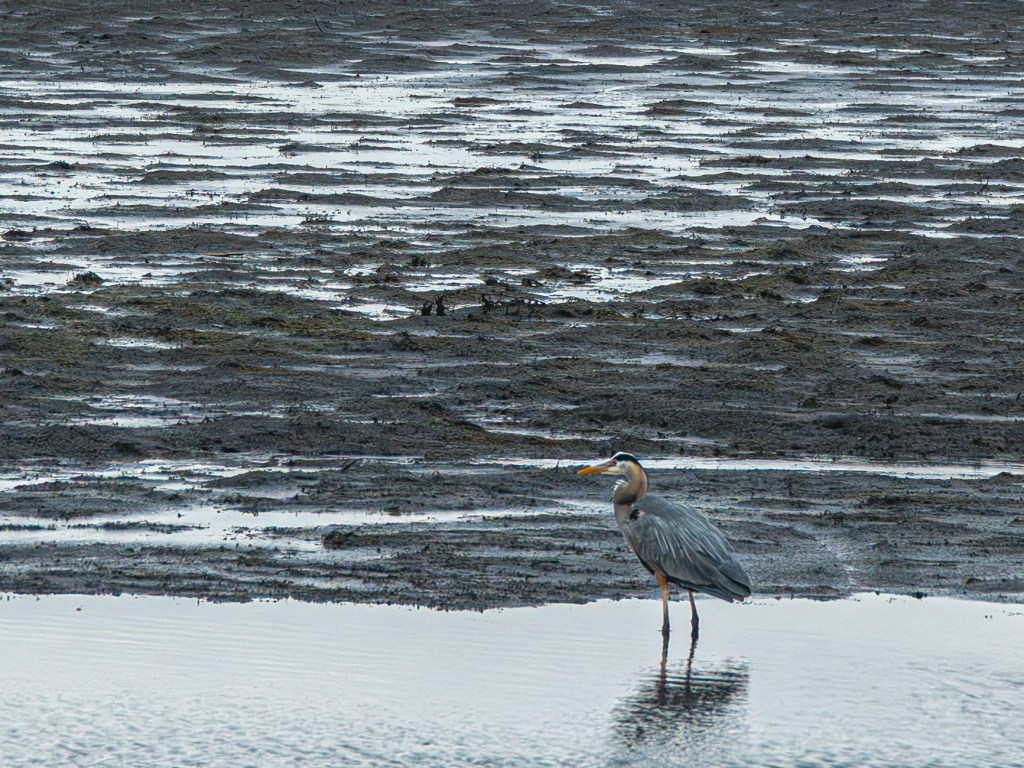
- Once this ribbon of water dries up, the great blue herons and other waders will seek new habitat — that is, if they don’t starve to death first. (Edit: This ribbon of water was gone by the end of May.)
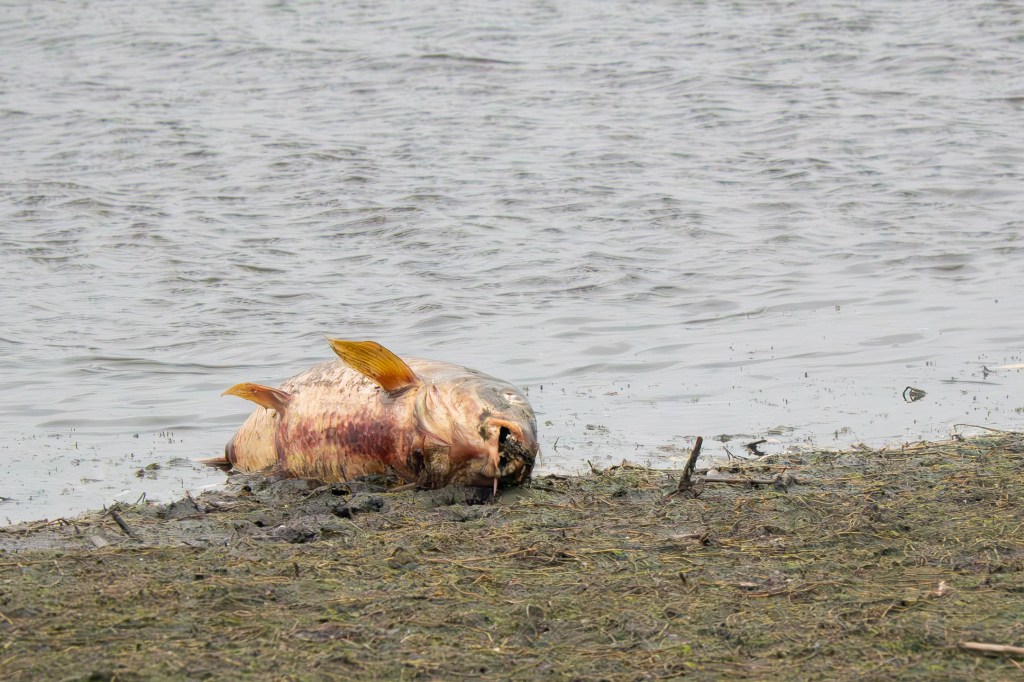
- “Biologists” at work. . .a smelly and harsh demonstration of arrogant disregard for the wildlife under their care.
“Well,” you may ask, “what about the other side? Isn’t there water on the east side?” Yes, indeed there is. The Seneca Canal runs for the entire north/south length of the Drive. It mostly attracts boaters and fishermen along with an occasional cormorant, a few eagles and osprey, and a kingfisher or two, but rarely a great blue heron or egret and never ducks, yellowlegs or other small birds that don’t catch their prey on the fly. The deep-water habitat it sustains is unsuitable for waders, divers, dabblers, shoreline feeders, and other wildlife that by instinct thrive in shallow-water marshes.
I took these photos (unless credited elsewhere) to show what happens when people in charge of managing a refuge don’t even know what the word means. They periodically obliterate the “diverse habitats [that] give food, shelter, water and space to many of Central New York’s wildlife species” in order to maintain a duck food garden in the mud, proving beyond doubt that when any one part of a food web is decimated, the rest of it is destroyed as well. Even though the USFWS asserts that “[w]ildlife on all National Wildlife Refuges comes first,” what they really mean is all National Wildlife Refuges except this one.
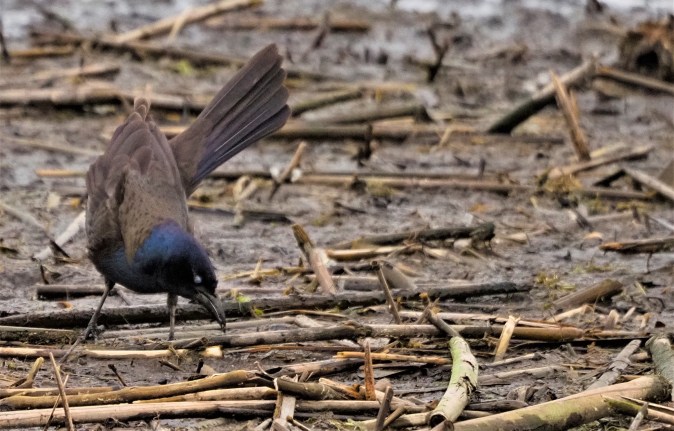
- Just a few weeks ago, when there was a decent water level, this pool was teeming with life. Now, however, the muck attracts an occasional grackle or red-wing scavenging for insects and searching for grit (having no teeth, the grit aids their digestion), PS Sorry about the grainy photo, I forgot to run it through ACR denoise.
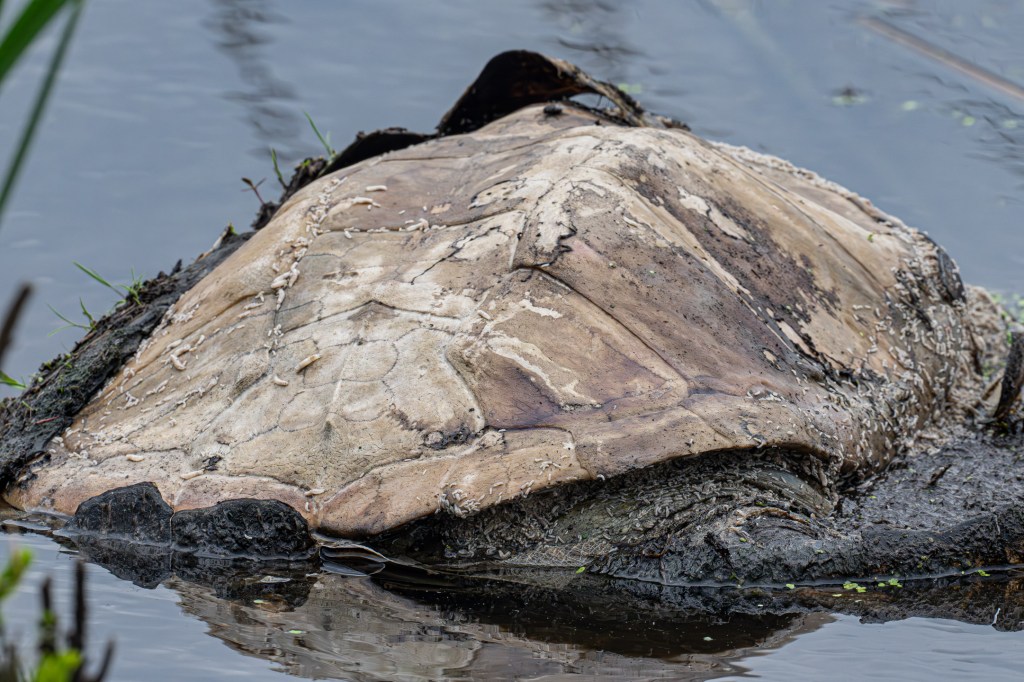
- This used to be a snapping turtle. Now it is maggot food (look to the edges on the left and right of the carapace).
This begs the questions: 1) What is so important about attracting a hyperpopulation of ducks to the refuge each fall? and 2) How does this importance justify the annual destruction of the very habitats MNWR is tasked with preserving? Montezuma personnel have yet to acknowledge my questions, much less answer them. (“Refreshing the wetlands” is not an answer, it’s an excuse — and a lame one at that.)
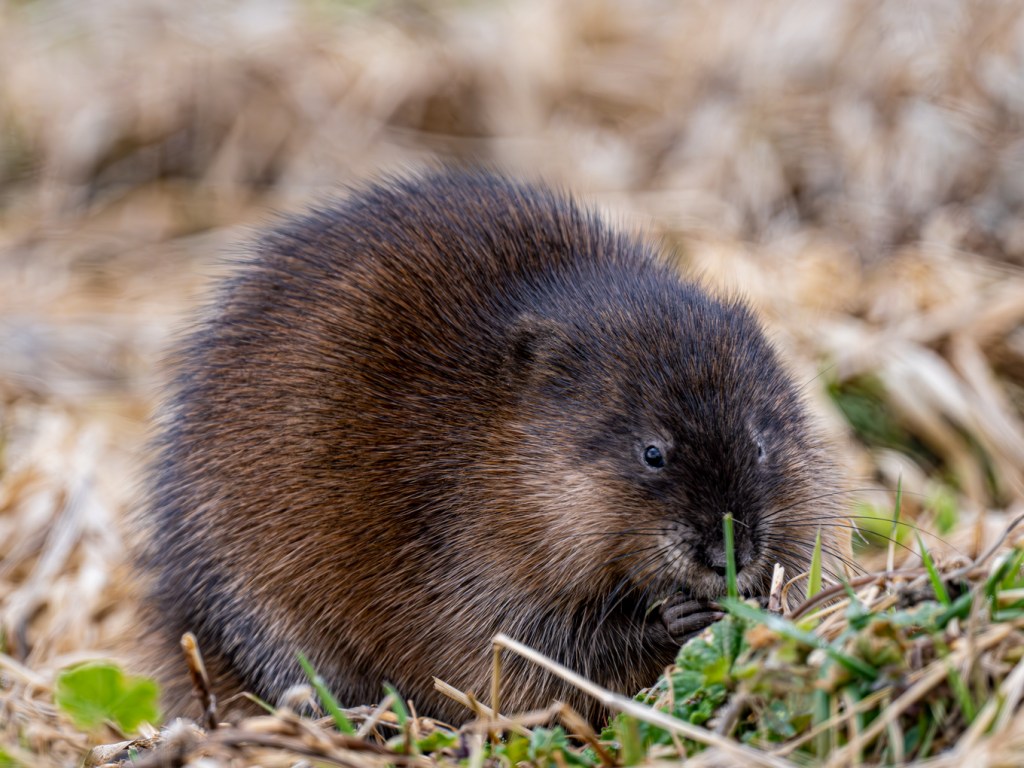
- This muskrat was seen on April 1st but its lodge and food supply were destroyed as the marsh was “refreshed.” By mid-month, the muskrat population had vanished along with its habitat.
I recently spoke to Logan Sauer, Resident Park Ranger and Visitor Services Manager at another NWR. The Iroquois National Wildlife Refuge deals with many of the problems that Montezuma faces in reclaiming farmlands lying within the Atlantic Flyway and then maintaining them as the natural wetlands they once were prior to their drainage in the early-to-mid 19th century. One might expect, then, that their maintenance methods might overlap, since these similar habitats share the same physical, meteorological, and geographical conditions.
Mr. Sauer spent some time explaining that the INWR marsh maintenance policy is essentially dictated by both established and predictive weather patterns. Iroquois does adhere to the rather standard 5-7-year water-lowering cycle (unlike the “duck food cycle,” which seems to occur whenever MNWR wants it to). The water tables at both refuges are controlled by a dike system that permits intervention at will. However (and this is important), it is done at Iroquois only when nature fails to self-correct. To date, annual drawdowns have been required only rarely, and when they do occur they are never drawn down to mudflat level.
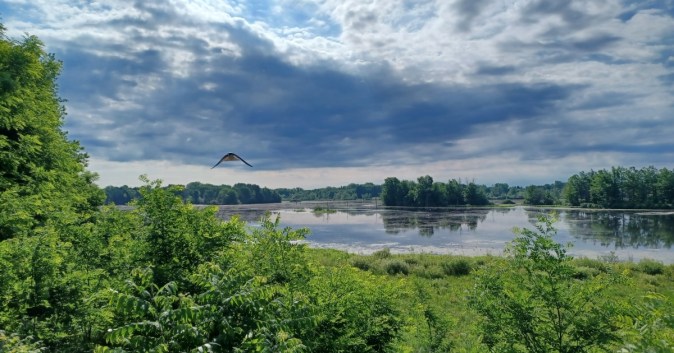
- Notice the lack of phragmites infestation. That’s because Iroquois National Wildlife Refuge shares vision and purpose with the Oak Orchard and Tonawanda Wildlife Management Areas, which promotes rather than restricts natural habitats. It’s a great place to spend a weekend. Photo courtesy of US Fish and Wildlife Service.
The goal, according to Mr. Sauer, is to “maintain the diversity of habitats naturally present” in the wetlands under their care (emphasis mine)
(Not discussed were the possible benefits of allowing the water table to regulate naturally once these farmlands are reclaimed, https://conservationevidence.com/actions/3198 . There just wasn’t enough time to do so.)
Sounds reasonable, doesn’t it? Except when it falls from the face (or the keyboard) of an MNWR rep. Then it sounds like bullshit.

Mr. Sauer was unaware of and unfamiliar with the practices I described to him based upon my observations at MNWR, which remained unnamed during our discussion — because when I broached the subject the look on his face was a mixture of horror and confusion.

While Iroquois and Montezuma do share problems, they clearly do not share philosophies. I suspect that’s because MNWR has something that INWR doesn’t — a financial partnership with the nation’s largest, most influential, and best-known duck hunting organization, Ducks Unlimited.
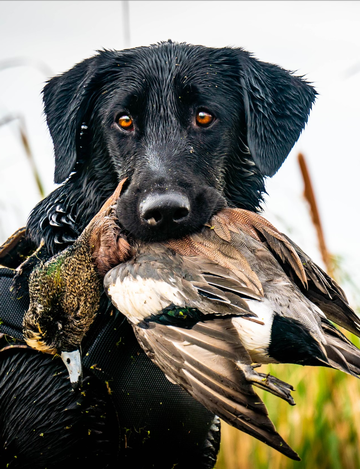
- This photo, courtesy Ducks Unlimited, helped advertise the 46th Annual Banquet held in Medina this year.
There is no reason, other than quid pro quo, for MNWR to periodically abandon their mission of protecting and preserving diversity of wildlife and their habitats in favor of a singling out one exclusively for ducks. Waterfowl — ducks, geese, swans, rails, and coots — are neither threatened nor endangered, and there is no shortage of regional feeding/rest areas on the flyway. In fact, the Montezuma refuge lies adjacent to the extensive Seneca Lake marshes which, to my knowledge, are never drained or “refreshed” but manage to attract ducks nonetheless. There is absolutely no need for Montezuma to continue overusing any duck-luring tactics — unless, of course, they wish to reward DU for its financial and in-kind contributions by providing a less-restricted and more populated duck-hunting experience than what is offered at the state-controlled Seneca Lake.
So, why do they do it? Why do they consistently violate the public trust by performing the wildlife equivalent of mass murder just to please a few duck hunters? Oh, that’s an easy one. They do it simply because they can.
According to state regulations and USFWS guidelines, individual hunters are subject to fines and/or license suspension should they be caught baiting wildlife. That’s why hunting is prohibited on “manipulated” (planted and harvested) land as long as bait — grain or seed — remains on the ground (the USFWS specifically mentions cornfields, since the post harvest litter could attract (and does attract) foraging wildlife). That’s also why DU (and other) hunters avoid the agricultural mucklands in the “potato farm” region of Rt 31 in Savannah and instead hold their “magnificent muck duck hunts” (their words, not mine) just a few miles away at MNWR, whose yearly endeavors ensure expansive, huntable mucklands of their own (something that isn’t philosophically possible at INWR — you know, that whole “diversity of wildlife habitats” thing).
And it’s all very legal. The acres of bait raised in MNWR’s muddy duck-food garden should guarantee a hunt-free environment, no? Because the USFWS regulates “wildlife food plots” as carefully as they do farmland, right? WRONG, because they’ve stuck this exemption right in the middle of all the restrictions and prohibitions listed in their guidelines: “If you restore and manage wetlands as habitat for waterfowl and other migratory birds, you can manipulate the natural vegetation in these areas and make them available for hunting.”
Apparently it’s against the Migratory Bird Treaty Act (16 U.S.C. §§ 703–712) to kill, sell, hunt, take, or capture migratory birds, and you can’t even collect cast-off feathers without a permit — but it’s OK to shoot them as long as you do it at this national wildlife refuge.
Kind of skews the entire meaning of the word “refuge,” doesn’t it, luring animals to rest and feed, only to sneak up, shoot them dead, and throw them in a boat. Having attracted them to a refuge. With bait.
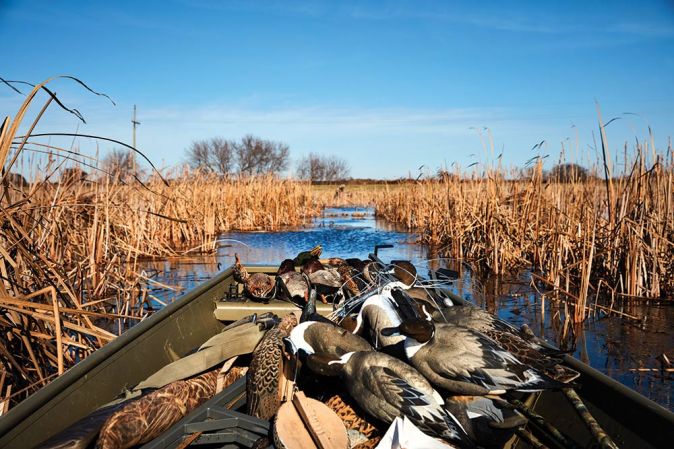
- The results of a “magnificent muck duck hunt” at Montezuma, courtesy of Field and Stream.
“BAM! Right between the eyes!” — Marisa Tomei (My Cousin Vinny, 1992).
I don’t financially subsidize MNWR and I rarely visit there anymore since I don’t much enjoy witnessing the effects of poor wetlands management. Pleasanter opportunities await elsewhere, and I find good spots while traveling to and from them. These roadside wetlands are smaller and subject to the whims of weather but never require “refreshment” beyond that supplied by nature. Yet they manage to attract all sorts of wildlife, including ducks. Who’da thunk it!
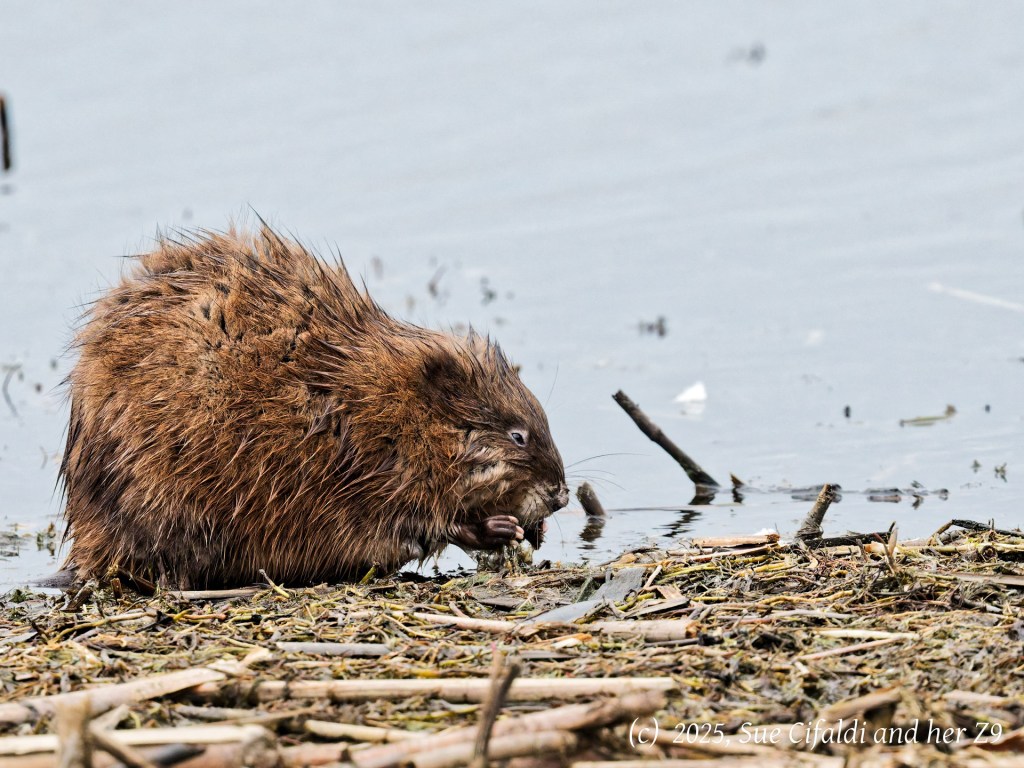
- A new beaver dam has “refreshed” the marsh in North Victory, and another family of beavers is currently working on the wetlands off 31 in Savannah.


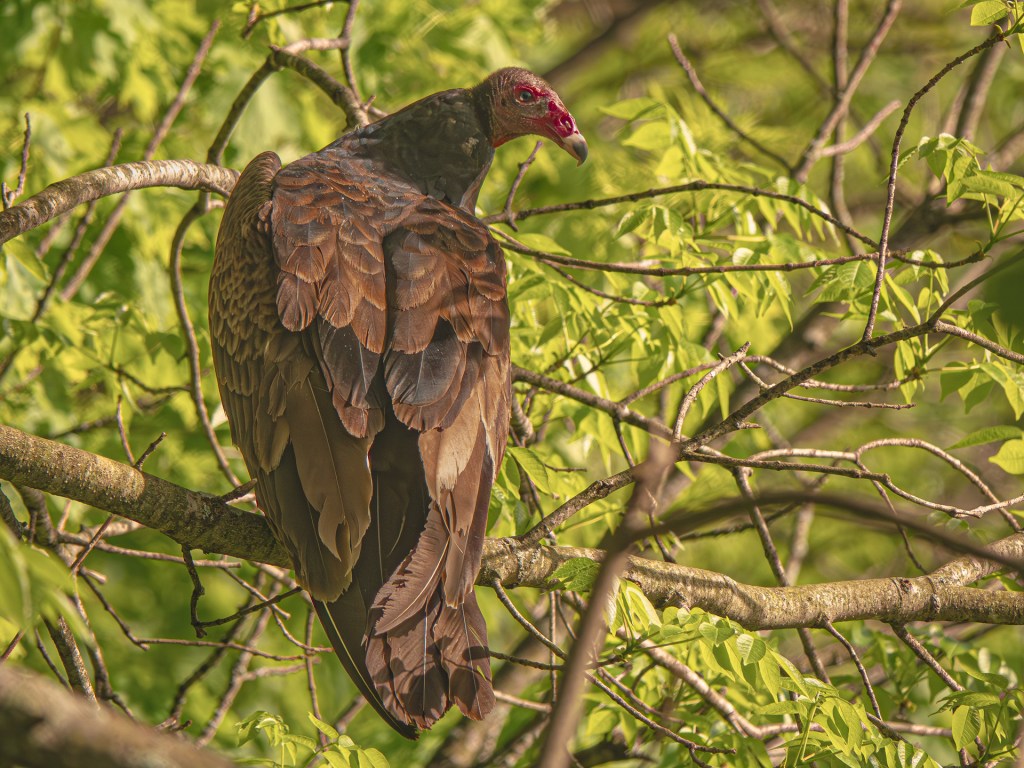
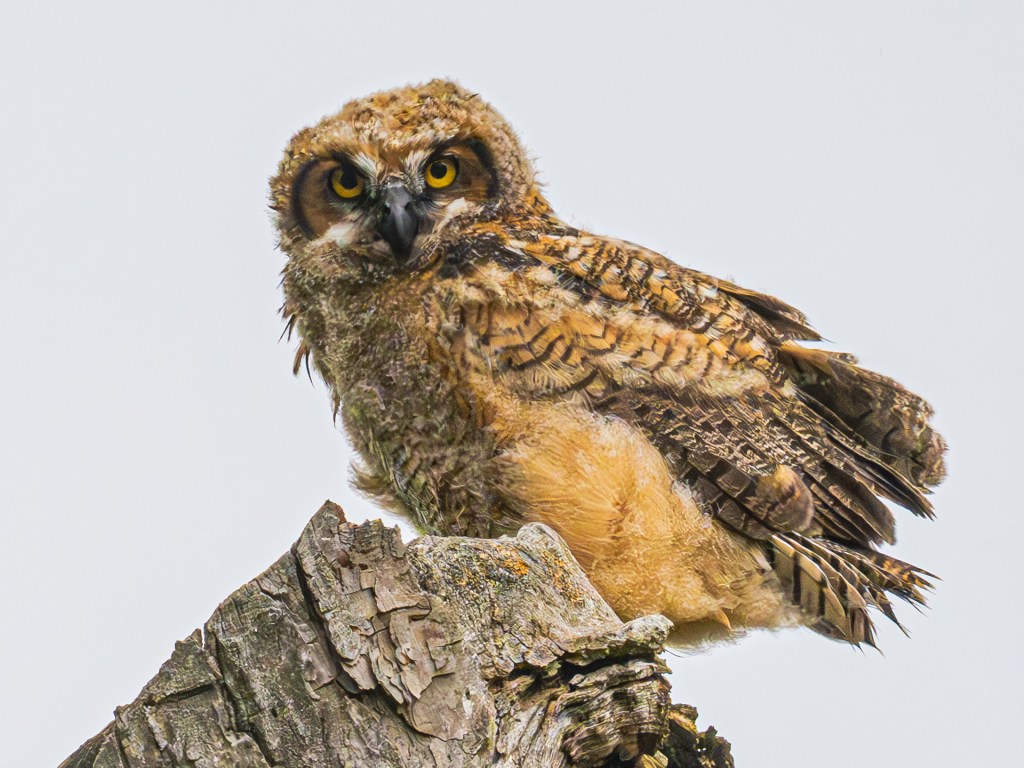
I must confess, though. I myself was recently lured to MNWR by an intriguing Facebook photo. It showed two cars stopped on the Drive and an MNWR representative scolding at least one of the drivers. Apparently someone had lingered beyond the alloted 5 minutes and/or was observed getting out of the car in an effort to photograph the resident owl family. Such conduct stresses the birds and “ruins it for everybody,” according to the post. Laughed out loud at that one, because said employee was neither confined to a car nor constrained to a 5-minute-or-less tirade while her colleague dutifully and digitally preserved the egregious visitor conduct as some sort of evidence.
Besides, how stressed do they think the birds get when MNWR employees intentionally and regularly collapse the food web by draining the marshes and then watching animals die? Asking for a friend.

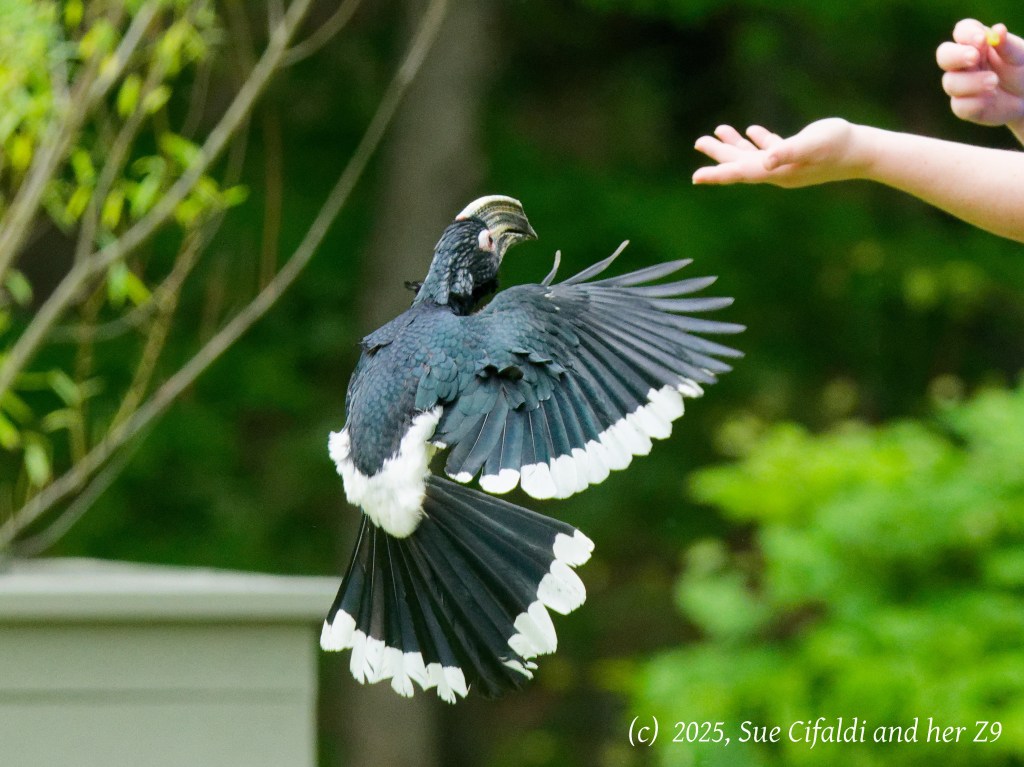
FWIW, I knew about this owl but avoided looking for it prior to this because it would be too stressful — for me (I don’t do well with glaring looks and sanctimonious verbal assaults). Besides, I already have (stress-free) photos of a great horned owl family that had nested at Sterling Nature Center a couple of years ago. At Braddock Bay, where they assist visitors with advice and guided walks, I photo’d some saw-whets napping high up in a pine tree. (They don’t call it Owl Woods for nothing!) BTW, Hawk Creek routinely offers educational programs and, for a small fee, photo walks as part of their outreach (below, a trumpeter hawk whose injuries prevent it from being released to the wild)
I mentioned all this in my reply to the FB post, further noting that MNWR’s owl chose to nest proximate to Wildlife Drive because her maternal instincts deemed it safe to do so despite the moderate traffic and occasional photographer, neither of which has caused her to abandon her family or move it elsewhere. So, I wonder just who is stressed by such flagrant disobedience — is it the owl or the rep?
I knew that comment would result in a big fat block, but it was so worth it. 🙂
In any event, it took about 10 minutes to get that photo (above) plus several others, and the owl never even flinched. In fact, it was still there about an hour later, when I went around the Drive for a second time. (Note, no birds or MNWR reps were stressed during this process.)
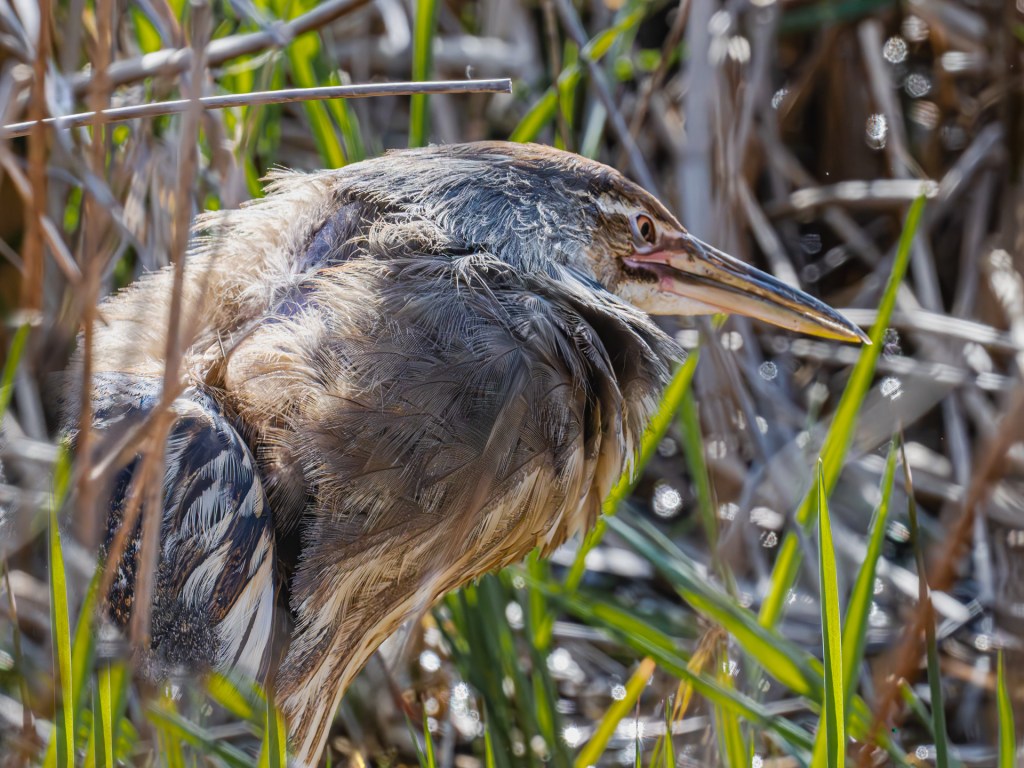
- Another photo that “ruins it for everybody.” Capturing this American bittern required multiple rule violations and a tripod. This guy has distorted his esophagus with the air he needs to produce a proper mating call. . .which kinda sounds like the “glug glug” gurgling of a slow-draining kitchen sink. 🙂 I waited for a while, but he gathered no female interest other than mine (but that doesn’t count).
Of course, MNWR doesn’t care about any of this. My writing is a minor annoyance that hardly interferes with the photographers, weekenders, home schoolers, sightseers, and unleashed dogs who “don’t believe [their] lyin’ eyes” and spend both time and money supporting a “refuge” that kills its own animals. Go figure.
- This blogpost is dedicated to Ken Prindle,
- who monitors an MNWR Friends FB page,
- but never did figure out
- that I had directed him to an Amish egg farmer
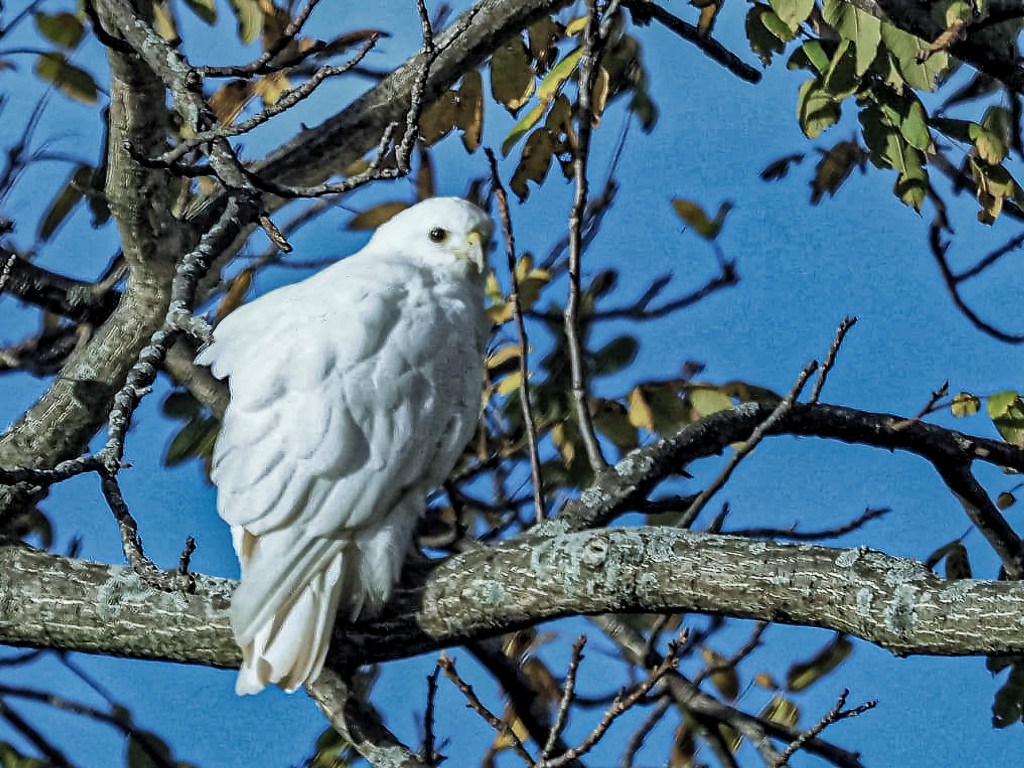
- and not the leucistic hawk
🙂
+ Africa, Andy Nguyen, baboons, Birds, Crane, eagles, egret, Fish, Geese, giraffes, hippo, Kenya, lions, Maasai Mara, mirrorless, monkeys, Naivasha, Nakuru, rhino, Uncategorized
(In and) Out of Africa
by Susan

Kenya, to be specific.
It was a truly unforgettable experience in many ways, not the least of which was the sprawling Maasai Mara and the incredible diversity of the wildlife it sustains.
I left the Olympus cameras at home. We really wouldn’t be doing much walking, so lightweight gear was not a consideration. Instead, I used the full-frame Nikon d850 and the Nikkor 200-500 telephoto lens. I also brought the d500 along, whose APS-C sensor would give a little extra reach when needed.
I had some trouble adjusting to the mechanical viewfinder. I am so used to the EVF on the Olympus, where what you see is what you get. So, some of my photos were, um, “exposure-challenged.”
Good thing Andy showed me how to use Adobe Camera Raw! I was able to salvage this cute little bee eater, albeit with some graininess that, had I paid attention to the available light, would not have been an issue. Lesson learned!
But that’s not all I learned on this trip.
I learned that the African savannah was not crowded with great herds of animals dashing about or dramatic life-and-death struggles between predators and prey — despite what we see in National Geographic videos. In truth, we had to search for the wildlife, sometimes for hours and sometimes without success. Most of the animals we did find were in small groups, and although we followed some predators, we didn’t witness any hunts-in-progress.
But the savannah does not disappoint!
We saw lions just about every day. Not only are they King of the Jungle, they are King of the Mara as well. And why not? They are at the very top of the food chain, if not the food web, so lions rule wherever they roam. Period.
We did find a lion guarding a recent water buffalo kill. The day was hot, so he would periodically lumber out from the shade for a meal or a snack. Other wildlife gathered nearby, but none were willing to risk the wrath of the lion by approaching too close. So, they simply waited patiently until the lion abandoned its prey, and it didn’t take long after that for the carcass to be reduced to mere bones.
Of course, the Mara was not just about lions, water buffalo, and hyenas. There were lots of birds, big and small. I can’t find my bird fieldbook, so I will identify the unnamed ones once I find it.
We saw lots of other animals, too.
And, of course there were hippos! Hungry, hungry hippos! Interesting that they spend most of the daytime soaking in the water, coming out at night to forage.
The broad expanse of savannah was awesome. There were few real roads, only parallel paths where tires from the 4-wheelers had matted the grass. The drivers had to be very careful, because matted grass could be a resting place for baby animals, and no one wanted to interfere with that.
But at other times the drivers had to be very aggressive! River crossings could be downright dangerous at times. It took some skill for the drivers to maneuver the 4-wheelers safely across rocky streams and quick-flowing water. There were several times when I had to close my eyes and hang on tight, hoping for the best!
Like, the time when the driver was struggling to get us across a slippery, rock-filled stream. In the midst of this struggle, one of our number urgently called out STOP! — because he wanted to take a picture of a bird. I suppose it’s a good thing that he doesn’t know how close he came to being ejected from the vehicle by a forcible, well-placed foot belonging to a terrified occupant who was angered by his selfishness (me).


Kenya isn’t all Mara, though. The trip organizer, Andy Nguyen, put his extensive experience and meticulous travel-planning expertise to work and designed an 8-day trip that gave us not only the full experience of Maasai Mara but also an exploration of two lakes, Nakuru and Naivasha, before returning to Nairobi to catch our flights home.
Nearing the lakes, we came across some sparsely wooded areas with enough trees to support some amazing (and amusing) wildlife.
We couldn’t access Lake Nakuru directly, but the ring road provided unfettered viewing.
More funny birds:
Other animals living lakeside included monkeys
and baboons!
The giraffes were really hilarious. I thought these two were a loving couple, but the guide assured me they were not — they were two males fighting over a female! When fighting, they attack the most vulnerable area — the neck. If a neck fracture isn’t fatal in itself, it would certainly cause the injured giraffe to starve to death.
However, there were some giraffes who were behaving nicely:
Surrounding Lake Naivasha is a small fishing village. The animals were amazing. . .
. . .almost as amazing as the villagers
There was only one thing that bothered me on this trip, and that was I WISH I was a better photographer! So many of my photos were duds, and I see lots of areas in these photos that really need improvement. I returned to the States with a task list to work on and with much gratitude and admiration for Andy, who devised this incredible safari. His example as a photographer, teacher, and an honorable man who is true to his word is certainly one that inspires!
Oh, yeah, well . . . there was this other problem, too. Unfortunately, a couple of participants were not satisfied with what the tour offered. Their extensive (expensive!) and divisive demands ruined the social affability we had previously enjoyed. They were pervasive, persistent, and far from silent; they even persuaded one of the driver-guides to take sides in the dispute. Although there was no way to send the troublemakers home while in the middle of the African bush, we simply made the best of a bad situation; however, it is comforting to know that they are banned from attending future tours — and that the aggrieved parties had withheld from the driver-guide his share of the customary end-of-trip tip.
And, I can attest to the success of this policy! I recently attended another Andy Nguyen phototour, this one in Costa Rica, and I assure you the absence of these two was sooooooo refreshing! Costa Rica was almost as wonderful as Kenya, so stay tuned — I will post the Costa Rican results soon.
For more information on Andy’s phototours, you can send a message to him through his Facebook page, Andy Nguyen, https://www.facebook.com/andybirdwhisperer . You won’t regret it!
P.S. All that stuff about his being the bird whisperer — it’s true!!
Just past the glitz of Niagara Falls (on the Canadian side) are the Dufferin Islands.
 These islands were created early in the 20th century during the construction of a generating station by Ontario Power Generating (OPG).
The area has been a government-administered nature area since 1999, when power was no longer produced there.
The islands are rather small and easily traversable. Paid parking is nearby, and there are benches near the water for those of us who want to check our gear for the proper settings before we begin.
 I met my friend and mentor, Andy, there yesterday for a lesson on birds-in-flight. Photographing birds – period – is hard enough, since they never really stay put for every long. You never know when they will take off, leaving just a blurry spot in your photo as evidence of their existence.
Birds-in-flight, though, is particularly challenging. . .for me, anyway. Part of the challenge is that I’m easily distracted by bird behavior, even when they are fairly static and just hanging around.
They’re so funny!
 So, while most of the lesson was learning how to pay attention, I did get quite a few useful pointers from Andy, who I swear is the original Bird Whisperer.
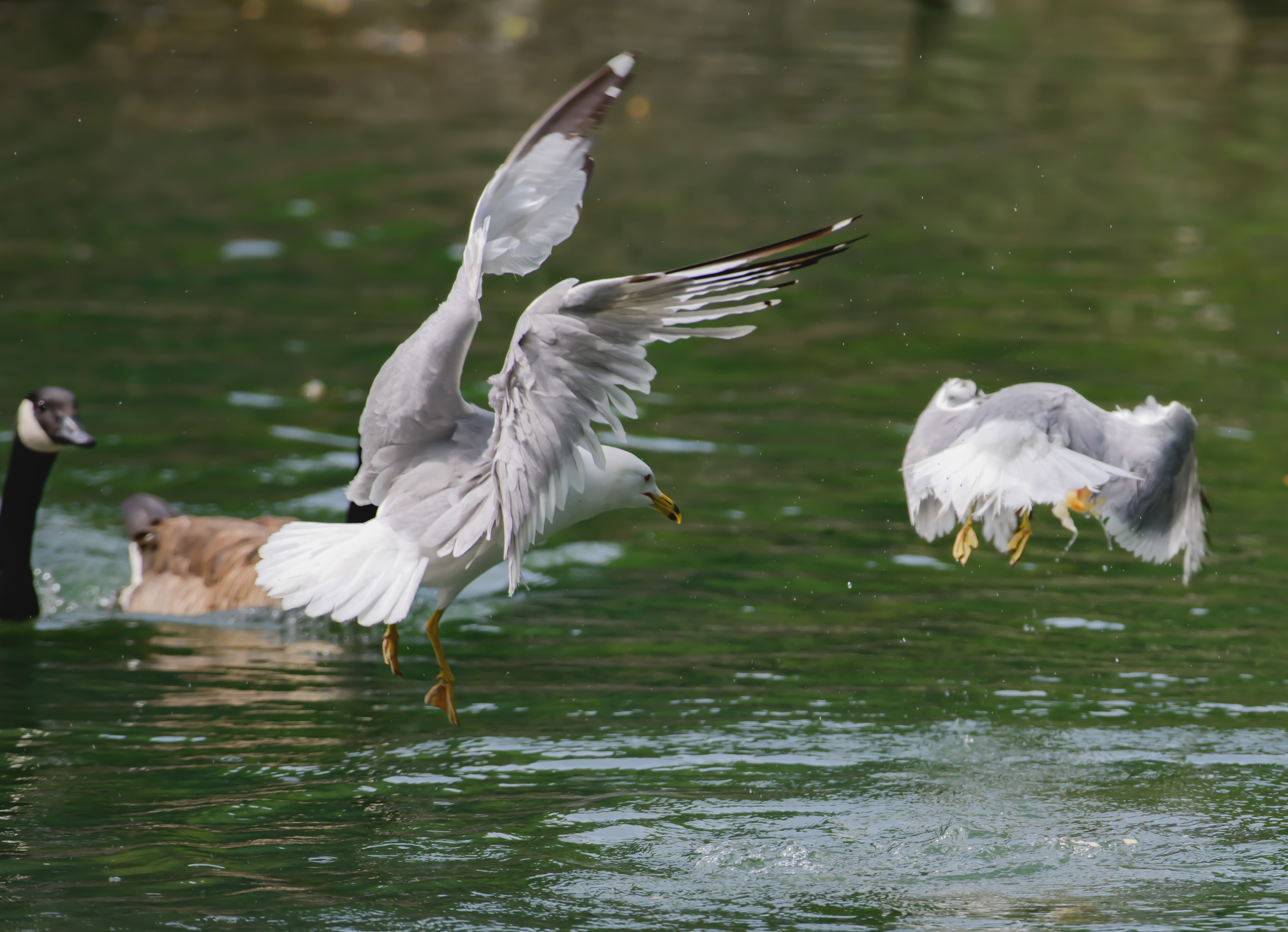
Armed with a stockpile of suitable bird food, Andy threw it towards the water, which immediately attracted flocks of Canada geese and ring-billed gulls.
The geese were lazy, not hungry, or both, because only a few of them chased after the food.
In fact, they mostly preferred to gather around our feet, waiting for us to scatter it on the ground.
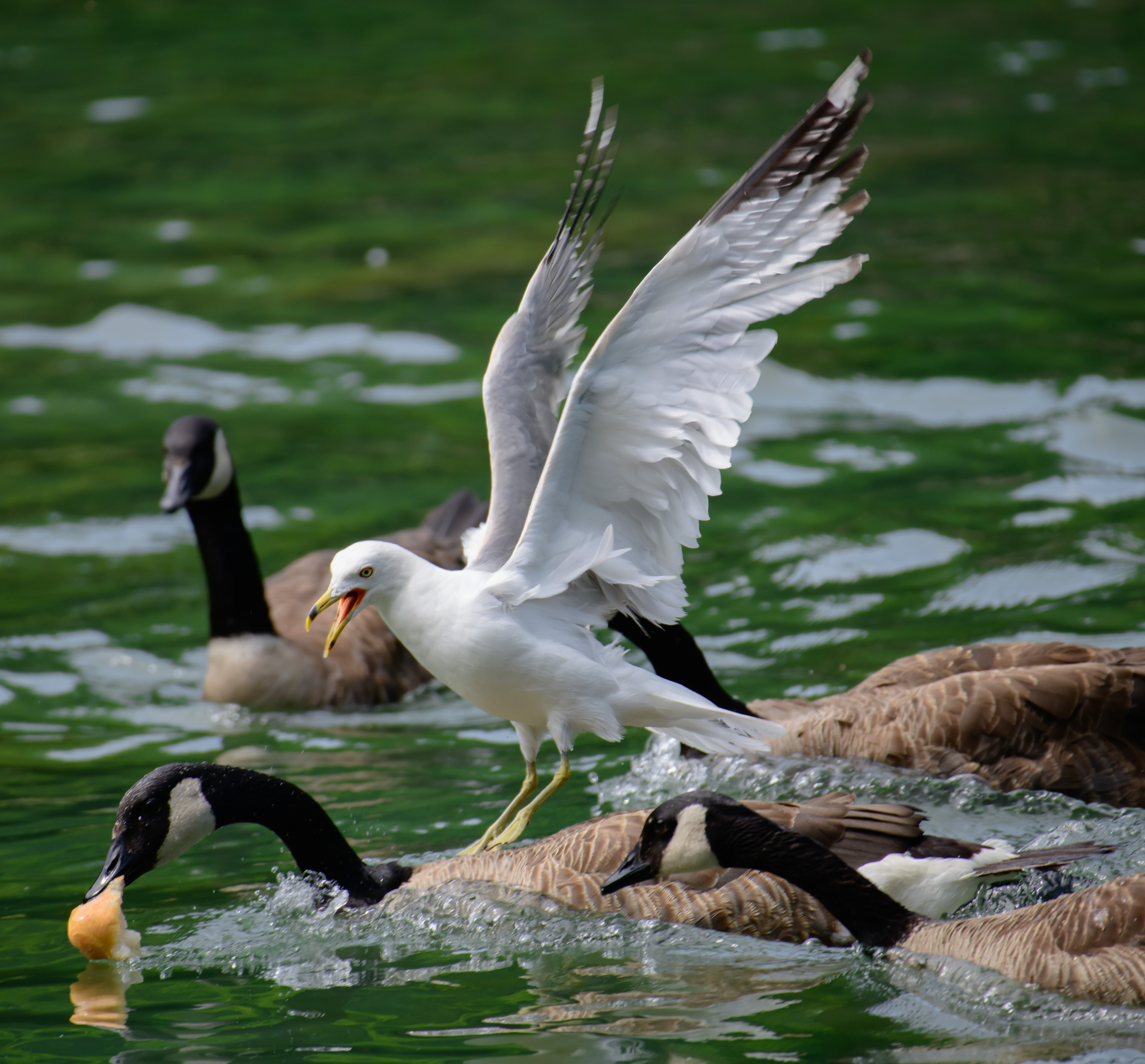 Even so, they pretty much ignored it.
The gulls, however, were different.
They battled each other, winging and splashing, until the triumphant victor rose above the fray and flew off with the tasty morsels.
And woe to the poor goose who dared to venture out and capture a snack!
It would get a scolding from an infuriated gull for sure!
So, it was a great opportunity for catching some birds-in-flight!
I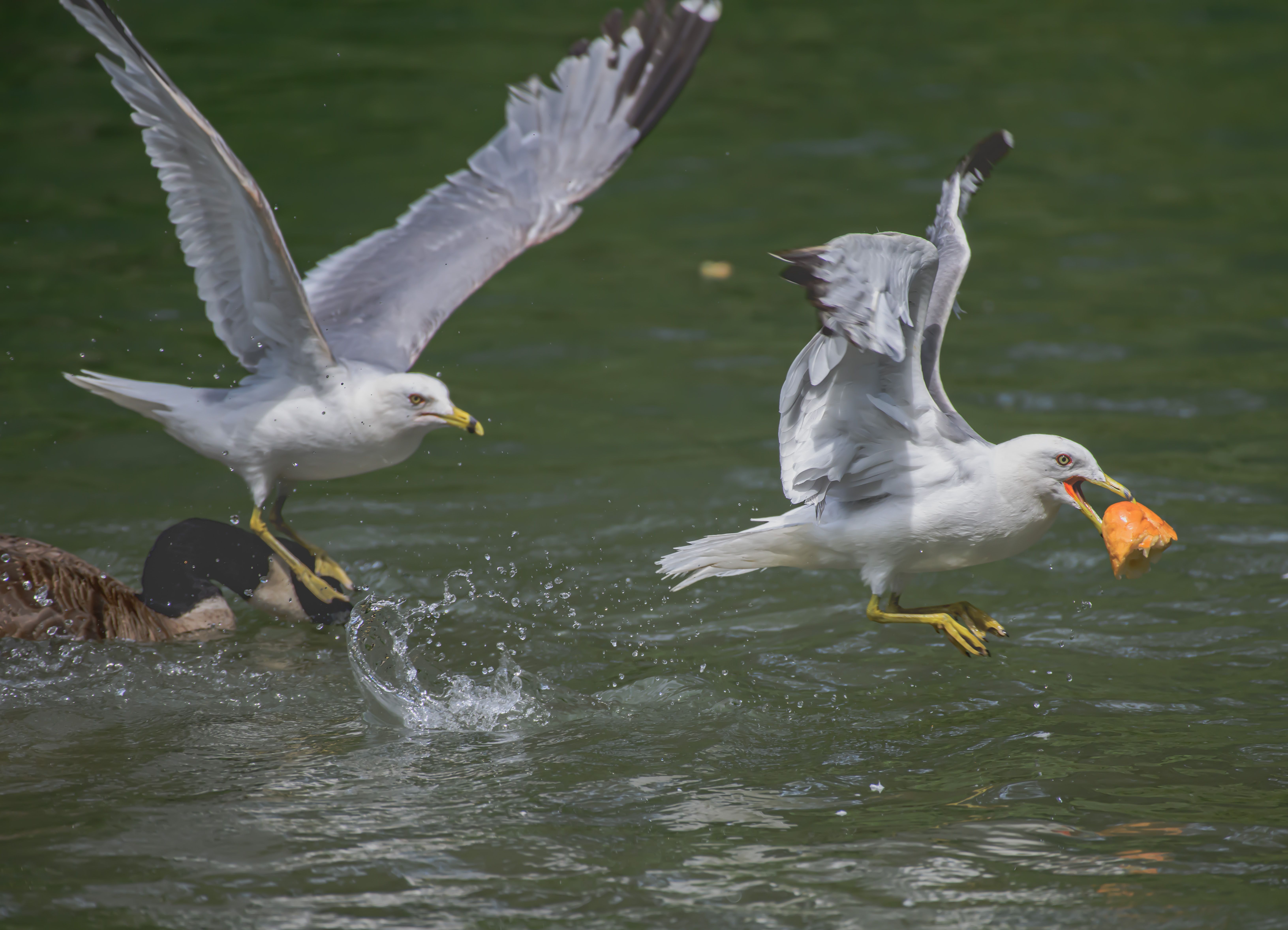 t was sunny at mid-day, so we shot wide open (for me, that was f/5.6) at 1/1600 or 1/2000 with a low ISO.
Andy advised a 4-stop difference if filling the frame with gulls (all that white would drive the meter crazy!)
But that would be a rarity for me.
At this point, I’m happy just to get a bird in the frame that is recognizable as a bird!
Unfortunately, I did get a good amount of blurry blobs but eventually managed some decent shots, especially after Andy changed my focus setting to group. . .
 . . .and coached me to try to keep the focus pont(s) centered on the bird.
That worked a lot better!
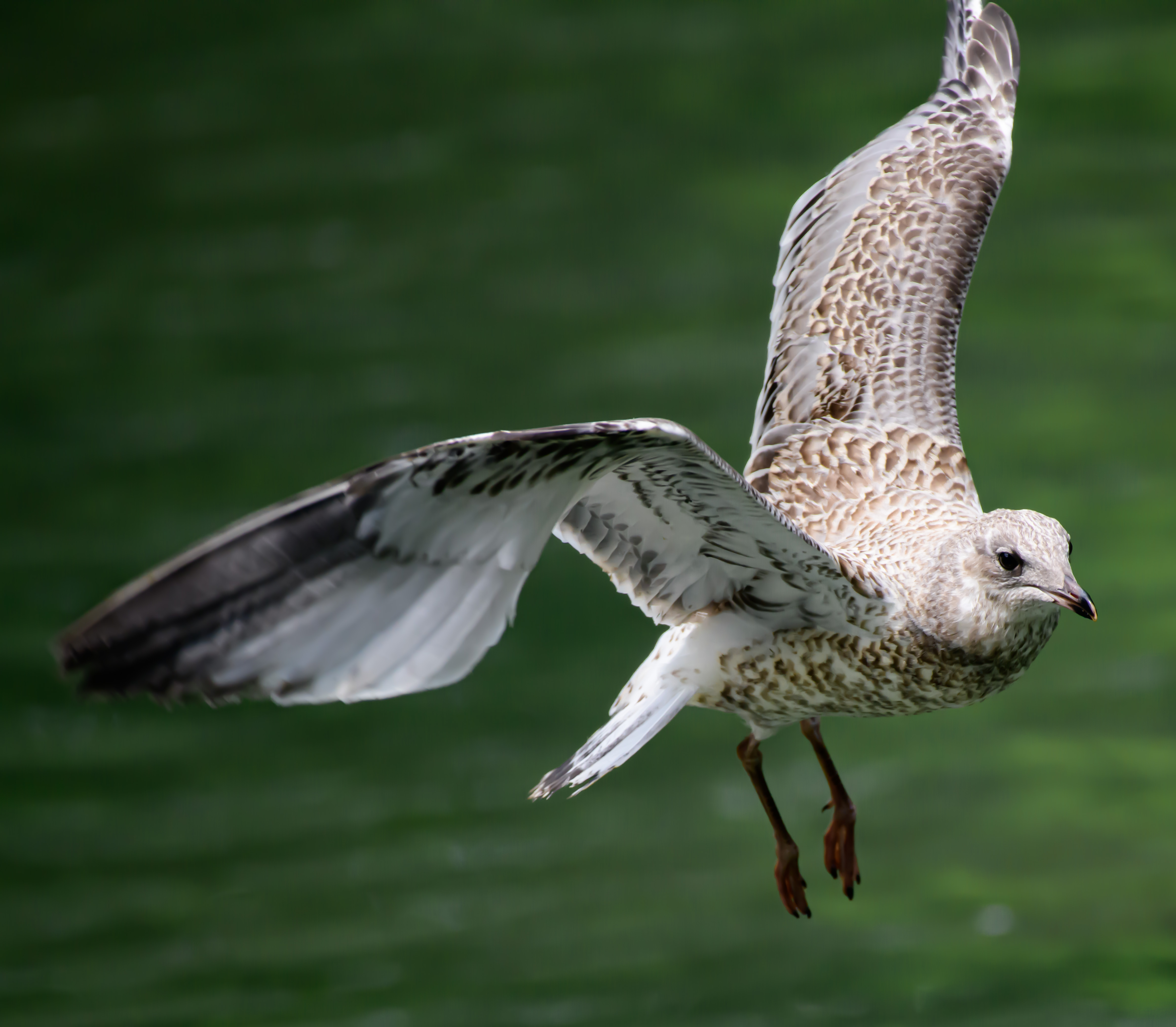
These birds may be “just gulls,” but they are living, breathing creatures doing what they are programmed to do.
And they do it beautifully!
Maybe not as colorful or rare as other birds, but good subjects to practice on. . .and amazing creatures in their own right.
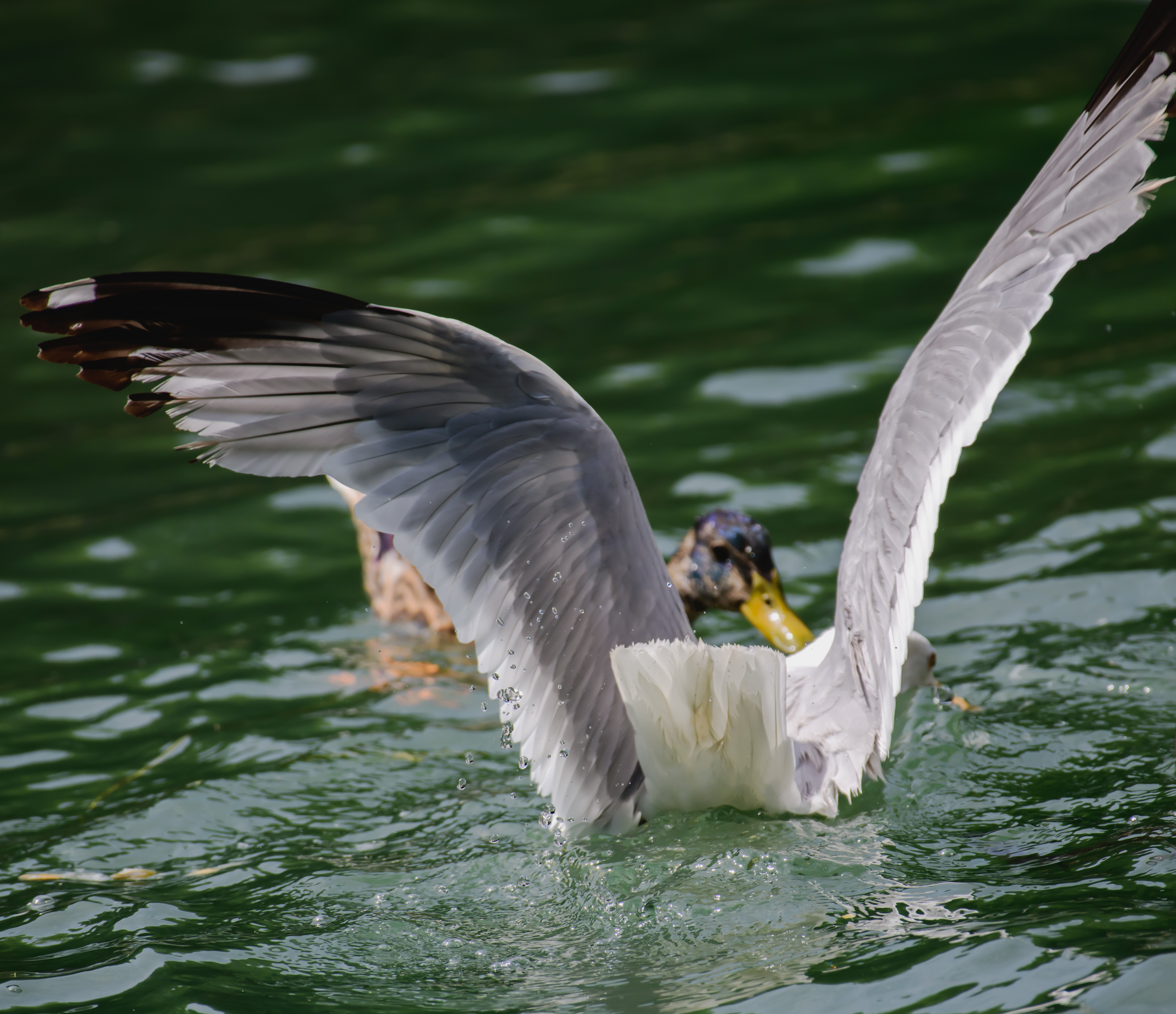 Butt shots are not acceptable in the good-photographer community.
However, I couldn’t resist this one with his tail so strategically elevated in the perfect position for a quick takeoff after landing and grabbing.
I think the duck was utterly surprised!
I worked reallyreallyREALLY hard on focus, which seemed to elude me despite my best efforts.
Another Andy tip — when focusing on BIF, “pump” the focus button. This will help keep a fast-moving bird acceptably sharp.
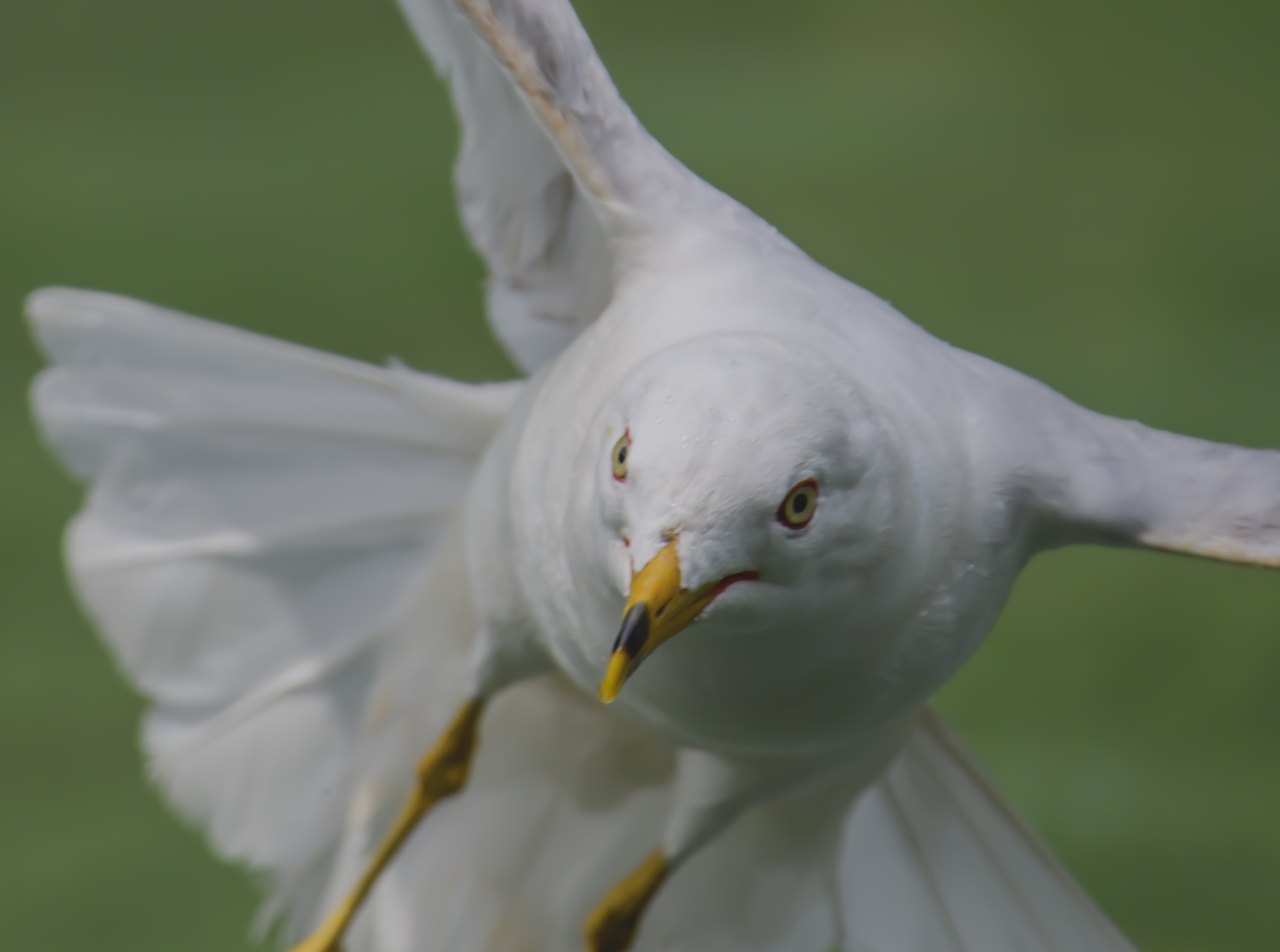 Back-button focus works well here, and I was pleased that I was able to set BBF without Andy’s help. 🙂
This tip worked well, so well that I was able to crop some of my photos for close-ups.
Just before we had to leave, in flew an adult black-crowned night heron! They call them “night herons”for a reason, so it was great to see one in the middle of the day.
Andy’s photo is much better than mine (he caught the red eye by moving to where the sun would catch the heron’s eye and light up the retinaH).
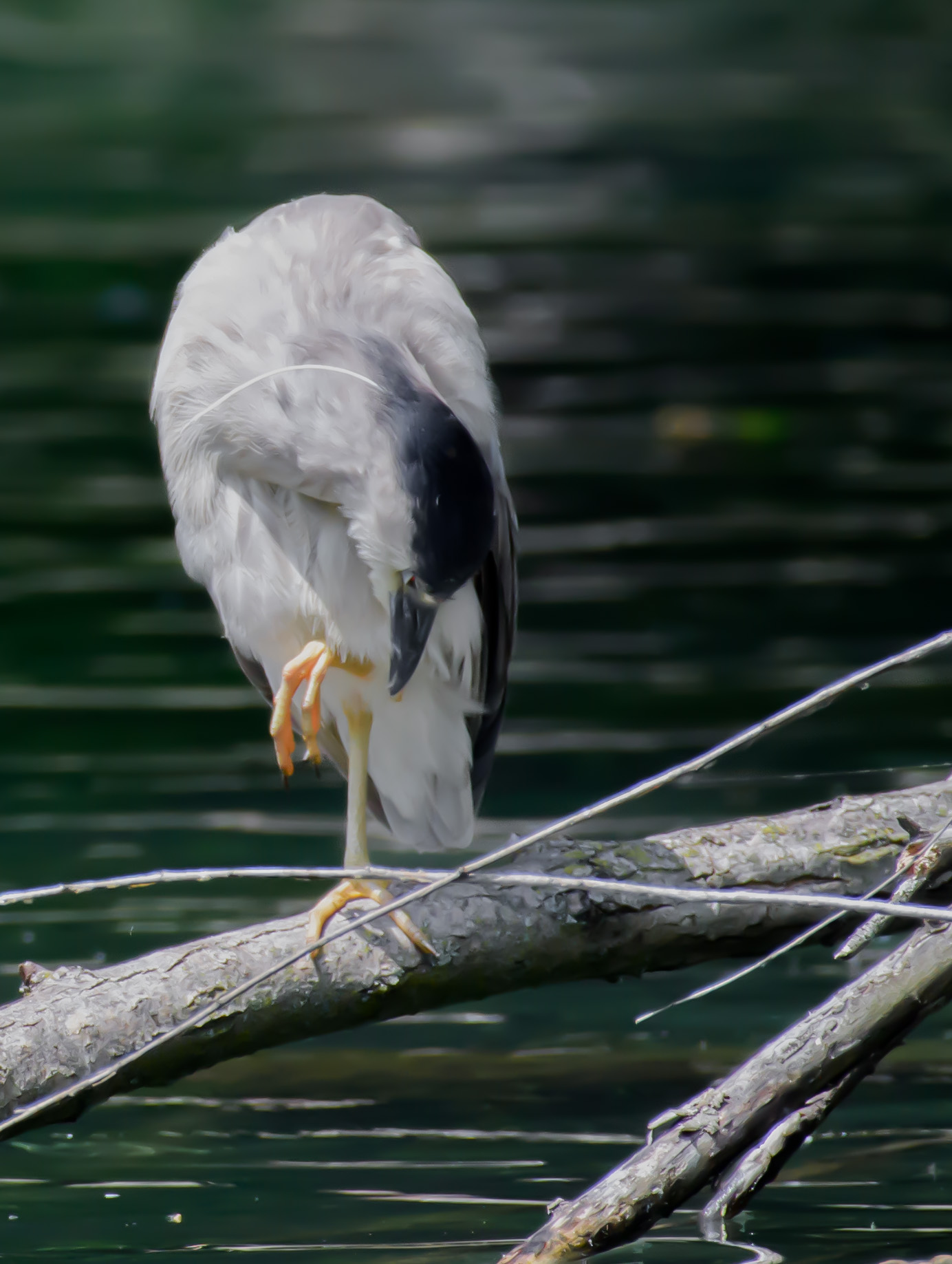 But I am happy with mine. The focus is good, and the heron is preening.
“Preening” sounds much better than “scratching at feather mites,” don’t you agree?
Anyway. My next lesson will be on reading the light.
But I need some practice first!
In case you are new to this blog and don’t know who Andy is, he is a phenomenal photographer who both teaches and offers higher-end workshops. His main interest is nature, specifically birds.
He really IS the Bird Whisperer, not to mention the Gear Guru.
Take a look at his photos, and I think you will agree.
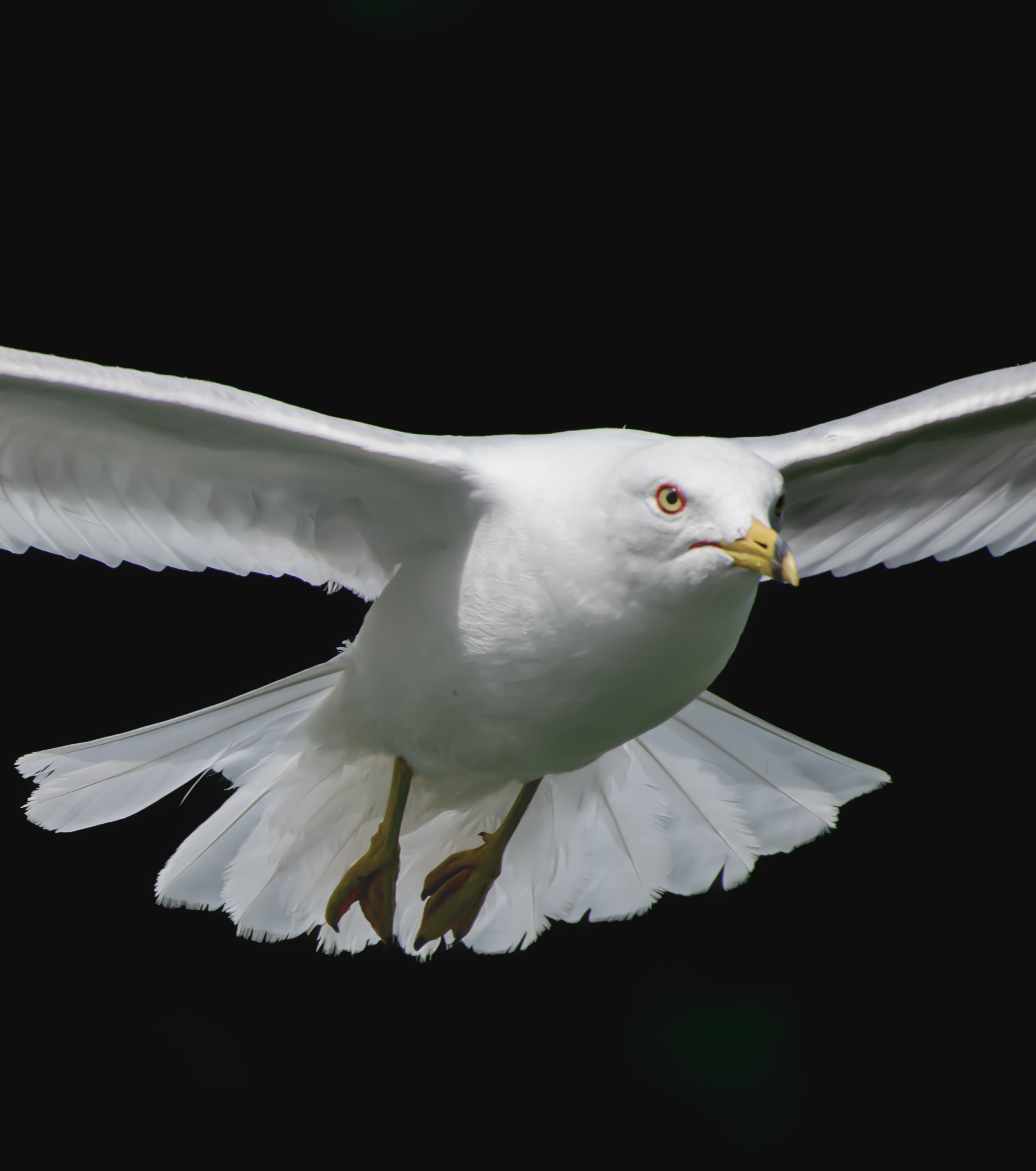 You can see his work here:
https://www.andysphototours.com/
or here on Facebook at Wild Wings Photography:
https://www.facebook.com/AndyNguyen600
Last I heard there were spots still open on the two remaining workshops for this year, one in Africa
https://www.andysphototours.com/2022-africa-safari
and the other in Costa Rica:
https://www.andysphototours.com/2022-costa-rica?fbclid=IwAR1OoOUkzyRPbwvQOWuoKfmAOKcyeJw0c2cFdBtCnwxZLrSmsT-SXBkAphg
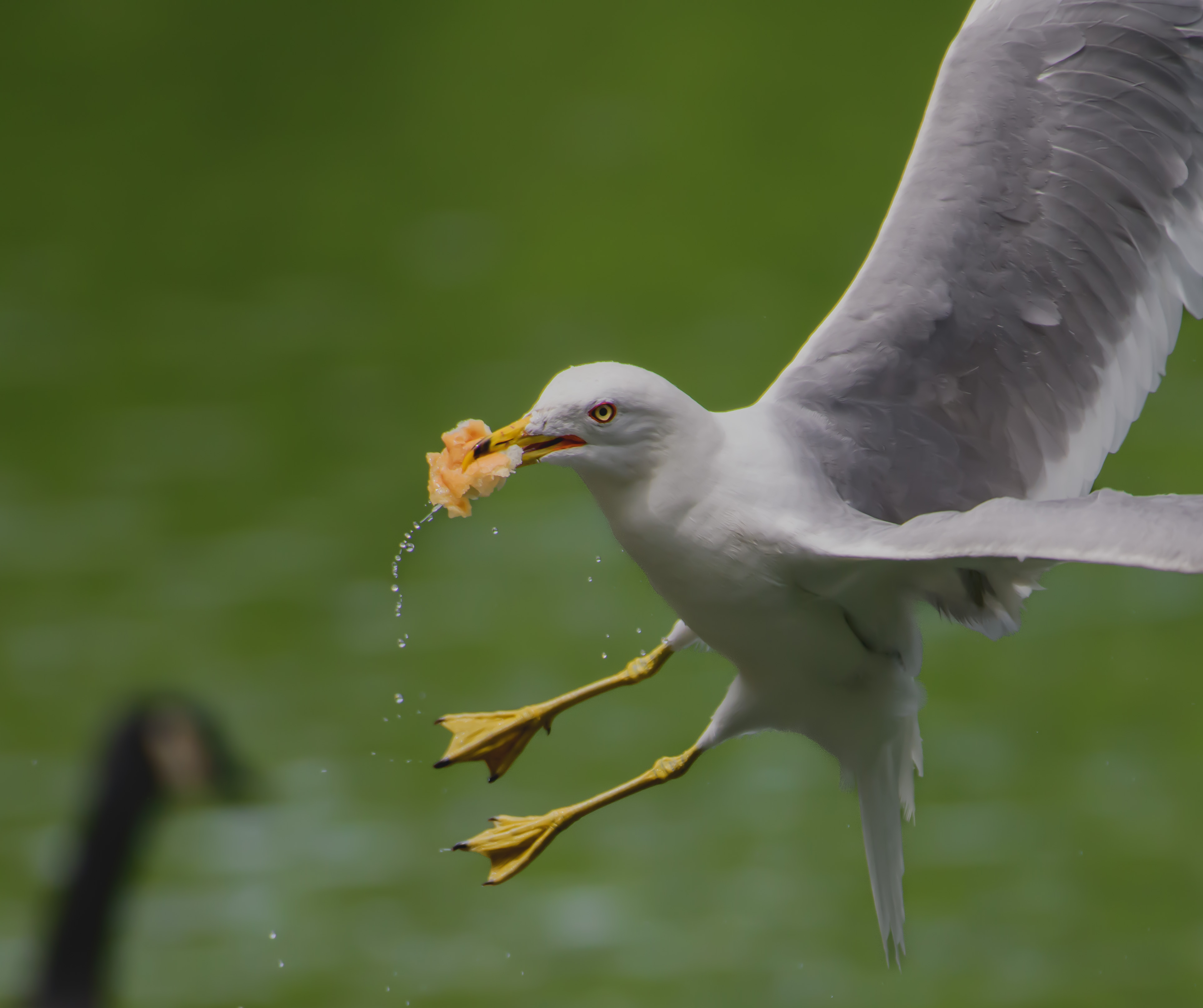
Been taking my camera out ss often as I can, experimenting with manual mode.
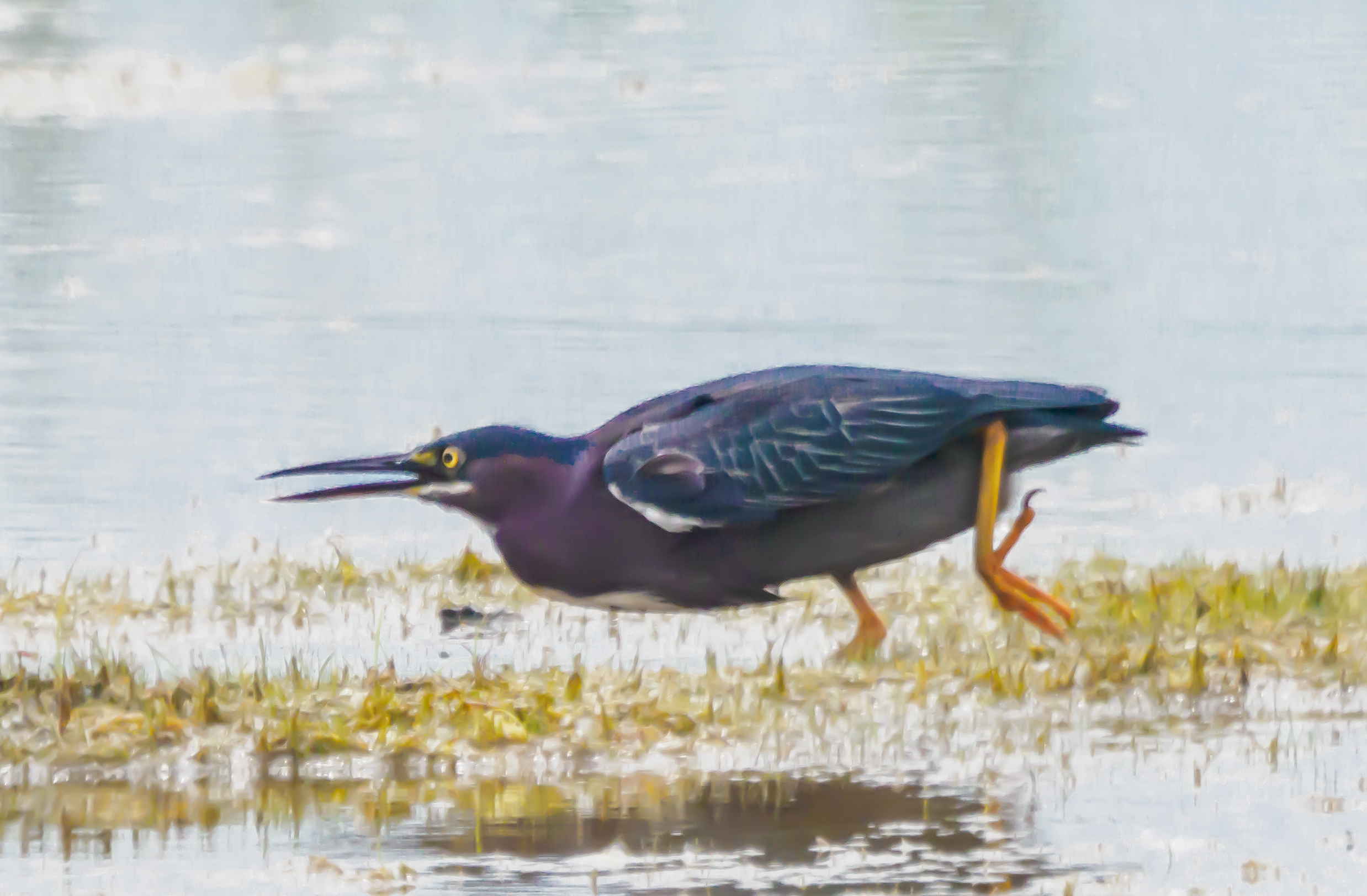
And lighting. That seems to be my biggest problem.
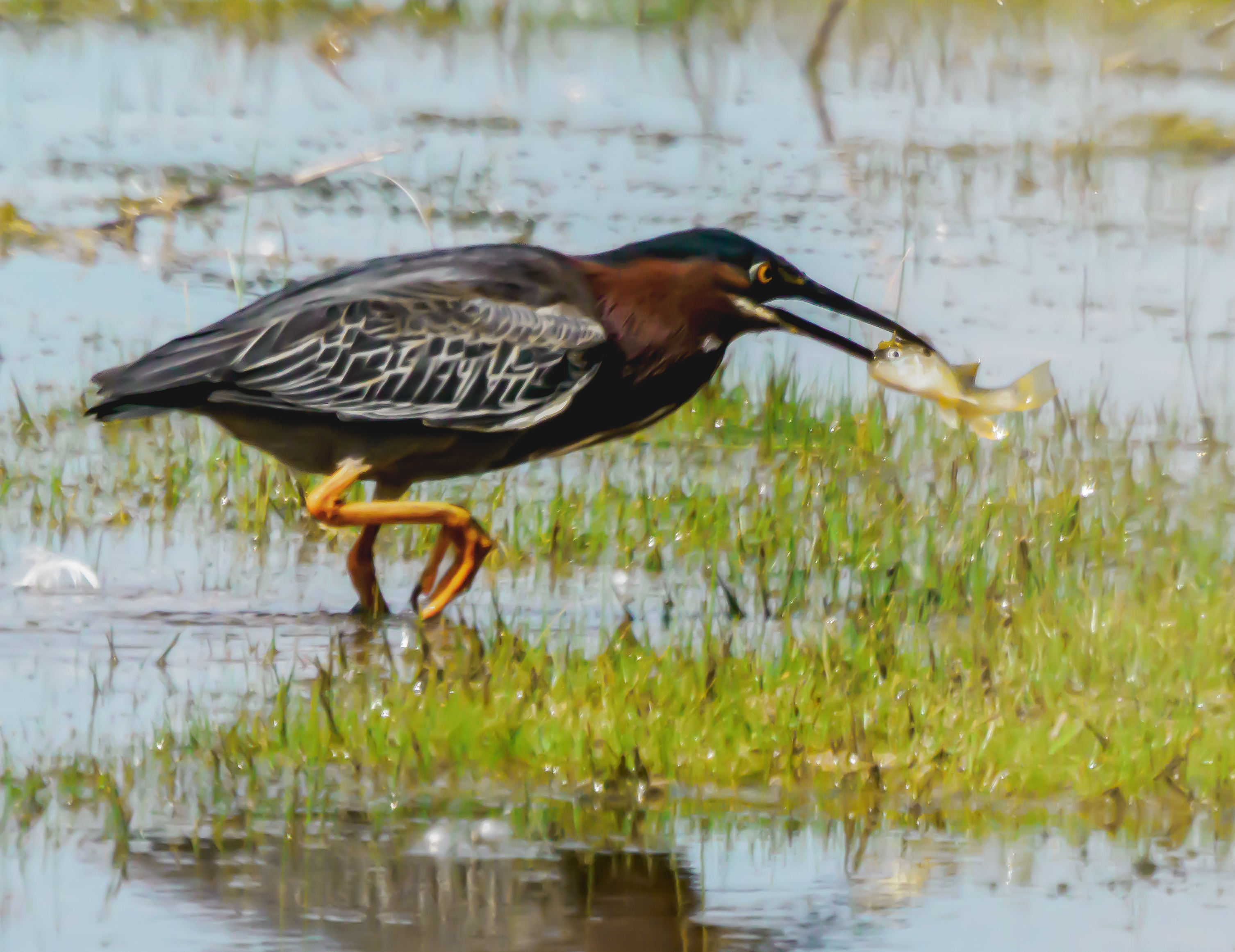
There was a particular grainy, 18% gray day this week, where everything came out fuzzy and monotone. Like this guy over here ———>
I went back on the next day, which was bright and sunny, and did much better. Like that guy down there. . .same greenie, better light so better focus.
Even phase-detection focus points need some sort of contrast to work effectively.
So, I’ve got to learn how to make the best use of available light. . .which may mean just waiting until there is enough of it to work with.
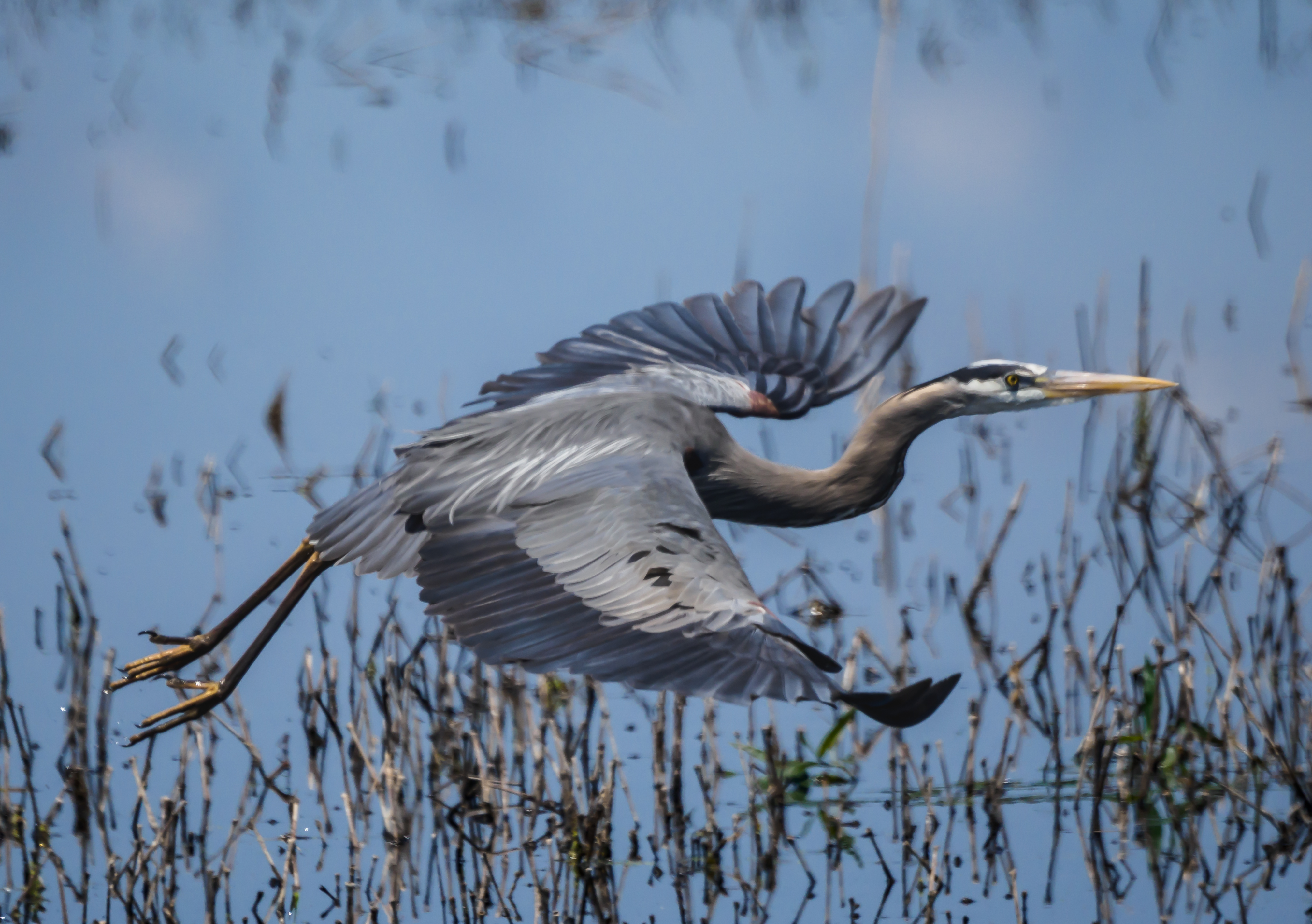
That, and birds-in-flight. Andy gave me some great tips, but it’s putting them into practice that’ the problem. . .
The first — and most important, I think — is to focus on the bird in the distance, before it takes off.
If you wait until it’s in flight and then try to focus, it’s really hard to get a good lock. . . reallyreallyREALLY hard.

Maybe not for others, but certainly for me.
Another issue: I’ve GOT to learn not to underexpose.
The lack of suitable subjects is frustrating. This has been worsening ever since I got back from Florida.
There were sooooooooooooo many birds in Florida! Here in western NY?
Not so much.
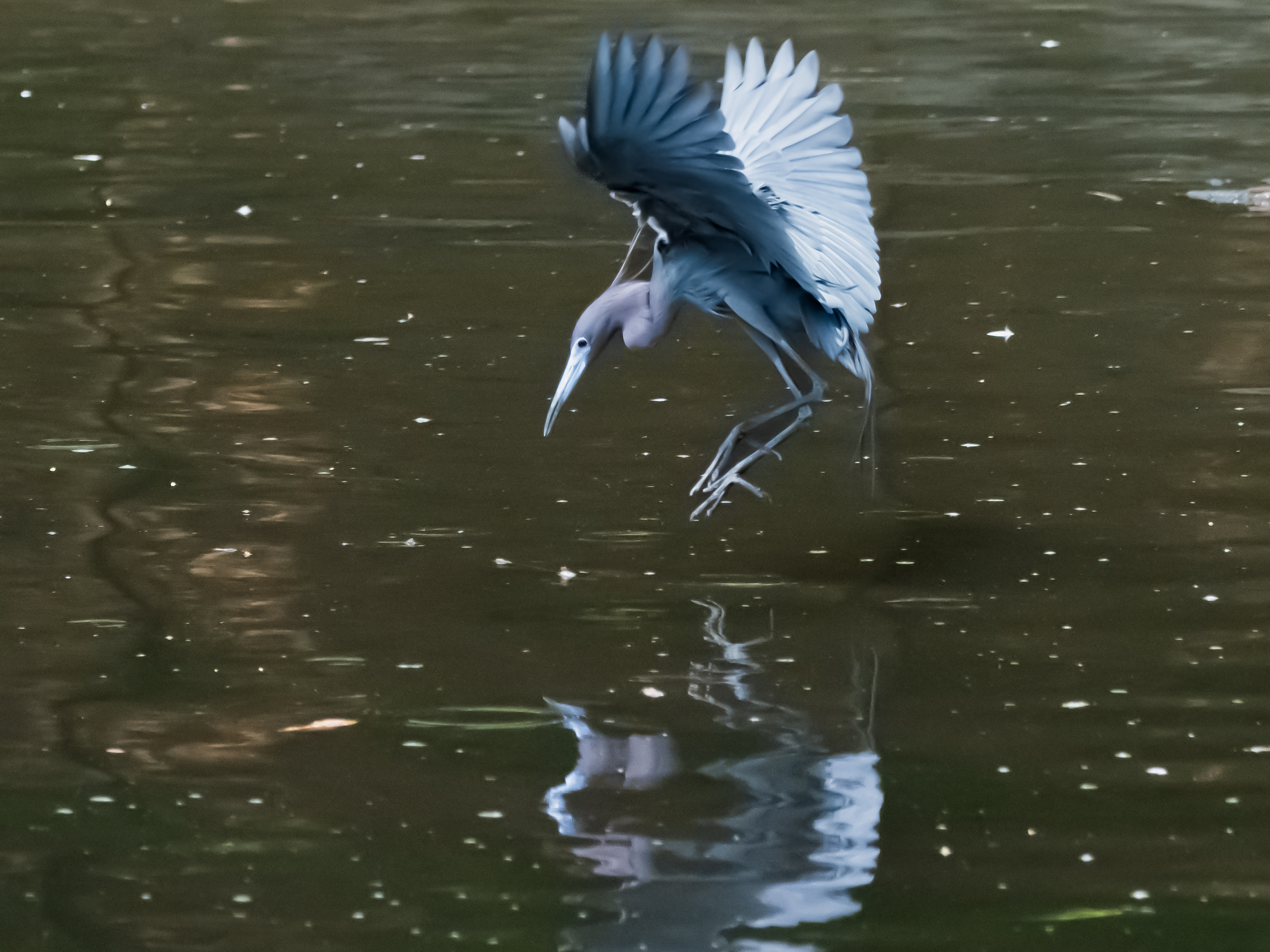
I’ve been spoiled!
I have only two nearby wetlands, and they are not very nearby. Each takes about an hour to get to.
Montezuma National Wildlife Refuge used to be my go-to birding place.
It has a 3-1/2 mile Wildlife Drive, which used to be a rich source of wildlife. On either side of the Drive there are wetlands, a marshy pool on the west side and the Seneca Canal on the east. As the Drive curves around to the west and south there are smaller bordering pools.
Or, what used to be pools.
You see, the marsh managers think it’s a good idea to drain the marshes every spring, which dries up a vital element of the food web.
They’ve been doing this for the past 5 years.
Indeed, the last year there was any appreciable water in the marshes was 2017!
The wildlife aren’t stupid.
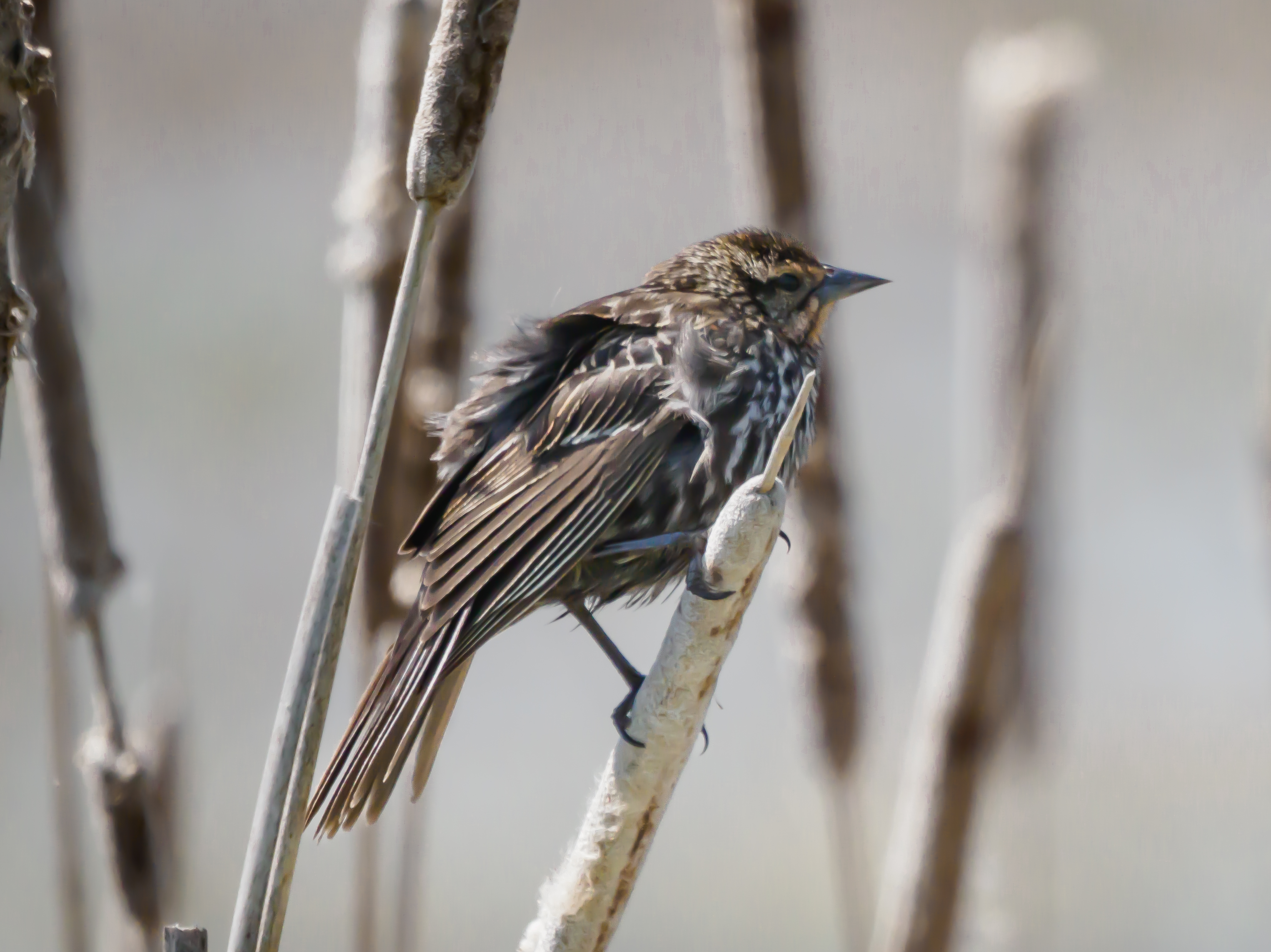
The herons, eagles, osprey, kingfishers, etc. who at one time frequented this Flyway stop, simply look elsewhere for better fishing grounds.
This year it’s been virtually deserted, except for a delightful sandhill crane family, who thrive searching the meadows-that-were-once-marshes for edible goodies (but usually on the bad-light side of the Drive!).
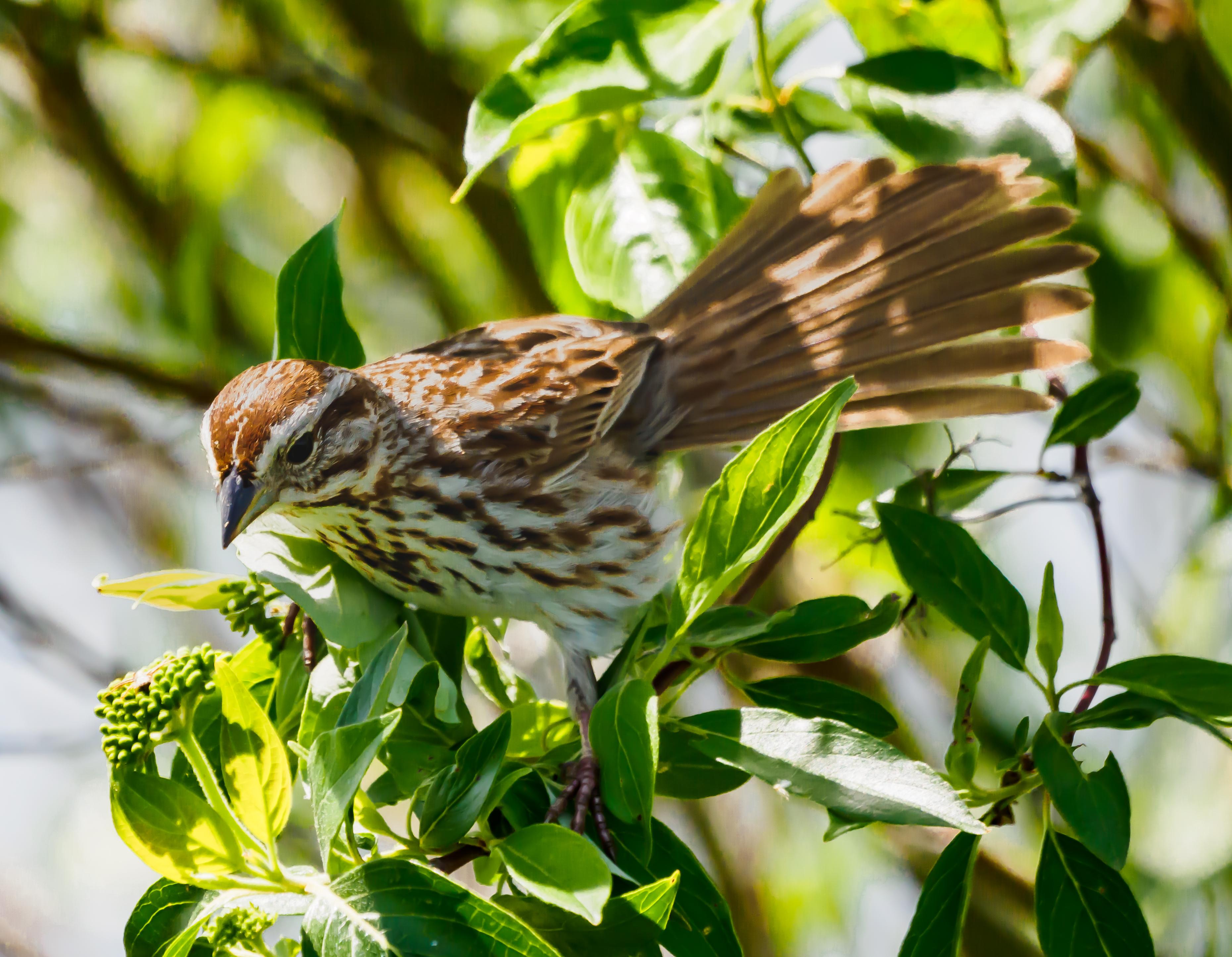
Of course, there is also the occasional great blue heron, an eagle or two, and a rare pie-billed grebe. And yesterday I saw two great egrets — but way out in the main pool, where there was a decent water level.
There’s always hordes of redwing blackbirds, purple martins at the feeders (in season), song sparrows, kingbirds, and a few warblers (again in season).
And geese. There are always far too many Canada geese!
The (formerly) good variety of shorebirds, which included a pair of Wilson’s phalaropes (!) are long gone, now that their feeding grounds have dried up.
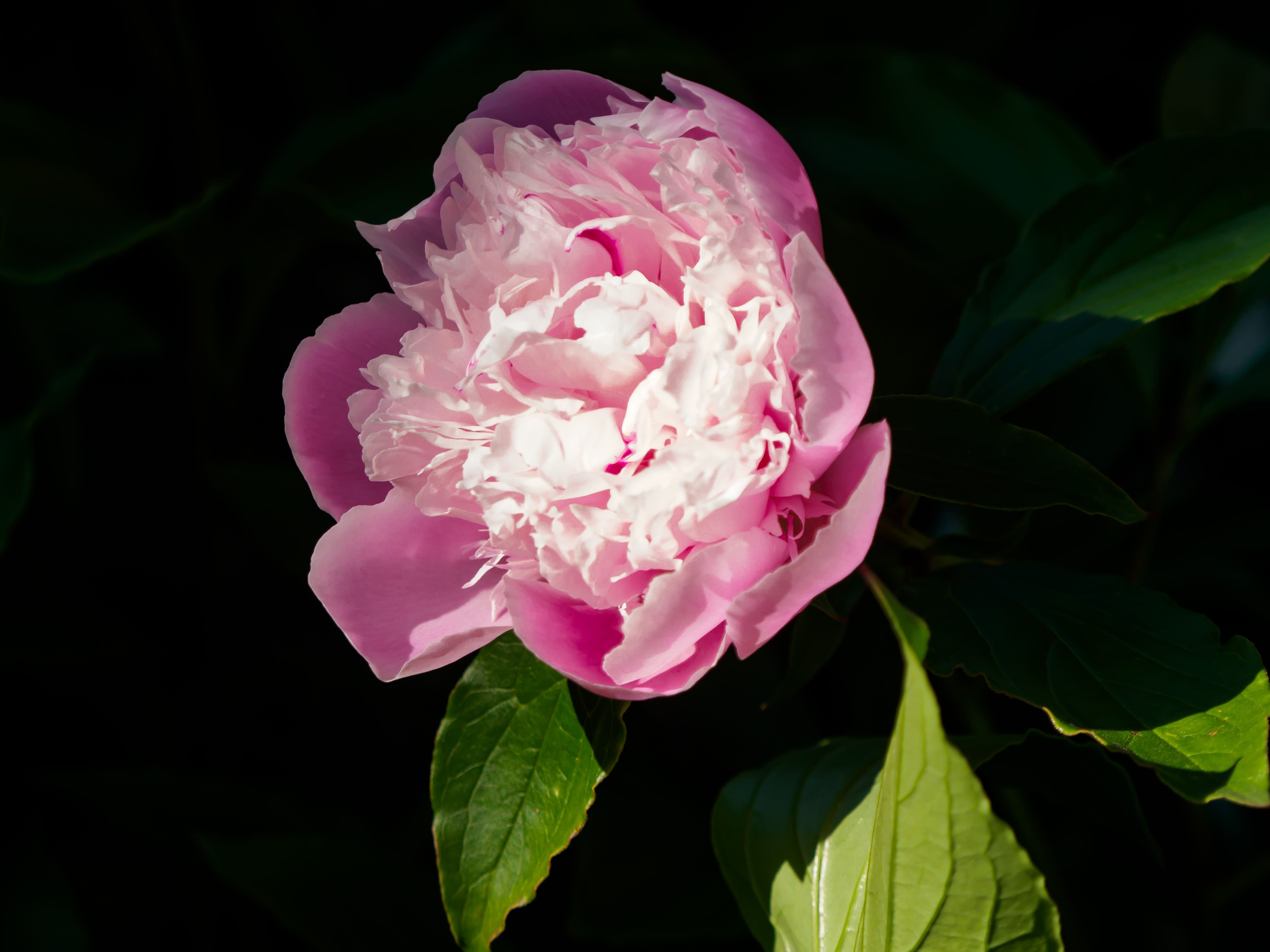
Anyway
My other go-to area is Sterling Nature Center.
No Wildlife Drive here, but certainly some very good trails, one of which takes you to a great blue heron rookery.
This is always a great place to visit!
Especially in the spring, when a variety of flora and fauna can be found and the herons are busy raising their young.
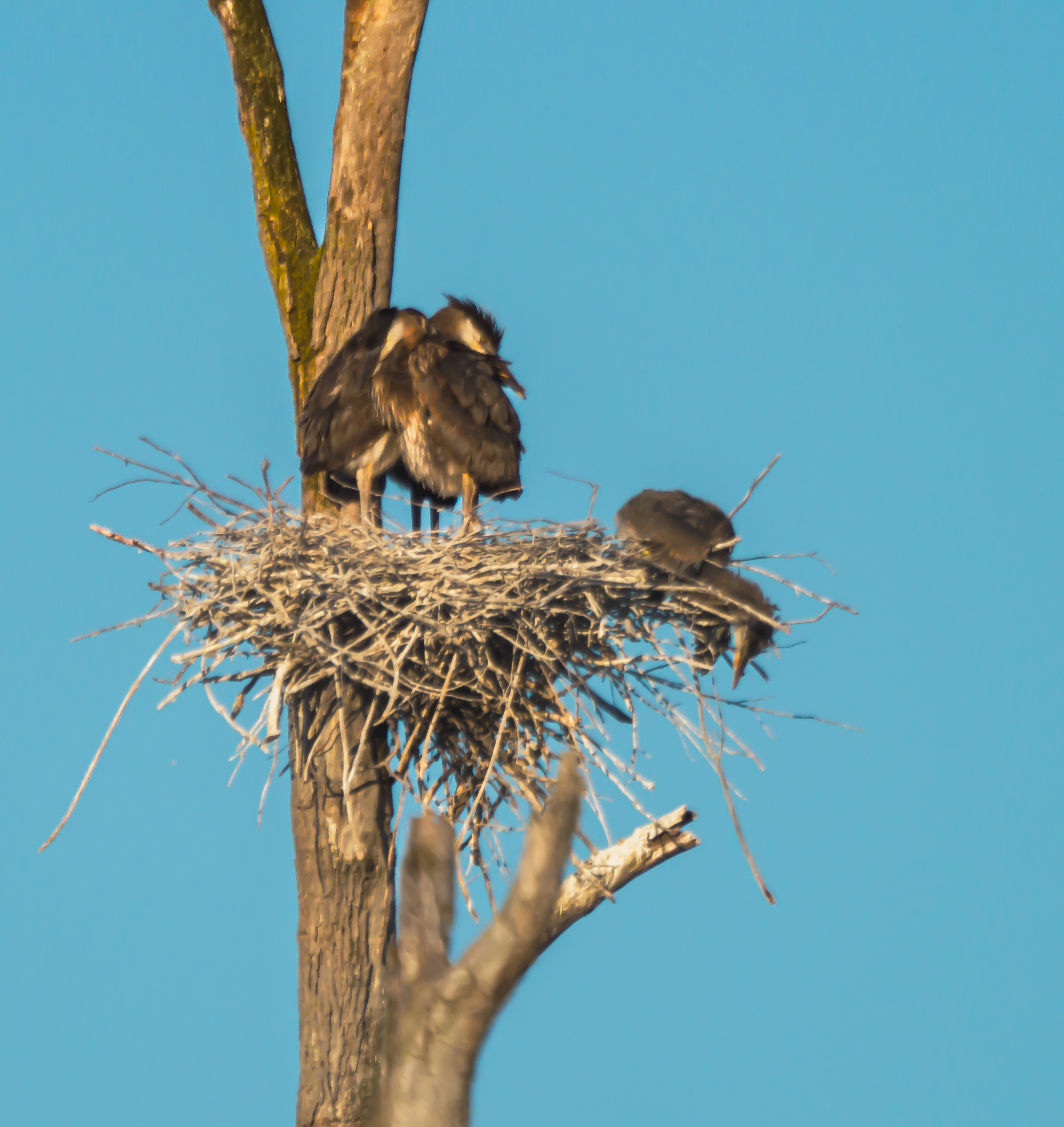
I am going to get busy and search for new hunting grounds, some close by and some farther away.
Stay tuned!
The Wild Wings Photography Tour, Costa Rica 2022 is a GO!
This is the kind of birds we will see —
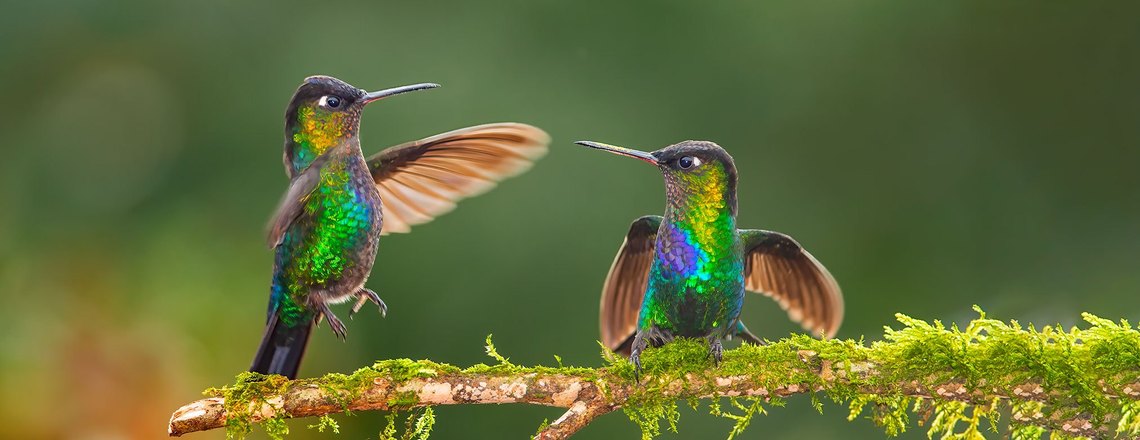
— and I am hoping that this is the kind of photos we will take!
With Andy’s patient help and expert teaching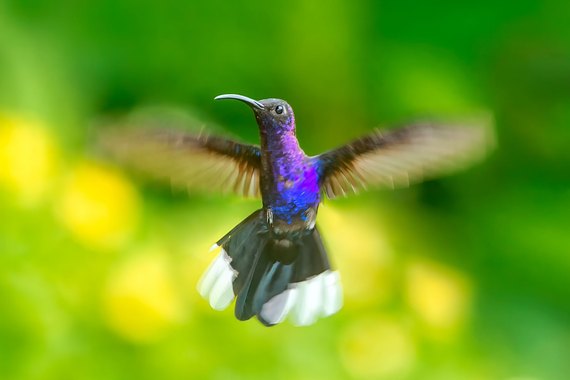
we will no doubt bring lots and lots of good photos back home.
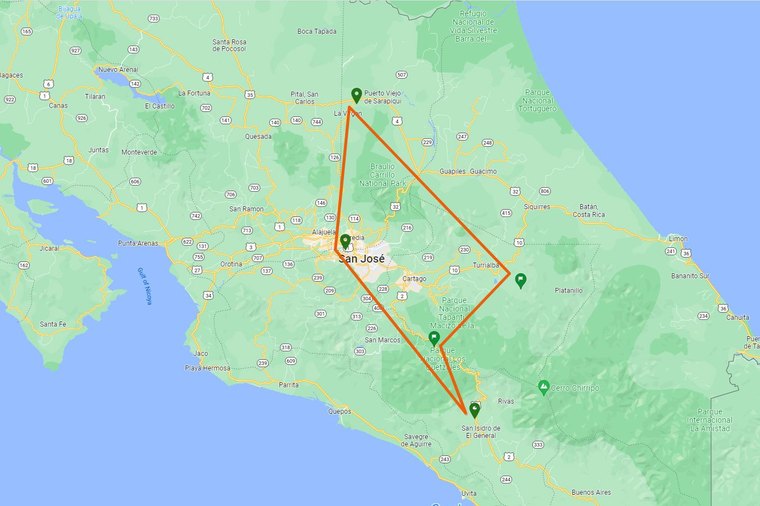
So, get your passports updated and your gear in order. November will be coming all too soon!
Hoping to make some new PhotoFriends there!
If Saturday was SuperSaturday, then I would have to say that Sunday was StupendousSunday.
I thought I was in photography heaven.
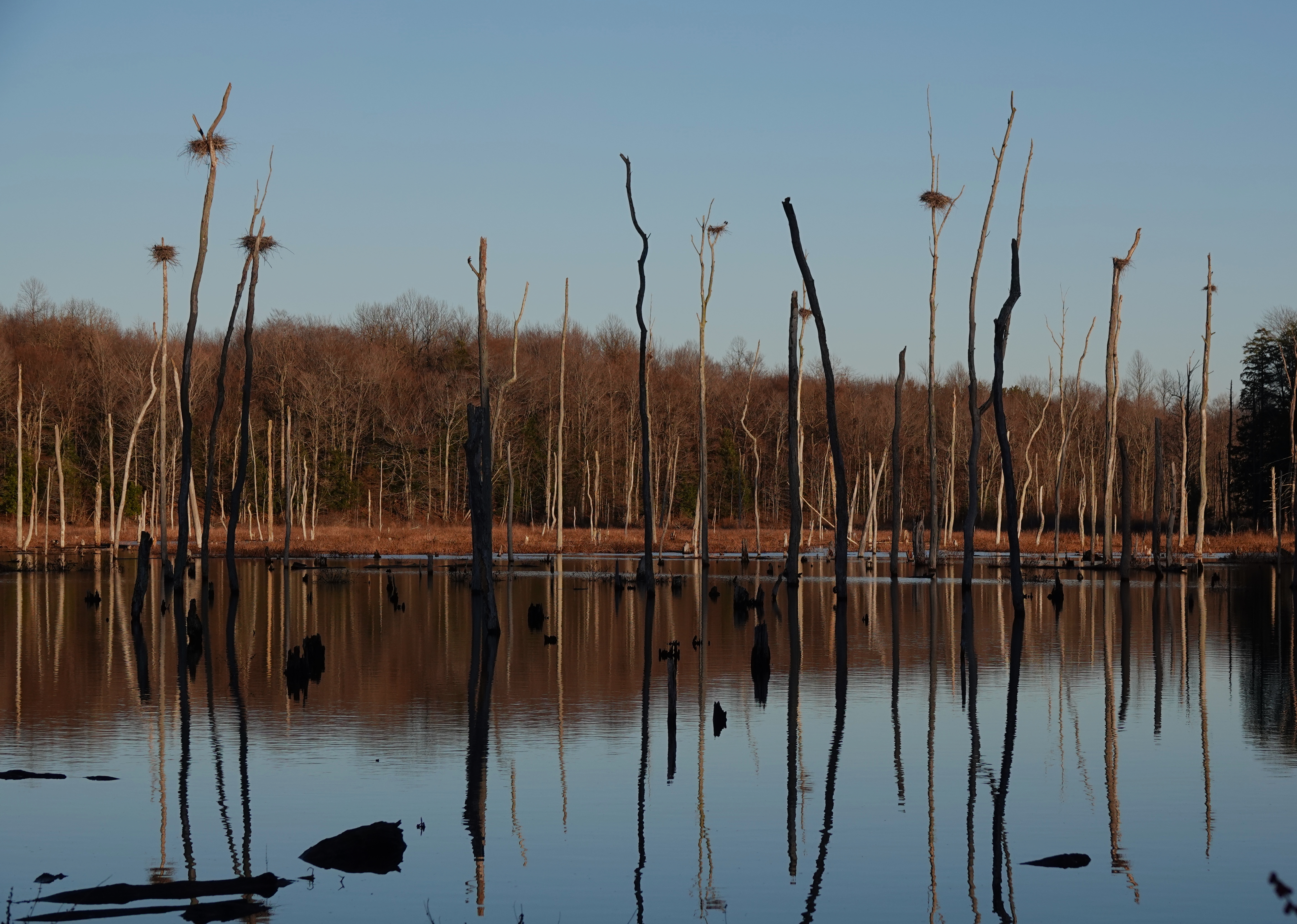 When Andy said he was taking us to a rookery, I immediately thought of this:
Which is a fairly typical example of a great blue heron rookery up where I live.
You know, a stand of dead trees in the middle of a beaver pond, which naturally attracts herons because of the protection afforded by the water.
Beautiful, but meh.
I see this all the time up north.
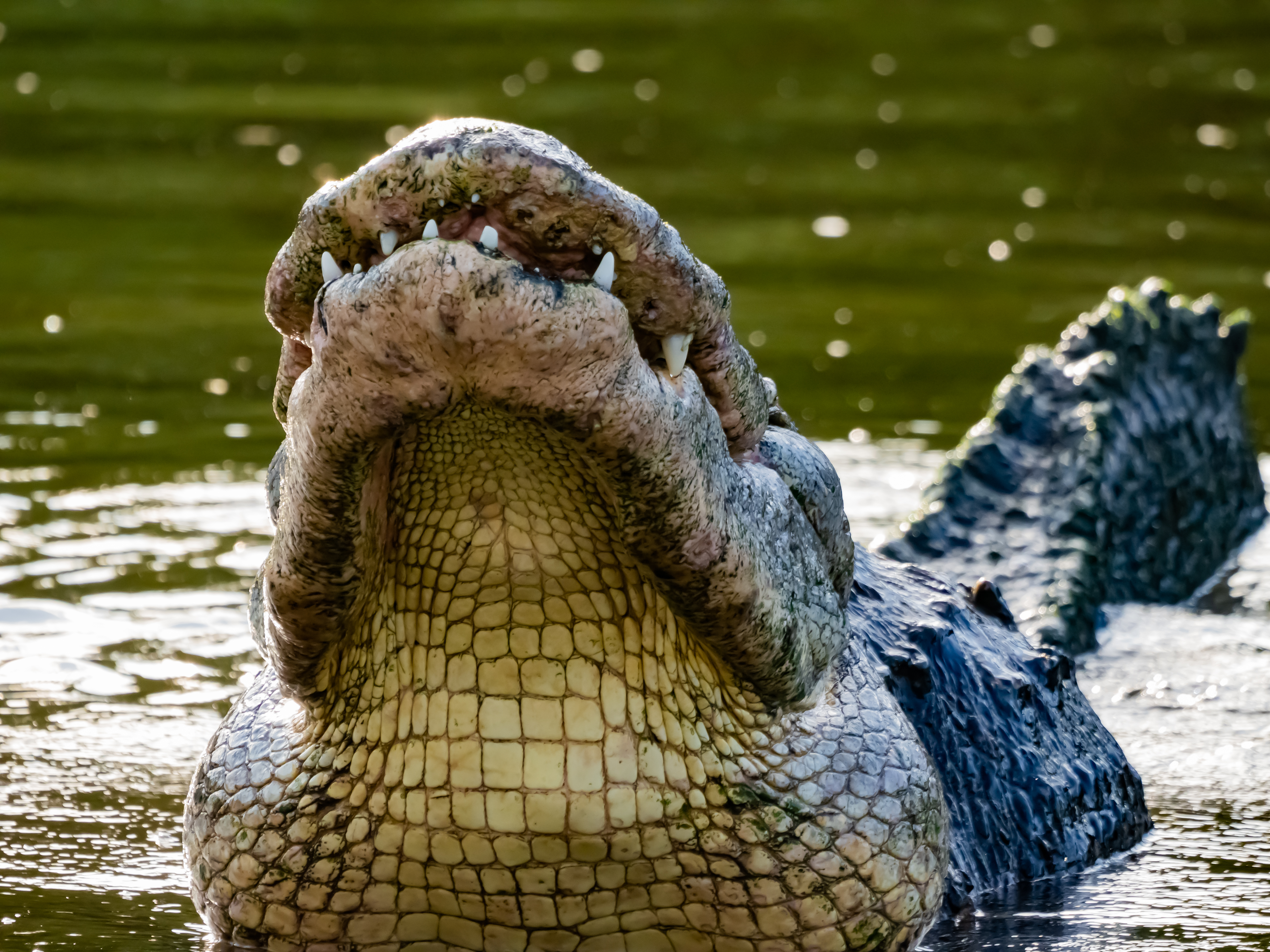 However, the rookery he had in mind was sooooooooooooo different!
It was surrounded by a protective body of water all right, but there were no groves of dead trees.
And the protection supplied by the water was amplified by. . .
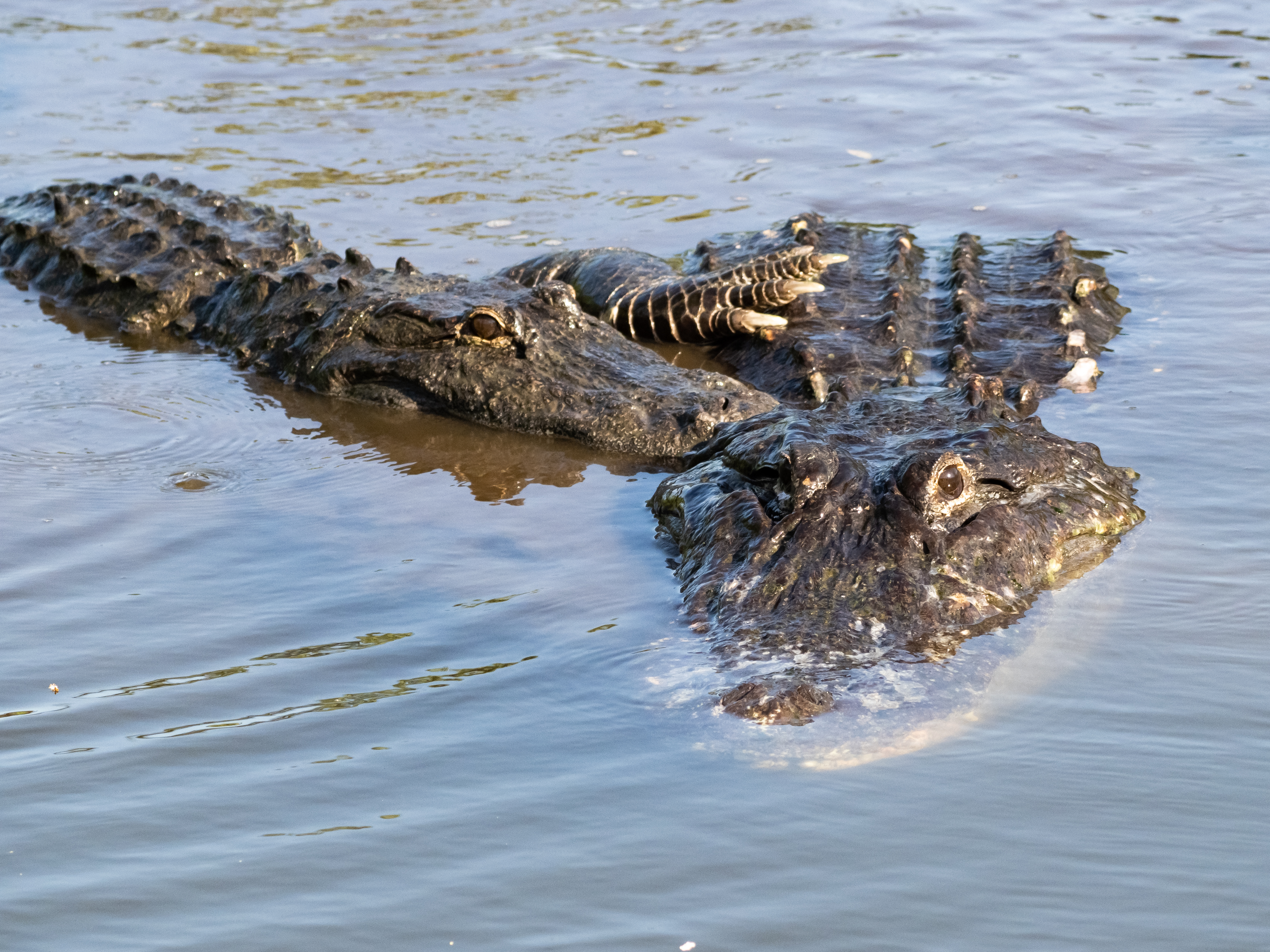
. . .ALLIGATORS!
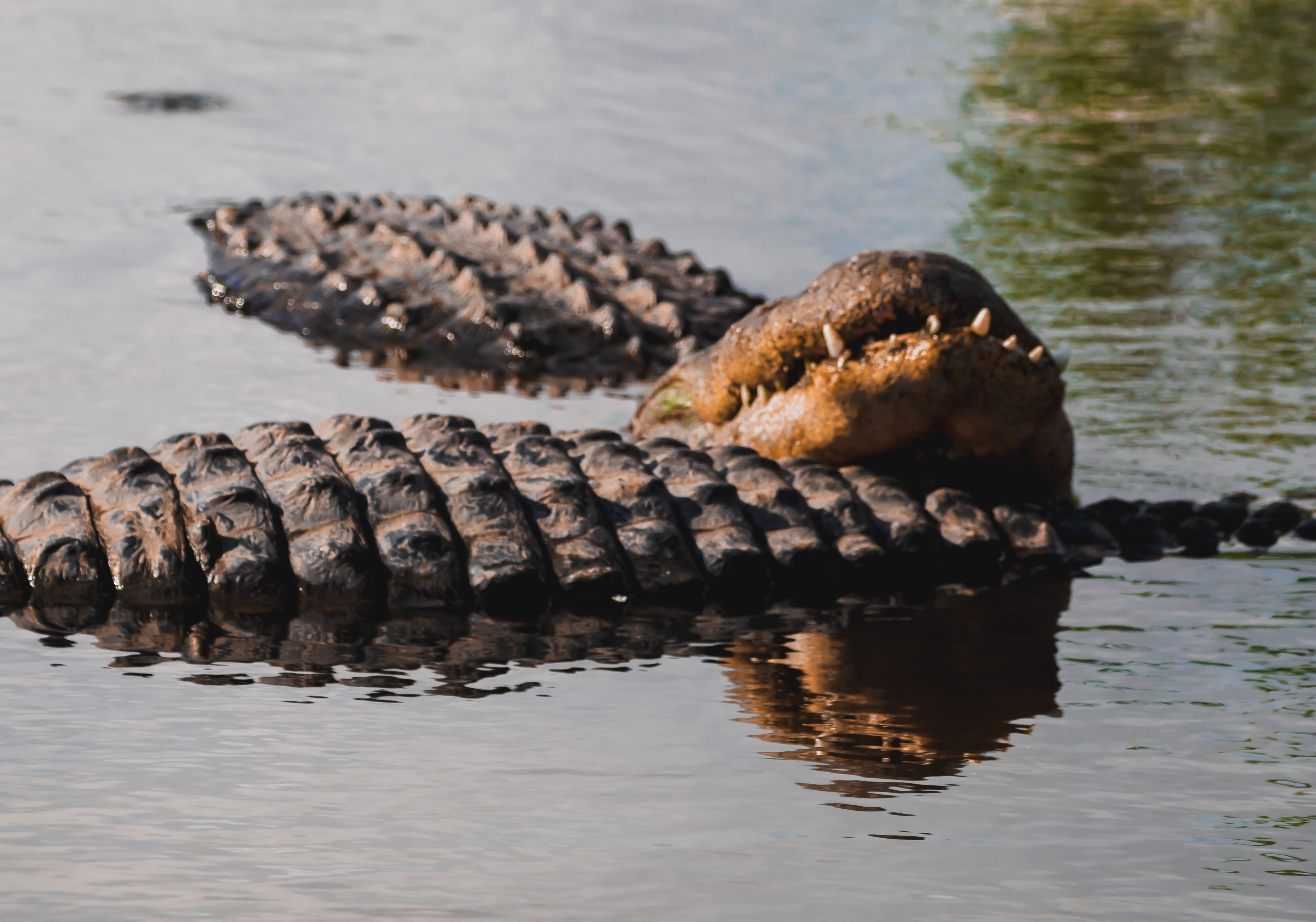
GREAT BIG ALLIGATORS, with LOTS OF TEETH!
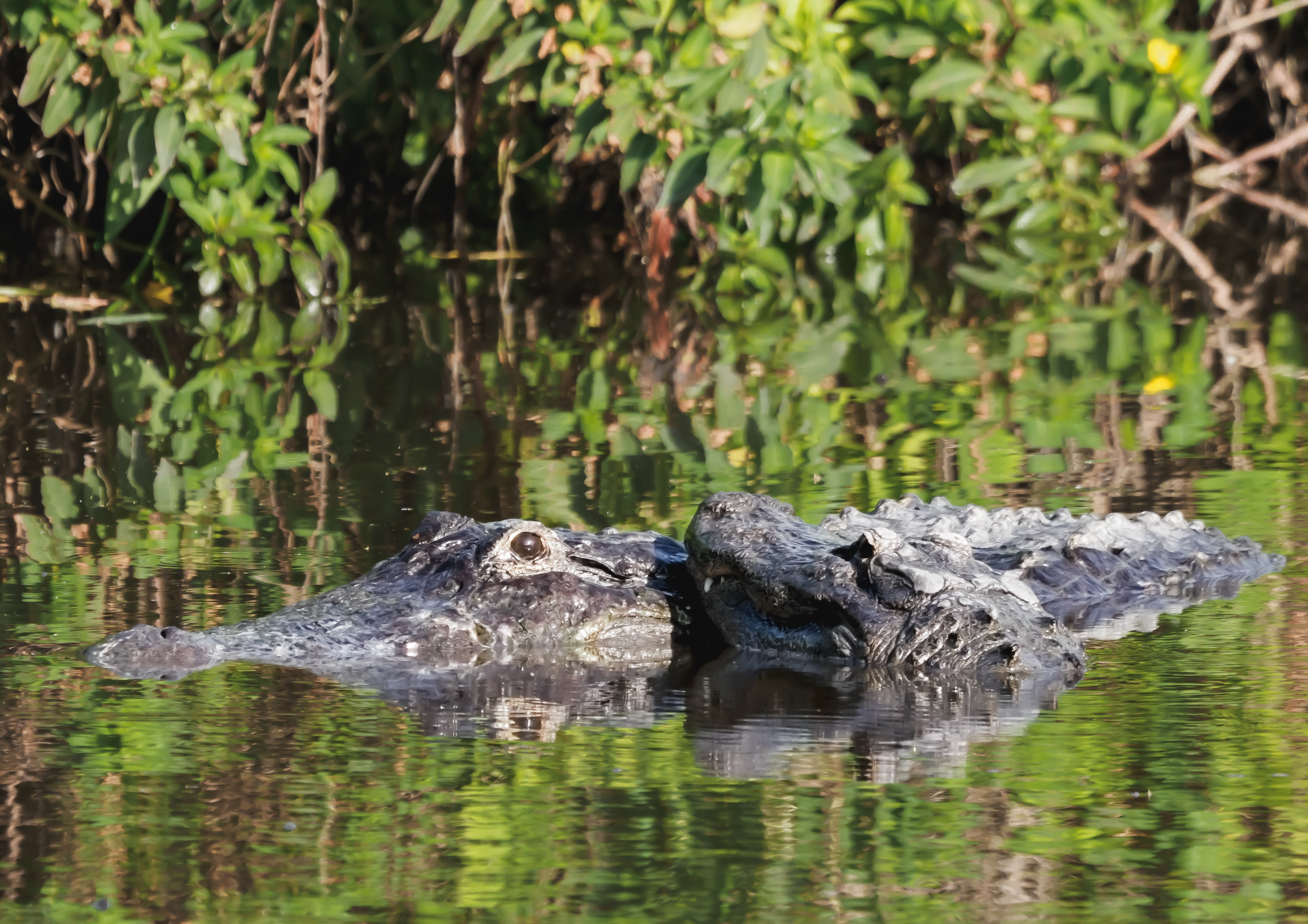 Hundreds of them!
Which, of course, proved to be The Star of the (Final) Day of Wild Wings 2022.
At least, to me. 🙂
Everywhere you looked, there was an alligator either resting in, thrashing about, or slinking through the water!
And the “rookery” was just as everywhere as the alligators were!
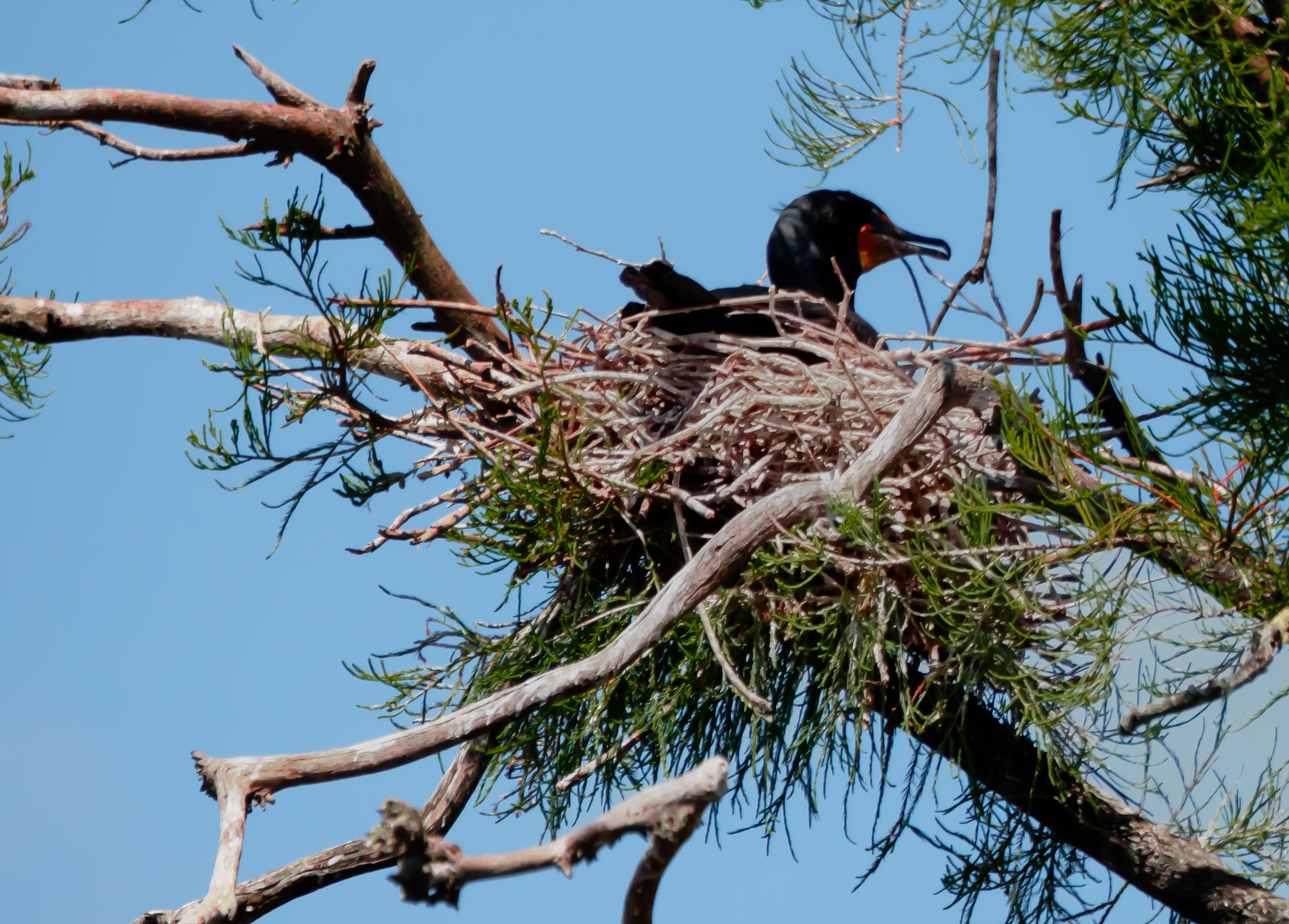
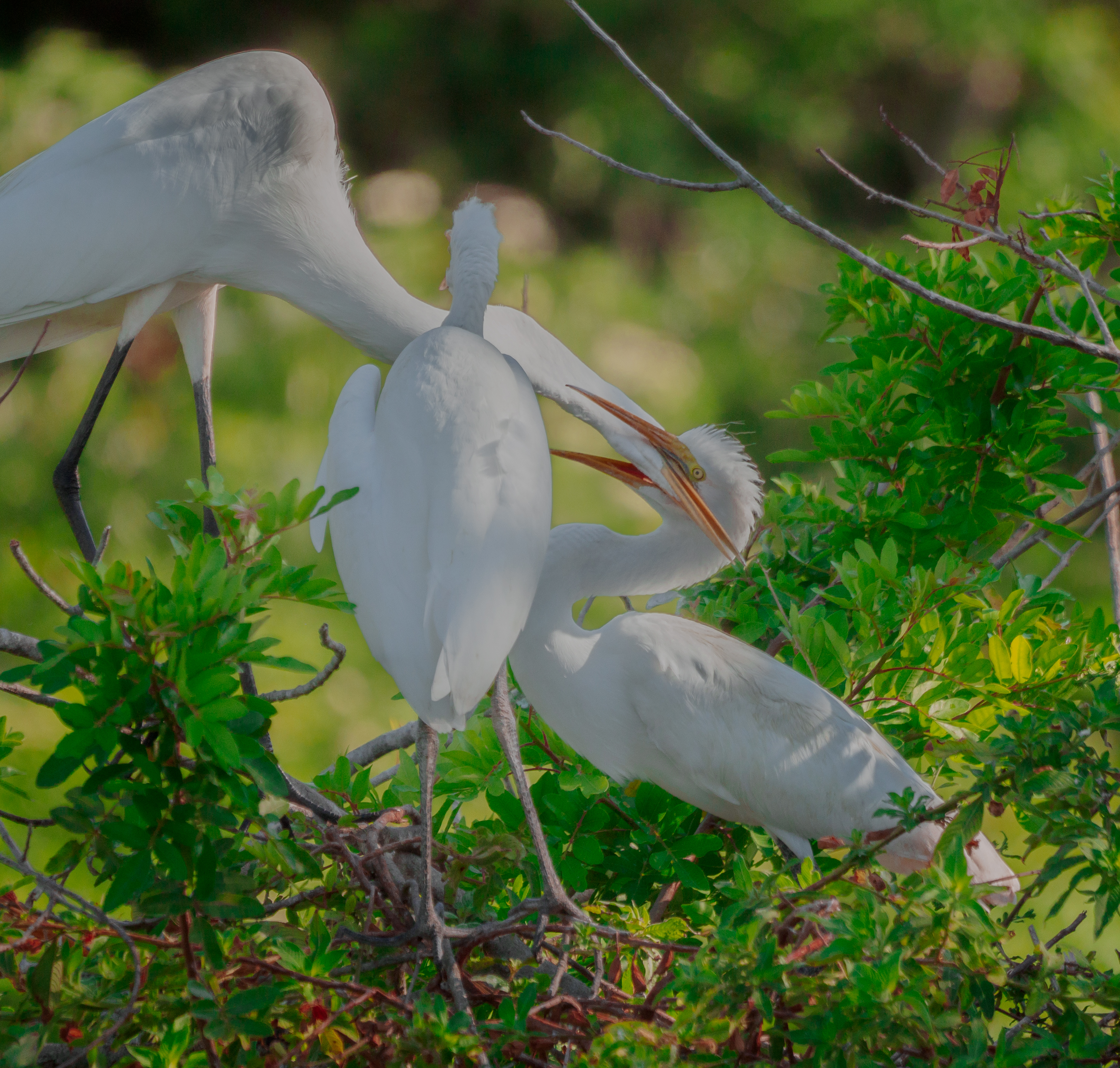
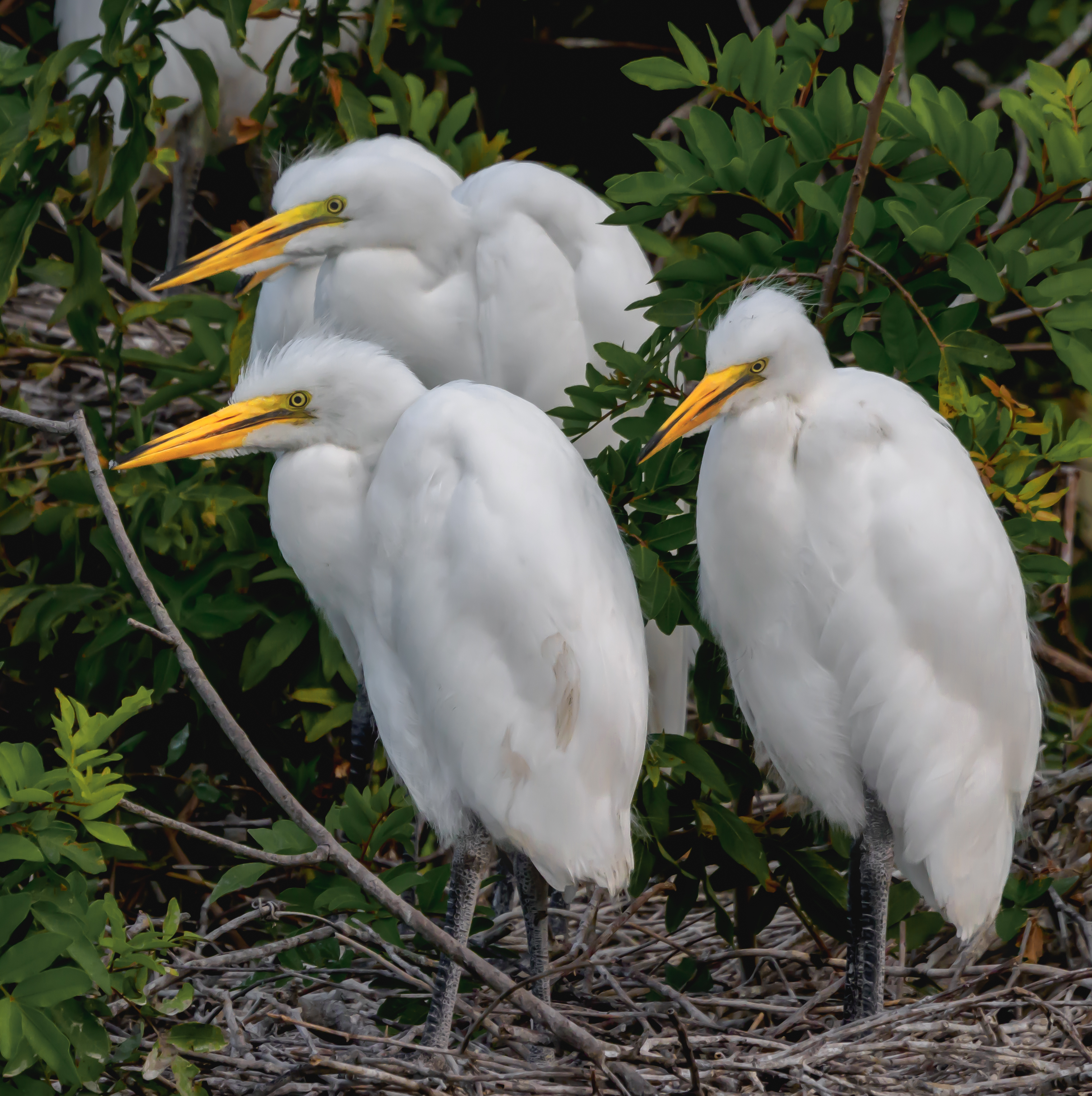
Just about any tree attracted birds of all descriptions, either resting or nesting.
Rare and not-so-rare, colorful and otherwise — preening, cleaning, screaming, or just sitting still.
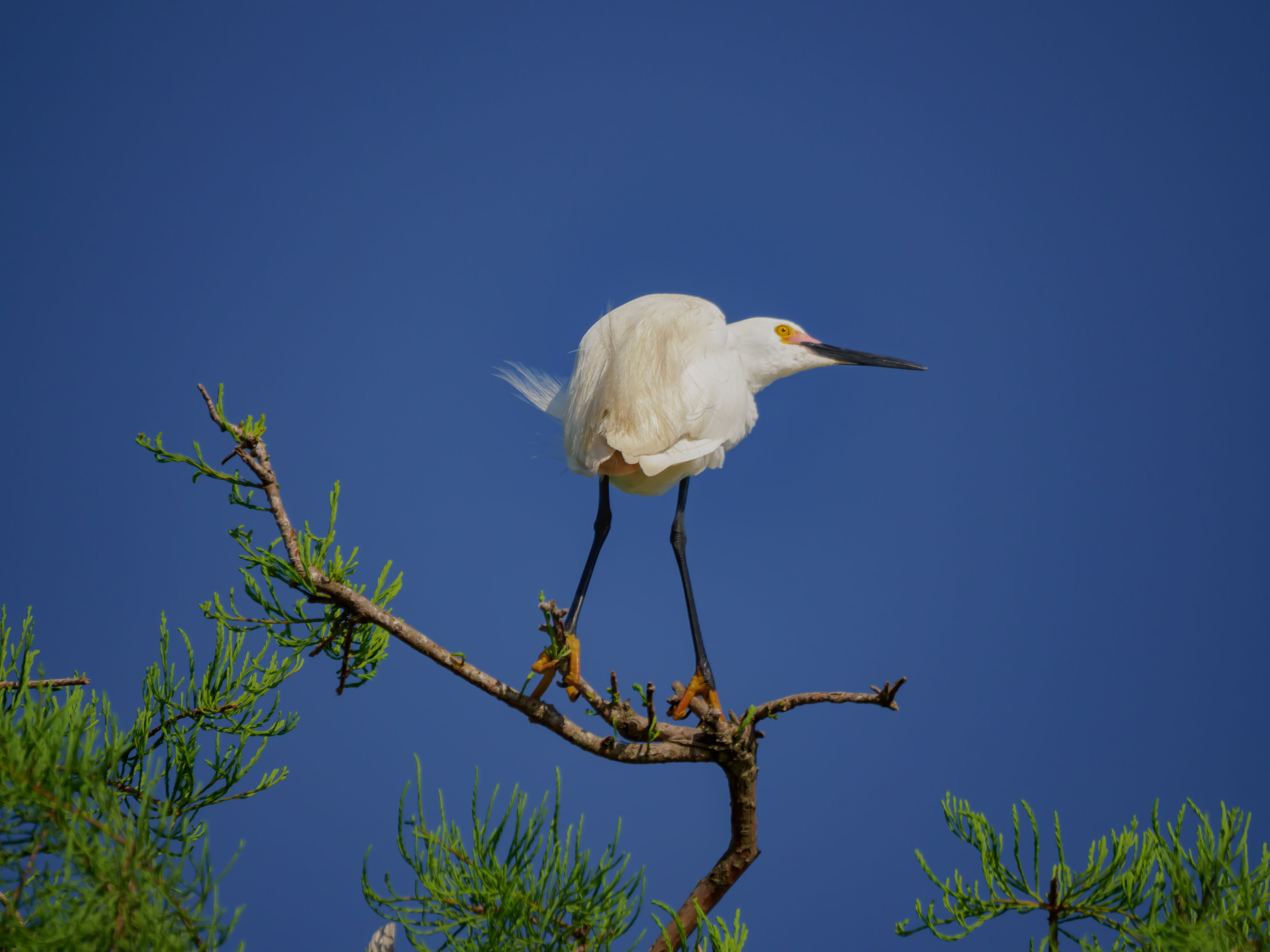 I can’t think of a hawk desperate enough or an eagle brave enough to risk clashing with an alligator simply to swoop down on a nest and dine on somebody else’s eggs or young ‘uns.
Although there was the ever-present danger of an egg or maybe a fledgling falling into the dangerous waters below. . .
. . .we saw none of that.
What we did see was simply amazing!
 When Andy pulled into the parking lot of what looked to me like a typical Florida tourist trap, I was confused.
I mean, during the entire week we had made every effort to avoid such places like the plague.
And this place looked very tourist-y, to the point that you were greeted by a huge plastic alligator head with its terrible, toothy jaws opened wide enough for even adults to walk straight through (so you could get that frightful picture to show Aunt Edith and Cousin Ned once you got home).
 But this place was different. It allowed early entry to photographers, so even though the golden hours were just beginning, we got to go in —
— long before it got too hot when the place would be crowded with tourists with their strollers, cell phones, and children asking “are we done yet?” and “can we go to McDonald’s?”
Anyway, I learned a lot of stuff.
Like, I didn’t know alligators make roaring sounds.
I thought it was thunder. . .
. . .but it was (mostly) male alligators in the midst of breeding season, warning others to stay away from their women.
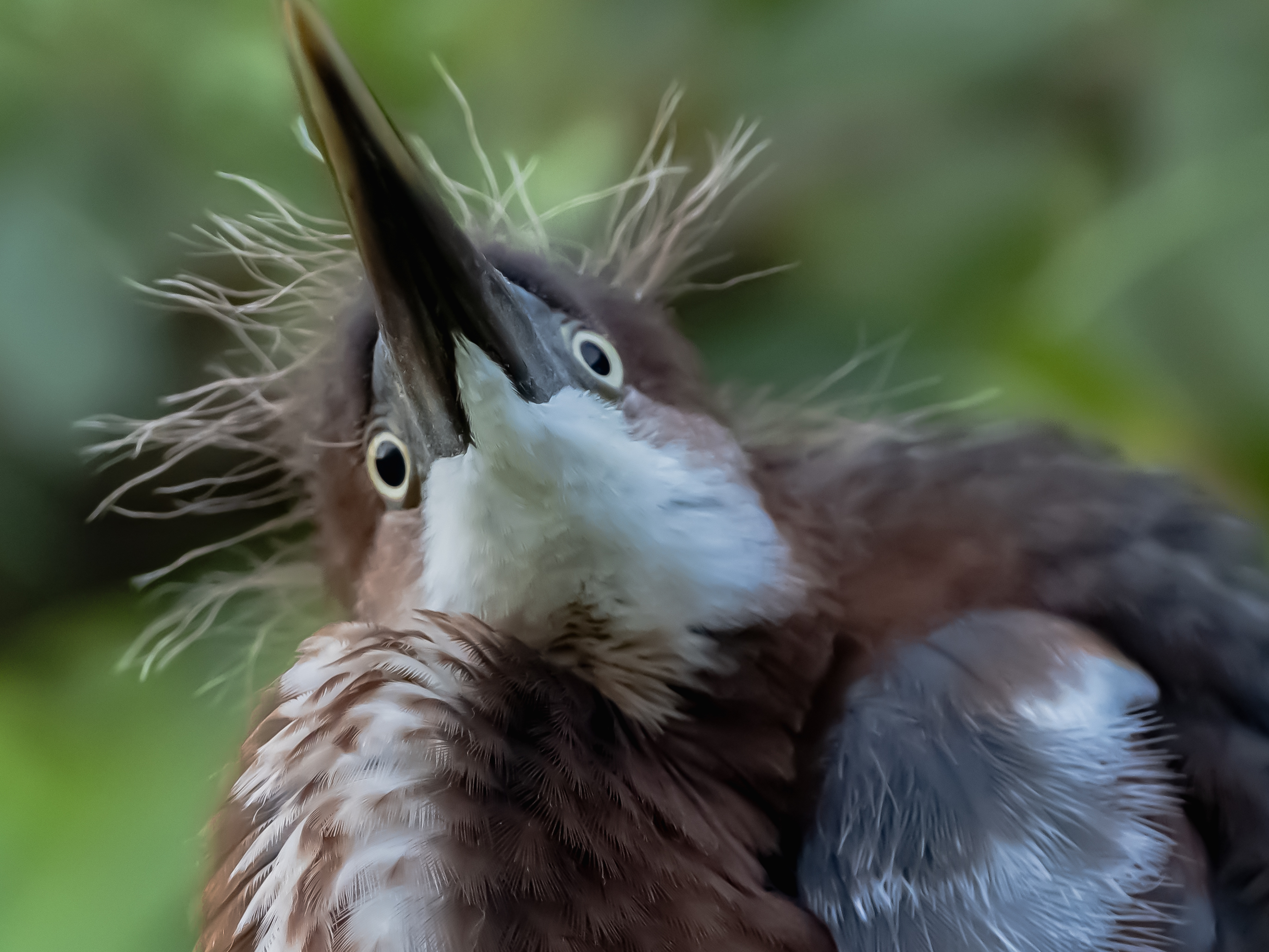 Andy told us to bring our tripods, which I did.
But, do you think I remembered the Swiss Arca plates? Not a chance! 😦 This was a valuable lesson learned, reinforced by the punishment of lugging a useless tripod around with me the whole time.
Ugh.
(My THREE plates, one for each lens, are now each affixed to the appropriate lens collars regardless of when or whether I need might need them!)
I saw Arthur Morris, the legendary expert I had inadvertently insulted when I accepted his business card but not his business.
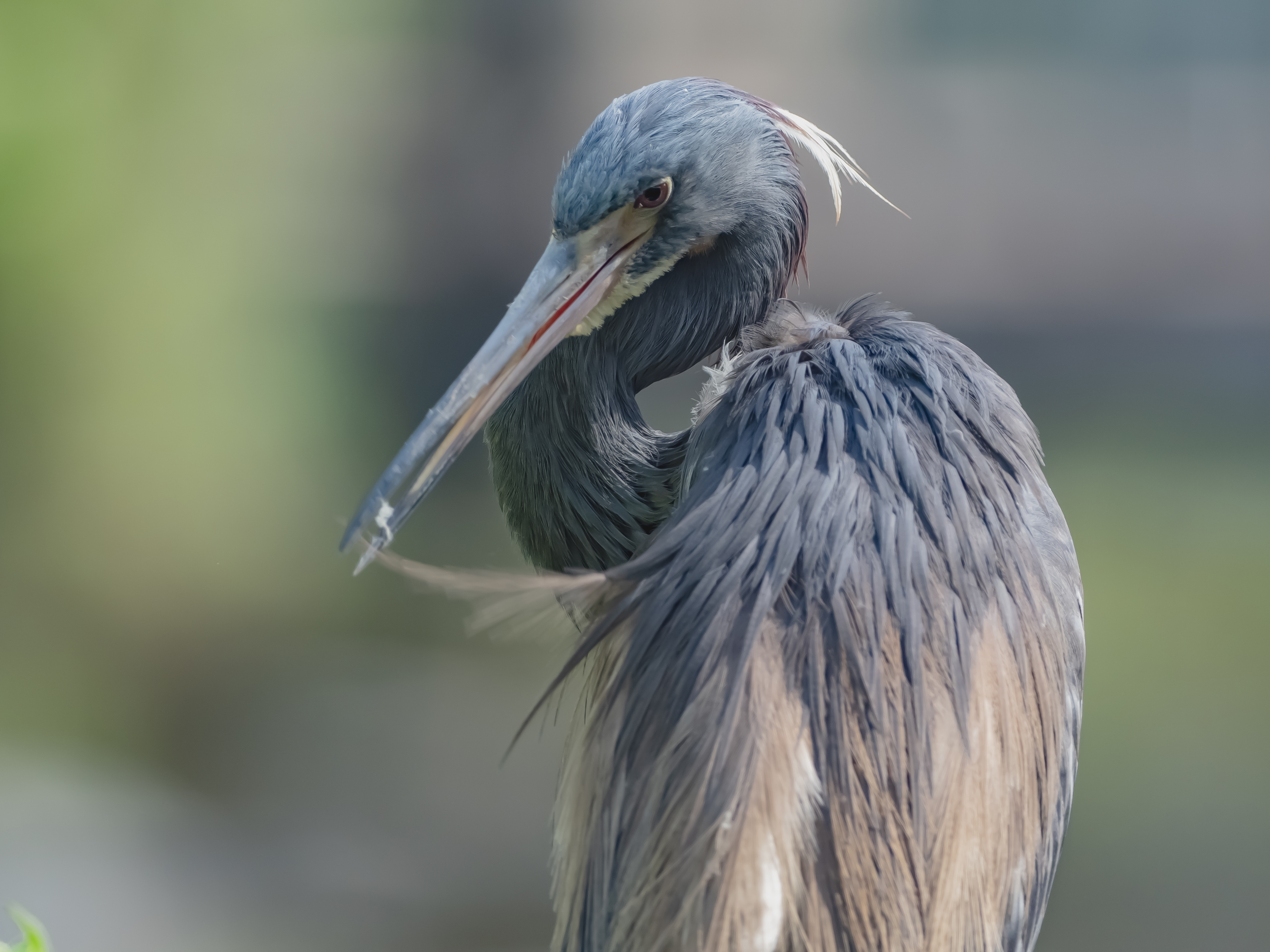 He pretty much ignored me.
But that’s okay, I really didn’t care. Too much to see and too much to learn!
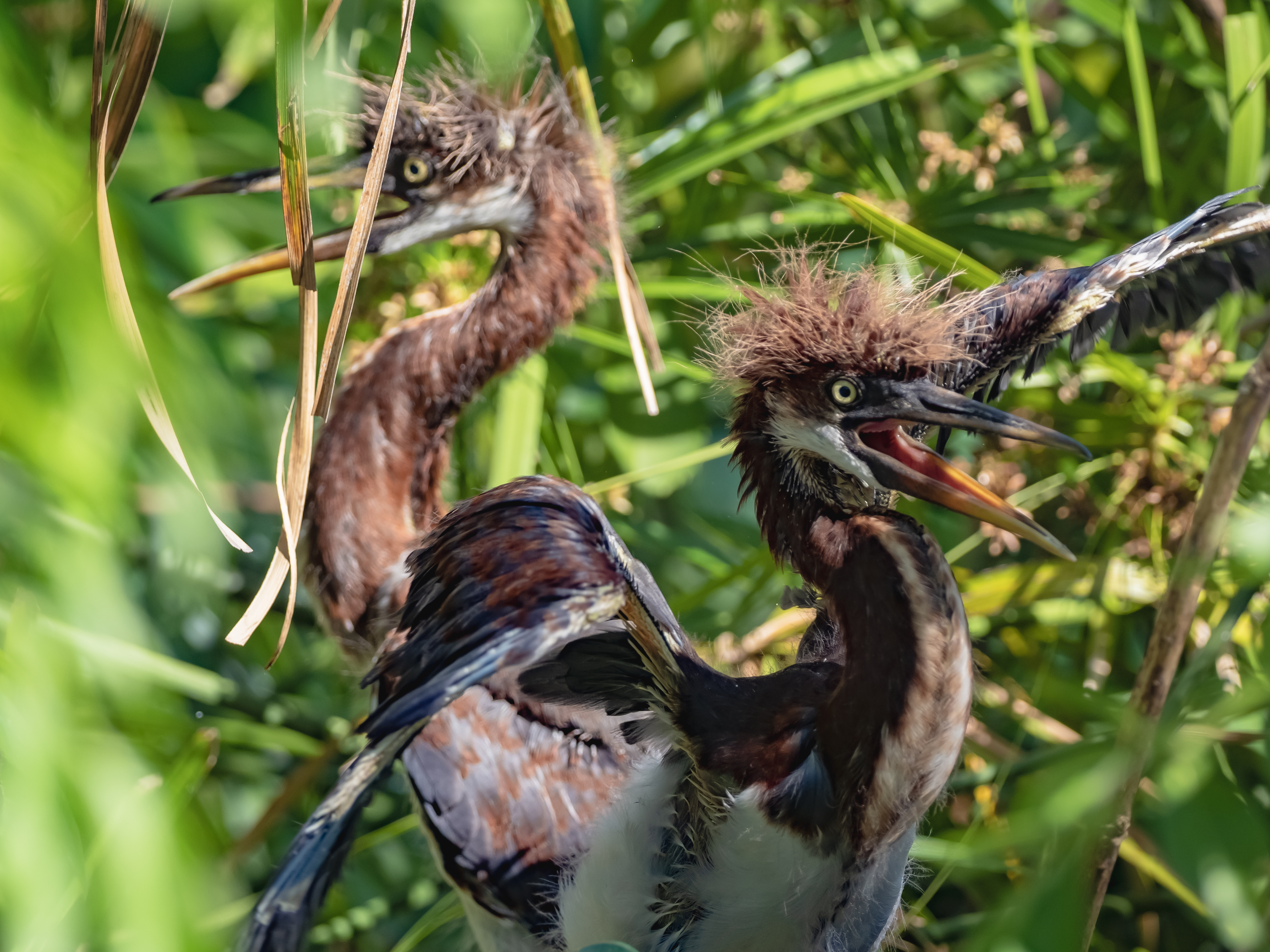
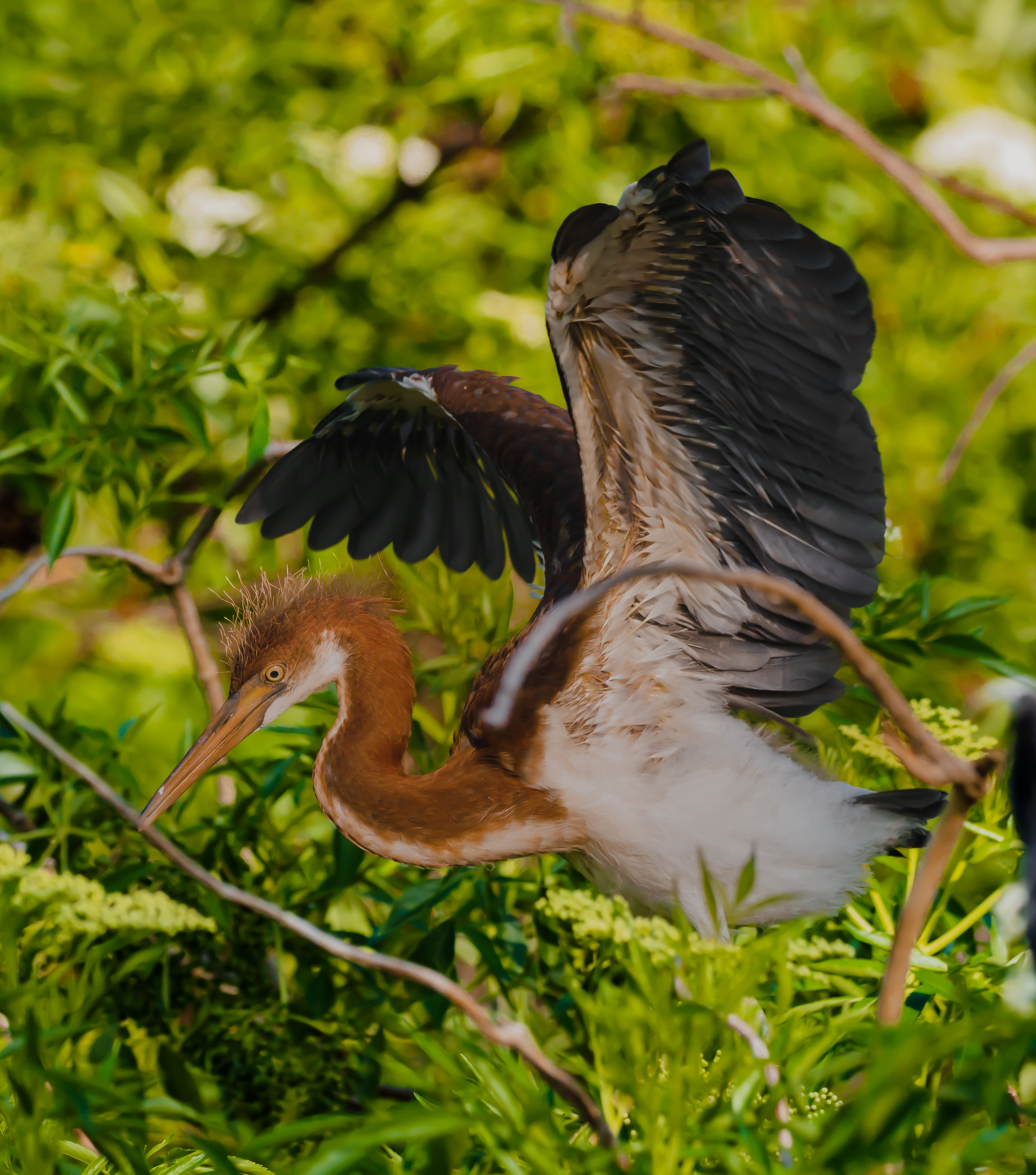
But I did meet another photographer (from Jersey) while we were both intent on capturing a couple of baby tricolored herons.
“Did you see that Arthur Morris is here?” He was pretty excited. “I got my picture taken with him, right by his tripod!” (whose crowning glory was the Sony Alpha 1 digital mirrorless camera — “The One,” according to Arthur’s blog).
“Yeah, I saw him, but he doesn’t like me much,” I replied.
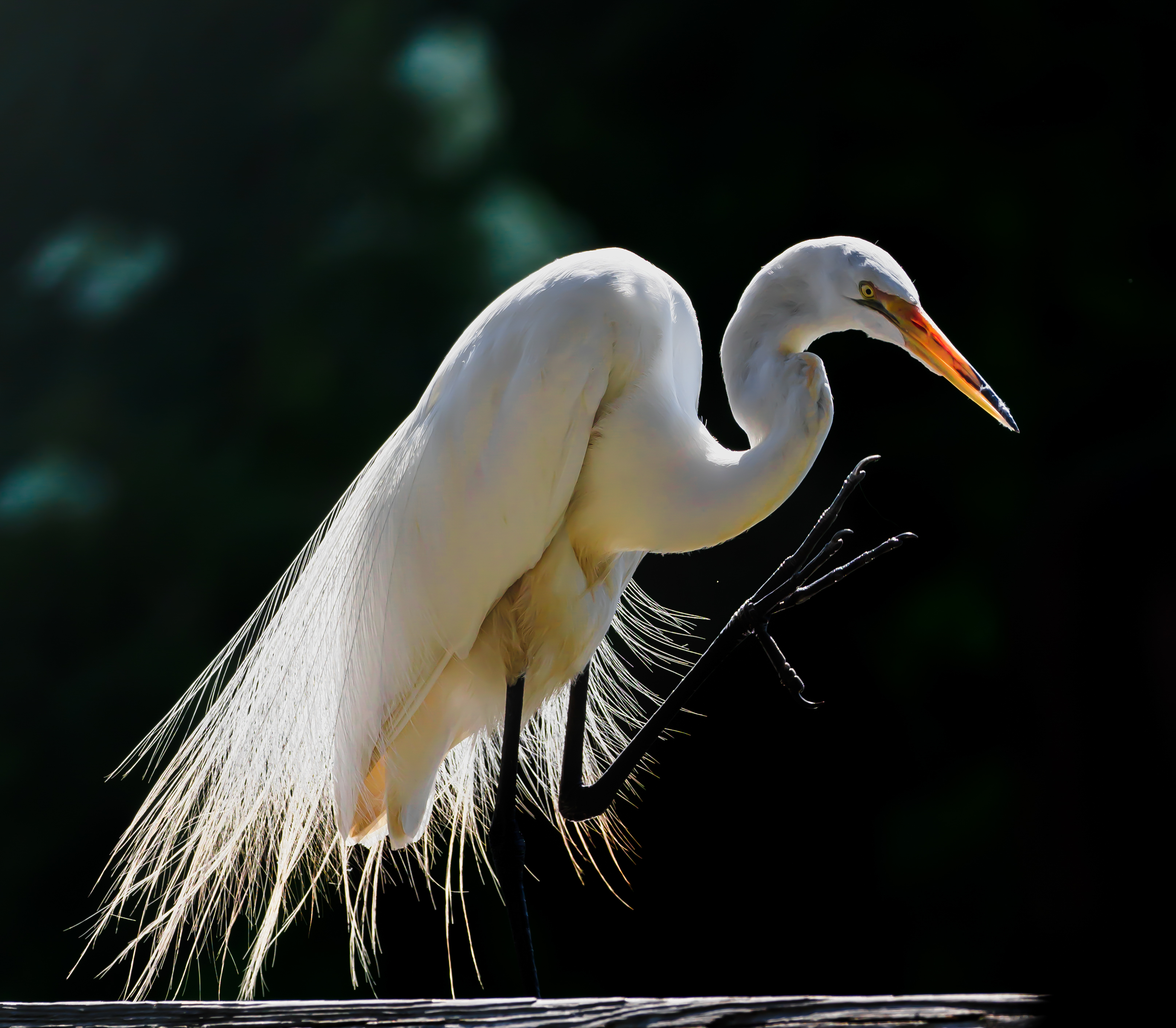 “Why, did you buy the wrong camera?” my new friend joked.
I had to laugh. “No, I bought the wrong expert.” (Andy uses an older Nikon that doesn’t even have IBIS —
— but with which he produces award-winning images IN-CAMERA that I would favor over Arthur’s nice and sharp but very photoshopped versions any day of the week!)
And if you don’t believe me about the award-winning photos produced in-camera, just look here:
https://www.facebook.com/AndyNguyen600
or here: https://www.flickr.com/photos/flightshots
Where you will see images like this:
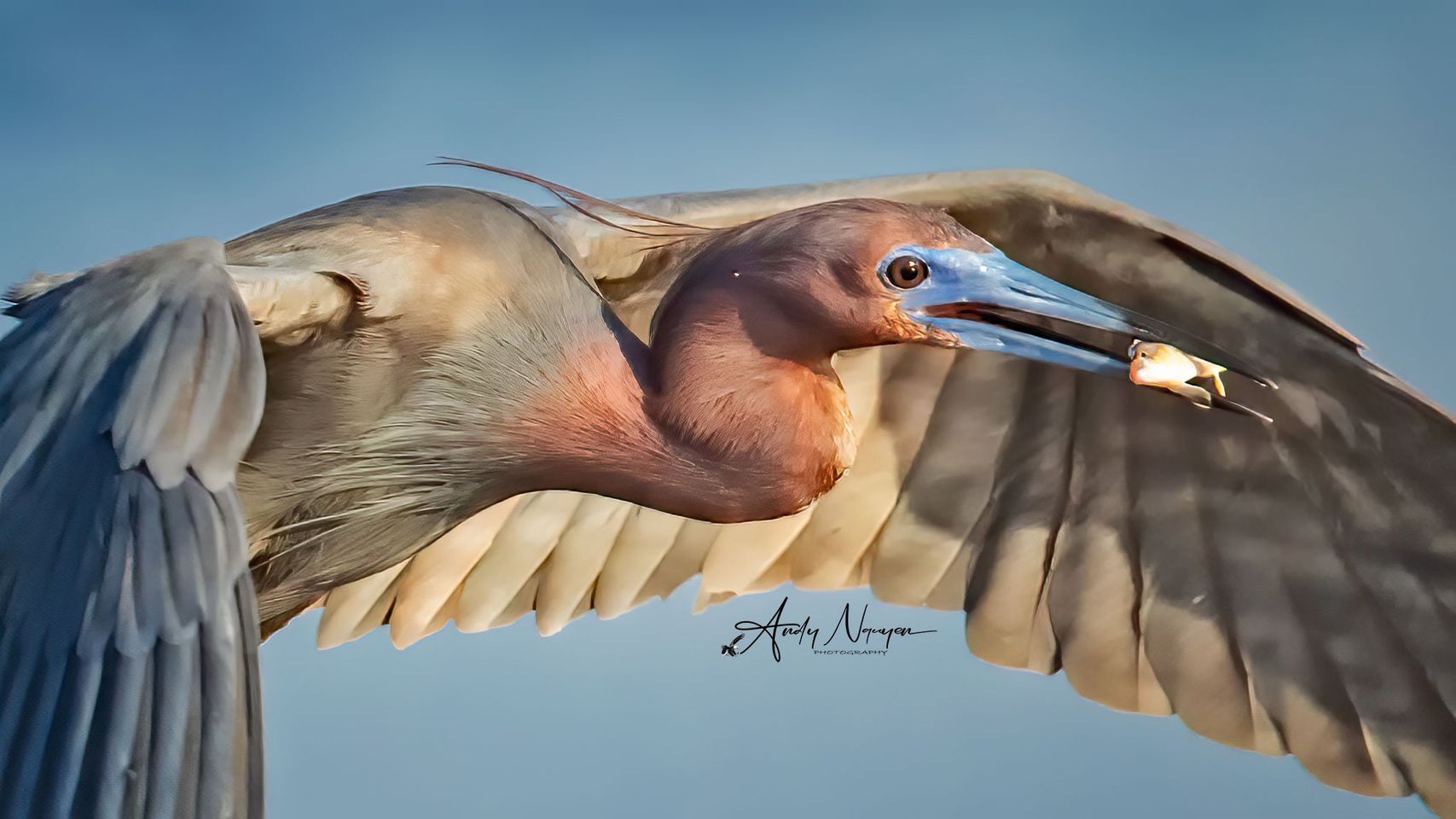
and don’t forget this! coming up this fall:
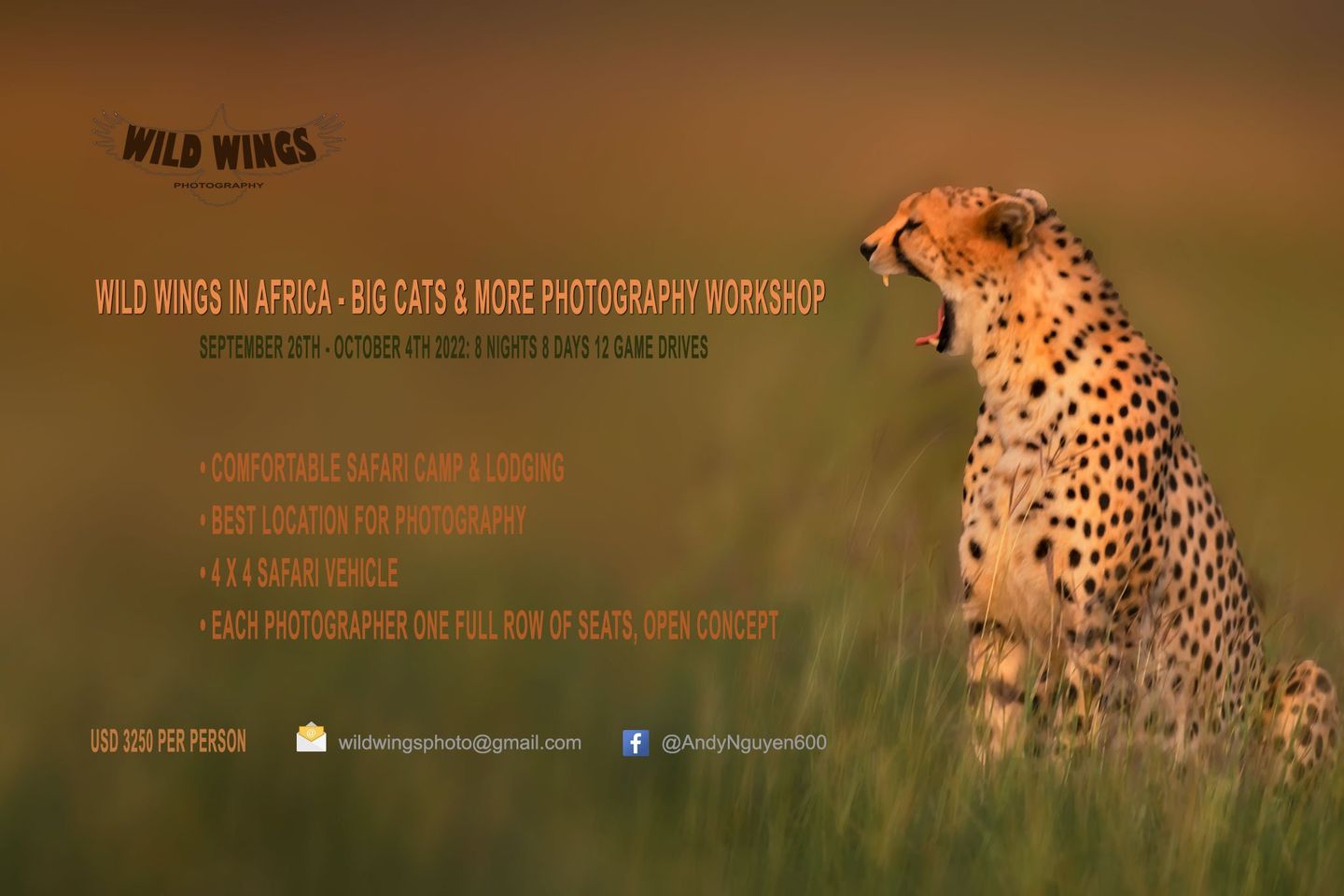
Hoping to attend every single photo trip that Andy sponsors! but I have some health issues to take care of first, not the least of which is getting rid of whatever-it-is I caught in the plane.
But I digress.
Wild Wings Florida 2022 ended with me totally convinced I should move there. . .until I remembered that the cockroaches are this big <<holding hands out wide>>
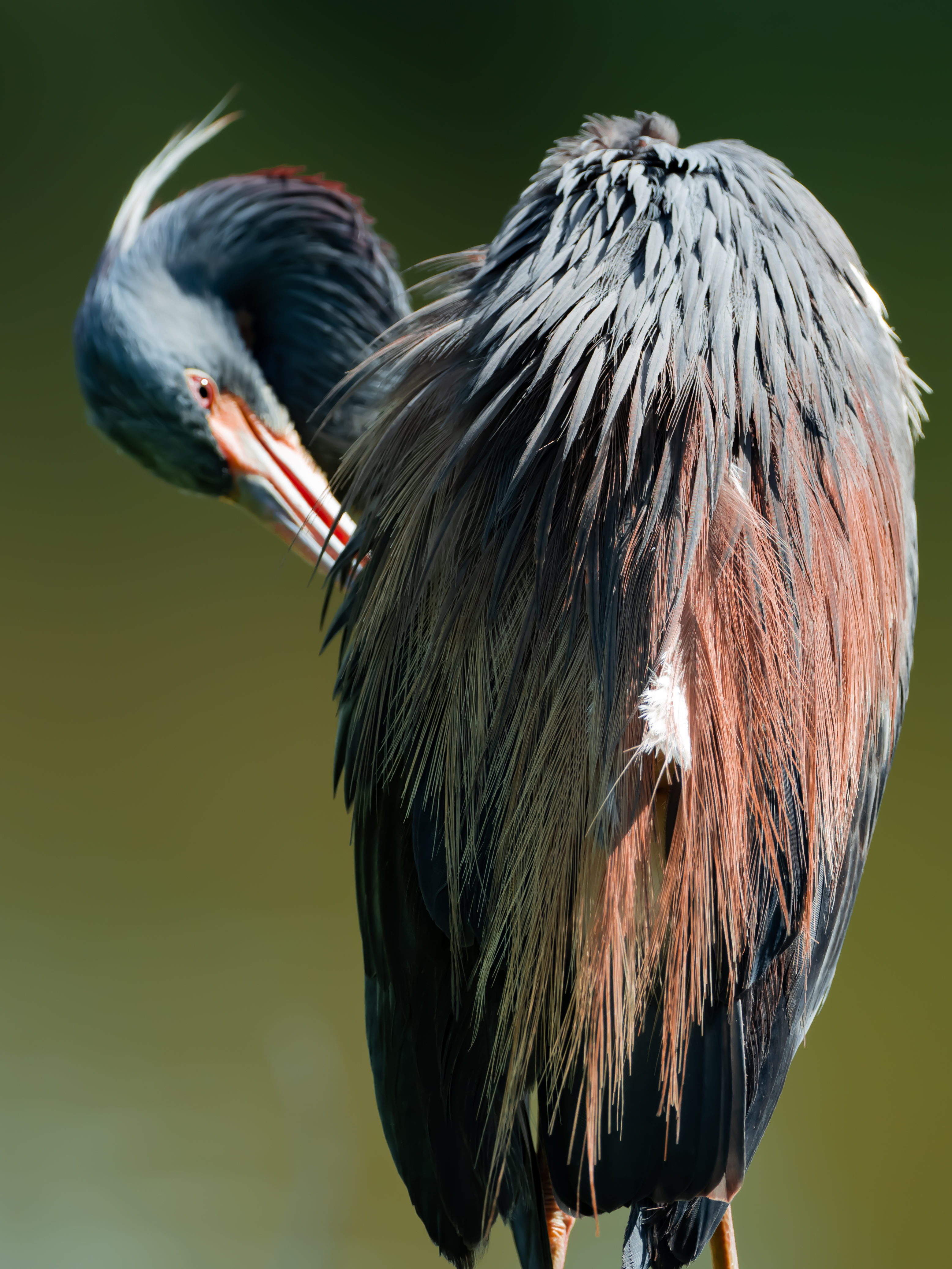
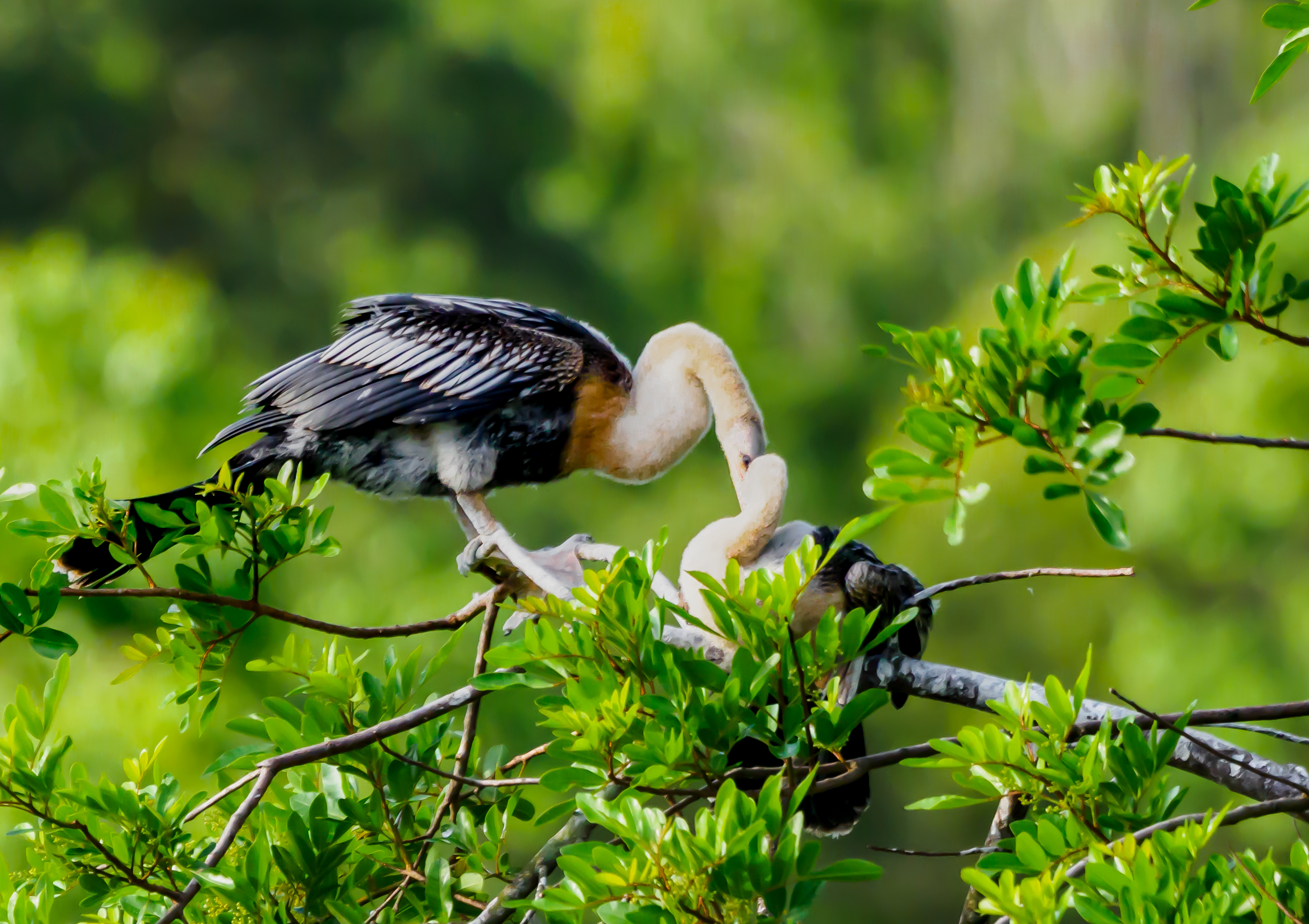
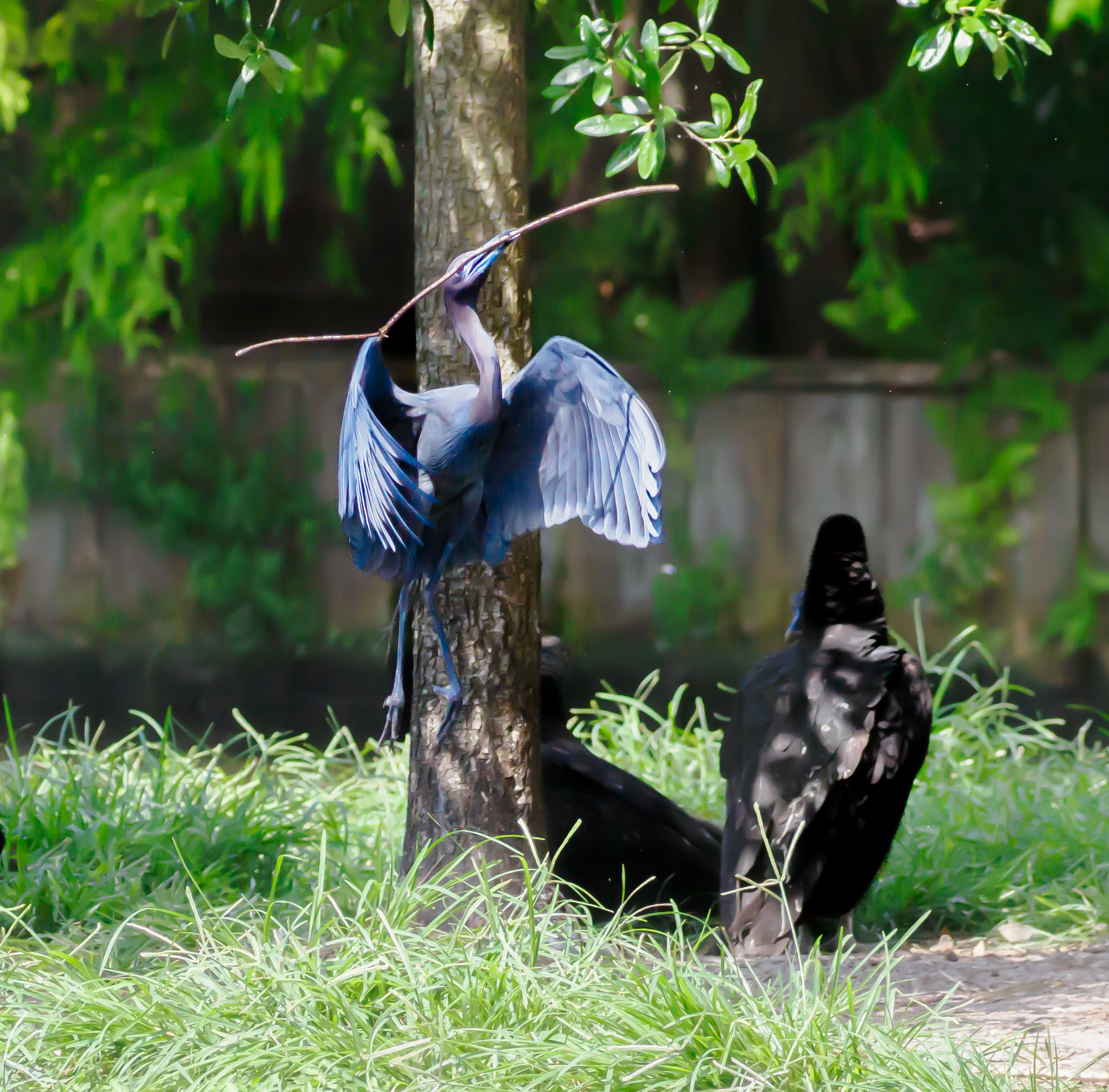
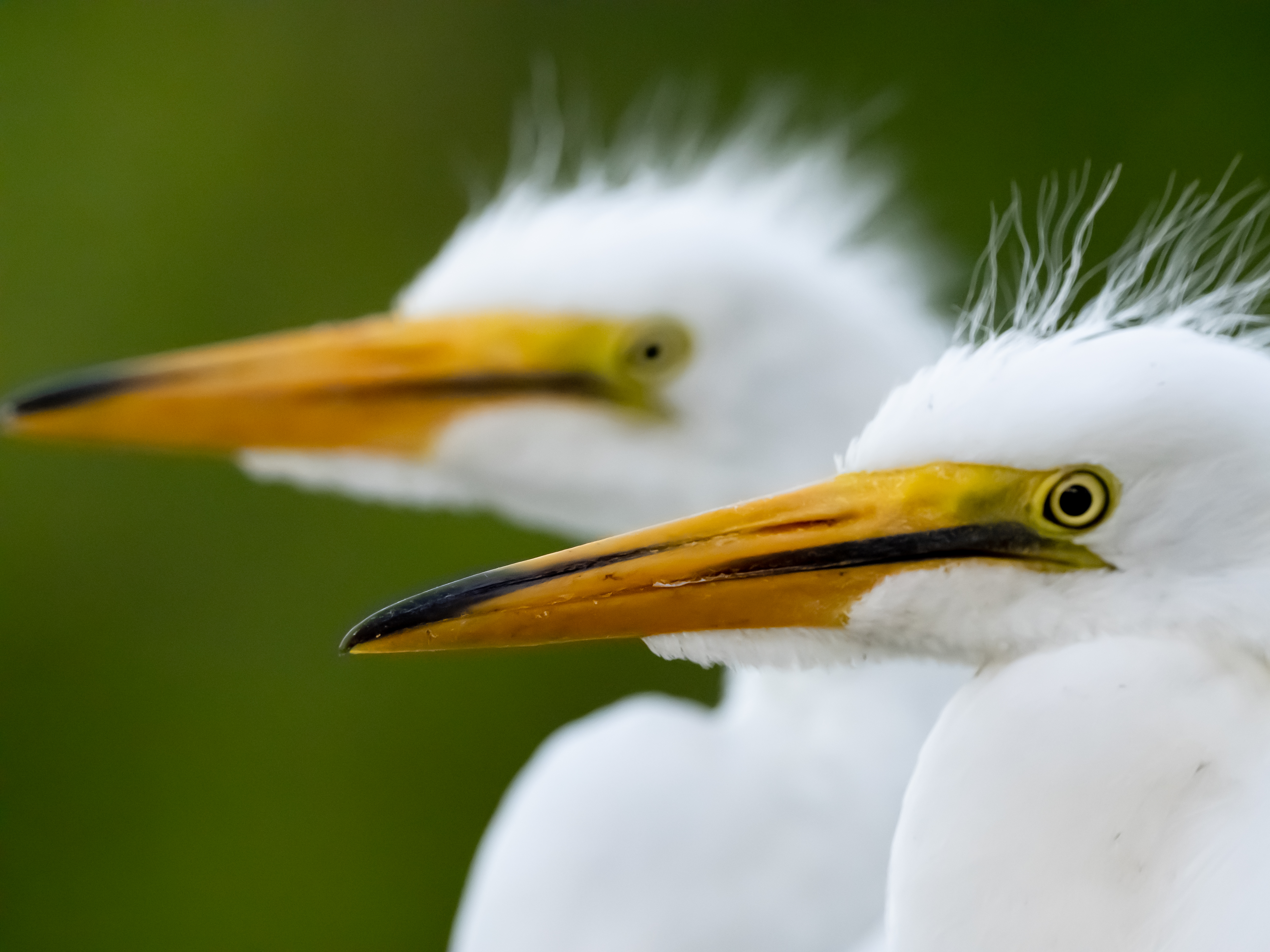
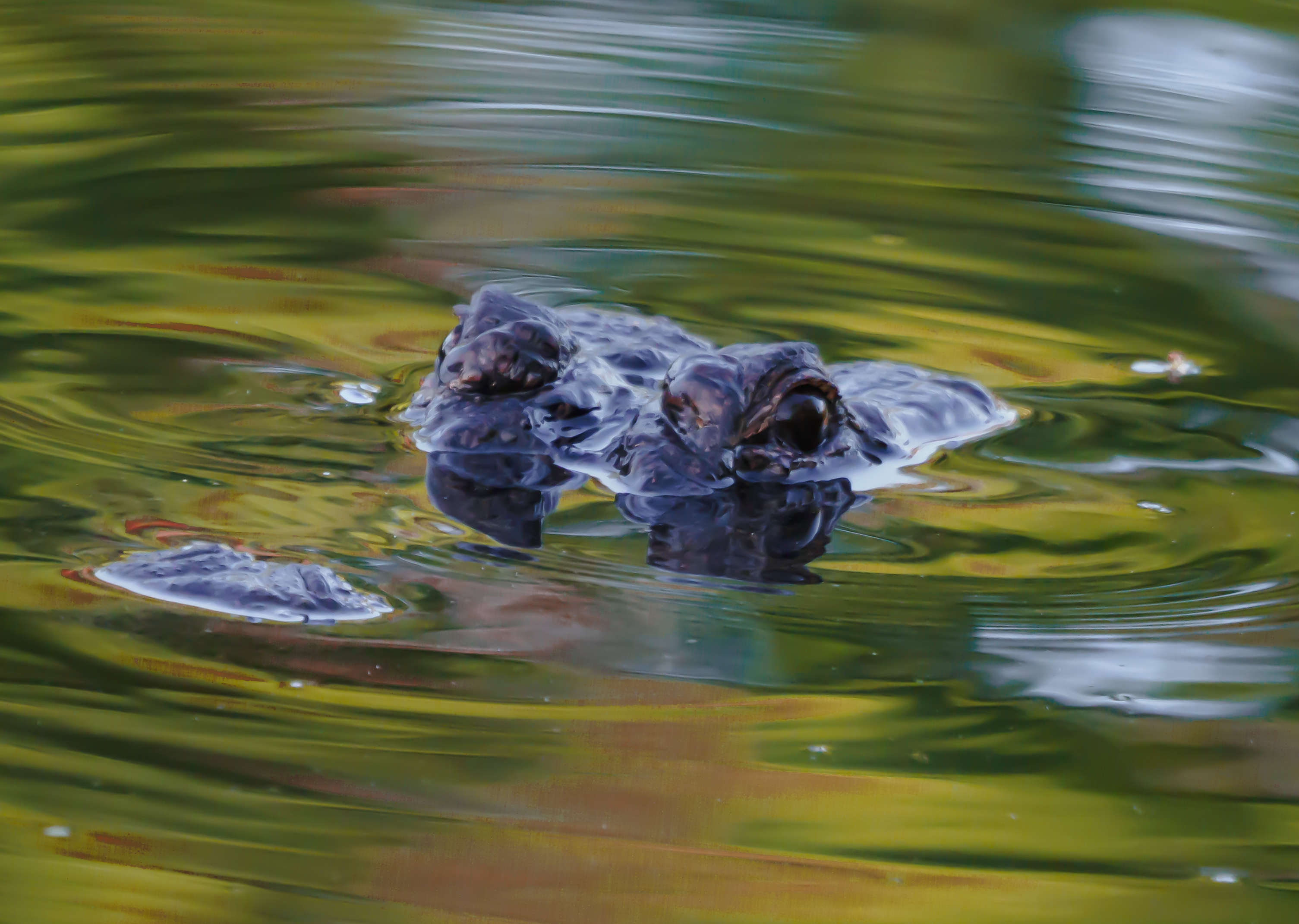
Here are some more shots, some good and some not-so-good, that I took on that wonderful Last Day of Wild Wings Florida 2022:
+ about me, Andy Nguyen, Birds, Crane, Ducks, Fish, heron, mirrorless, Montezuma, osprey, Uncategorized, Wild Wings Photography
Wild Wings Day 5: The Star
by Susan
Today was SuperSaturday, so by definition The Star of the Day would be a SuperStar.
And it was!
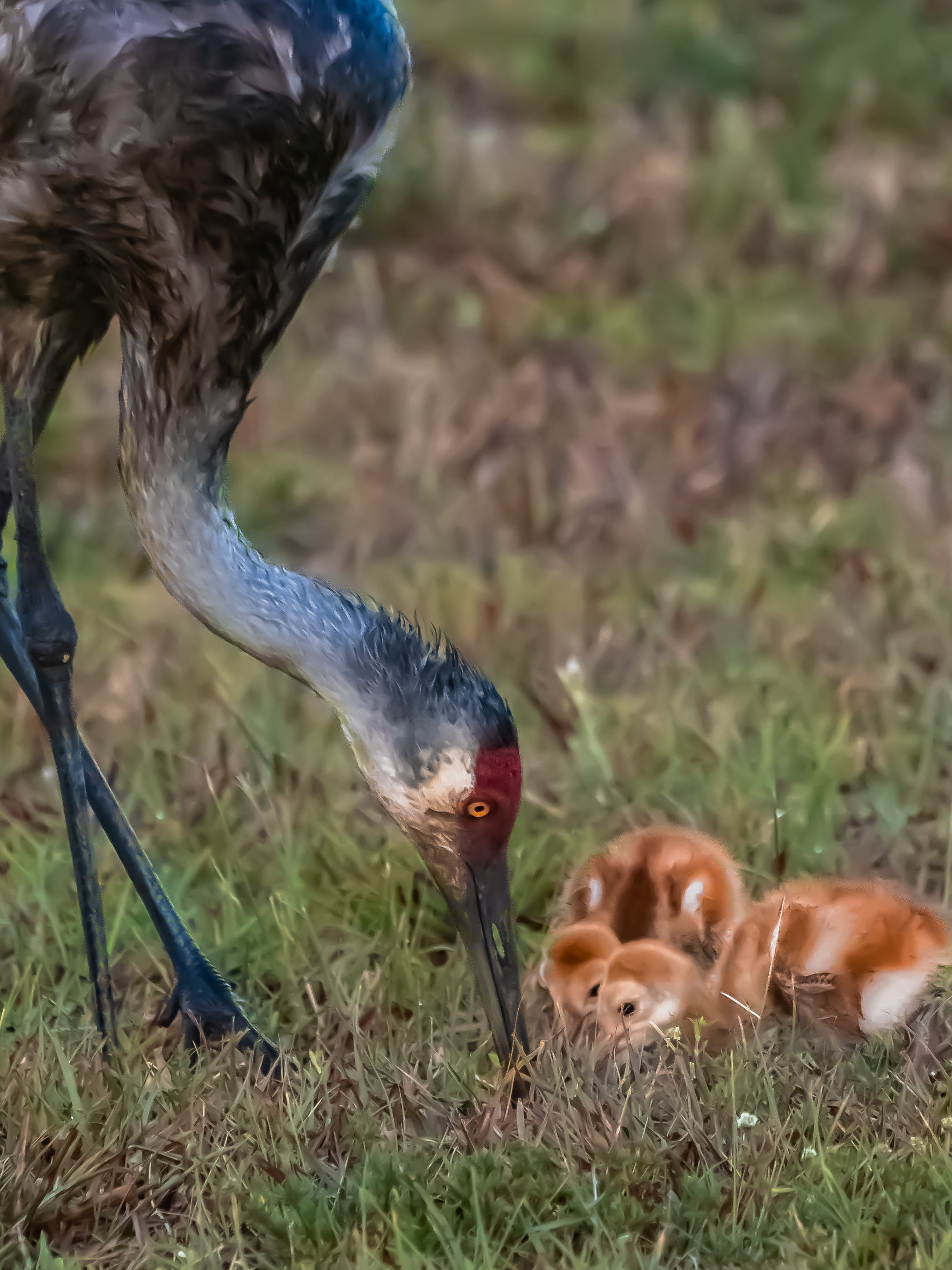 No doubt about it, it was babies!
Babies clearly were the Number One SuperStar of the Day!
Our morning outing was delayed by thunderstorms, severe enough to prompt lightning warnings.
But once they cleared we were off, looking for SuperStar candidates.
It didn’t take long to find one — in fact, we found it during an impromptu roadside stop when we saw a sandhill crane family feeding near a small pond.
And we didn’t just find one; we found two of them — in the delightful form of two fuzzy little sandhill crane colts.
They were a little wet but undetered by the thunder receding in the distance.
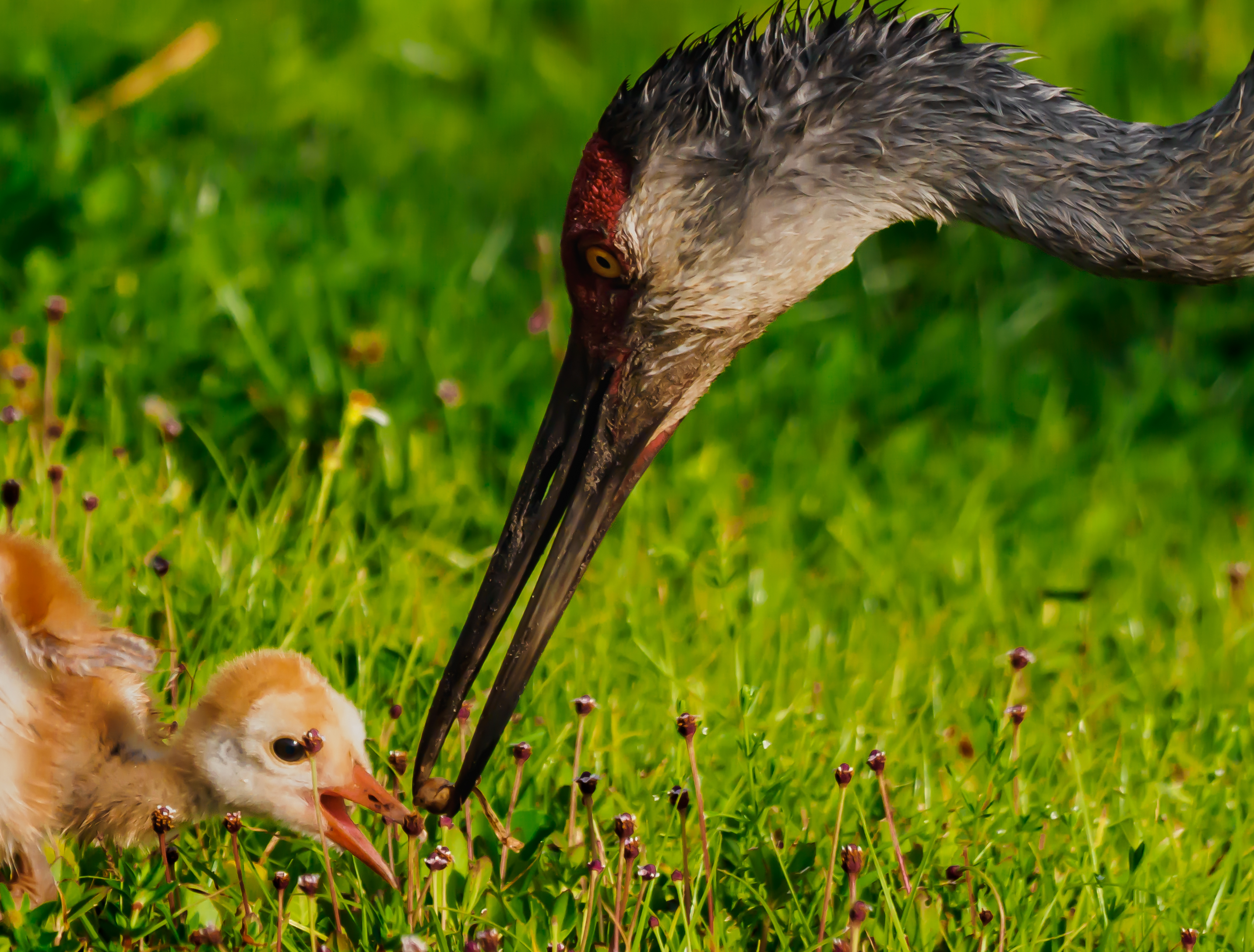 We have a few sandhill cranes up here in western New York, most reliably found at the Montezuma National Wildlife Refuge, but they tend to wander just out of telephoto range.
Plus, they have a rather frustrating habit of feeding on the bad-light side of Wildlife Drive.
Not so with this sandhill crane family. They allowed us to approach to a close but respectful distance, which permitted some great captures.
Andy says that in Florida the cranes can have two, possibly three broods in the season.
Amazing!
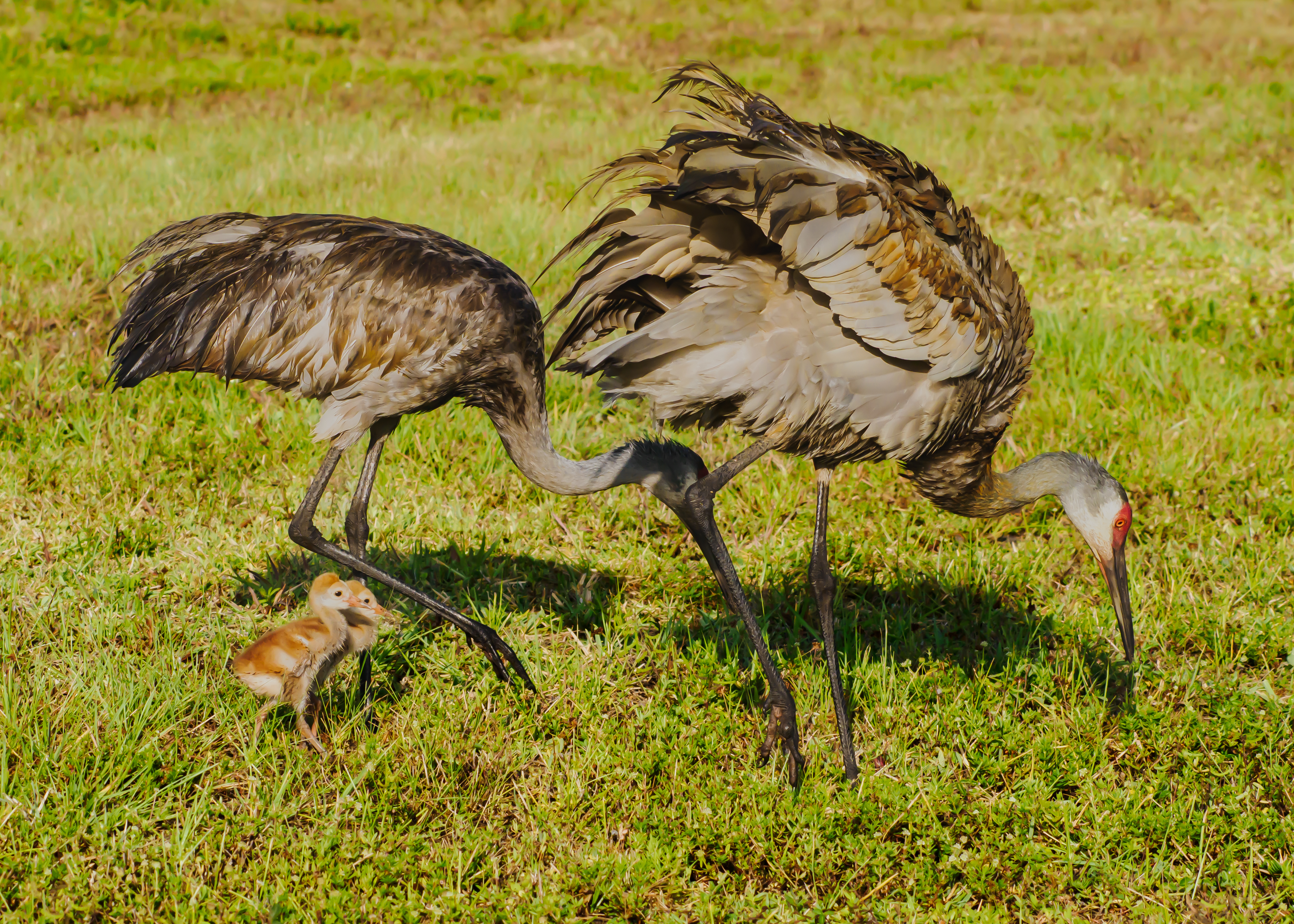 Leaving the cranes was hard, but Andy had another place for us to explore.
This was at a freshwater national wildlife refuge with a Wildlife Drive at least three times the length of the one at Montezuma, and it didn’t disappoint.
There were no signs warning us to stay in the car lest we disturb the wildlife.
And there was no marsh drainage or other attempts to “simulate drought” in order to grow duck food.
(For the uninitiated, see Montezuma National Waterfowl Refuge here on this site.)
 Apparently this refuge doesn’t really care about hunters or duck stamp dollars.
And Ducks Unlimited, Inc. is not on their list of financial partners.
They manage very well without them.
Yay!
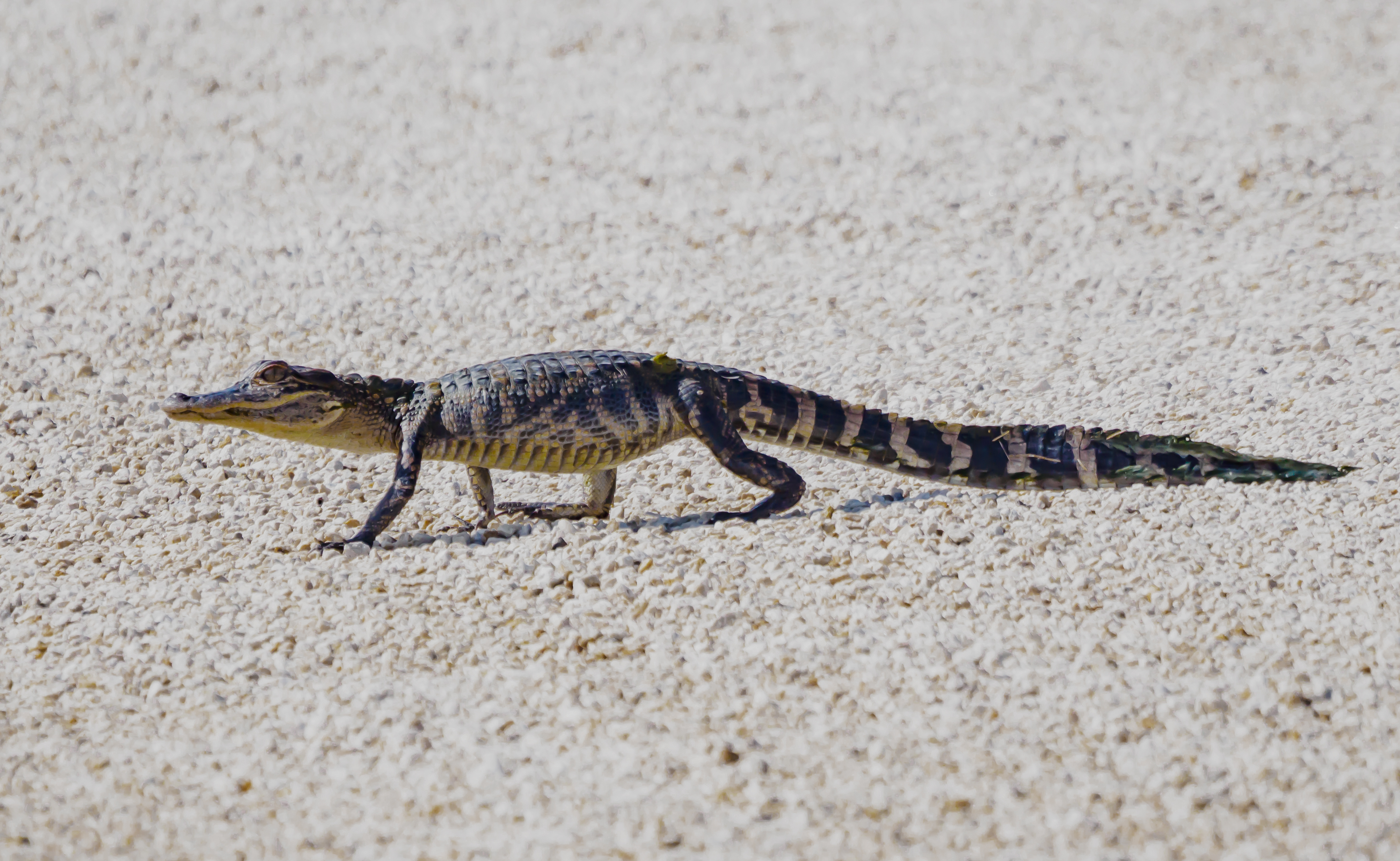
The very first animal we saw was an alligator!
I think Andy rolled his eyes a bit while I snapped away, but by this time he was getting used to my alligator fascination.
This one, he said, was “only a baby,” but it looked huge to me!
 We saw a variety of shorebirds, the identification of which taxes the ability of my tiny brain to remember names.
But we also saw some “easy ones,” like black-necked stilts and killdeer.
It was pretty windy, which disturbed the birds.
And whatever I had caught on the plane was getting worse, which disturbed me.
So, I spent the harsh-light hours resting and eating lunch (two bags of Ricola cough drops).
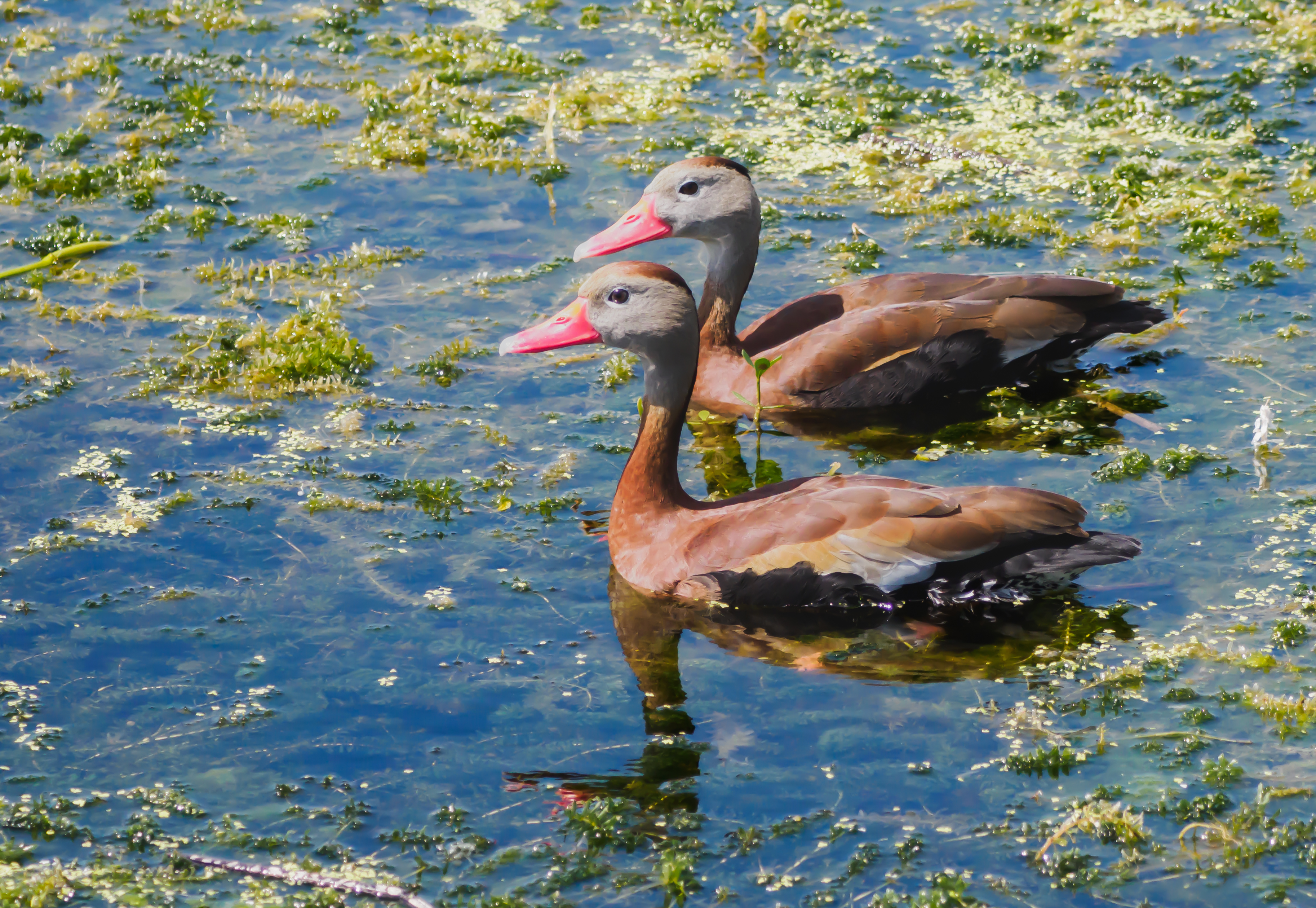 The afternoon excursion was at a walking trail.
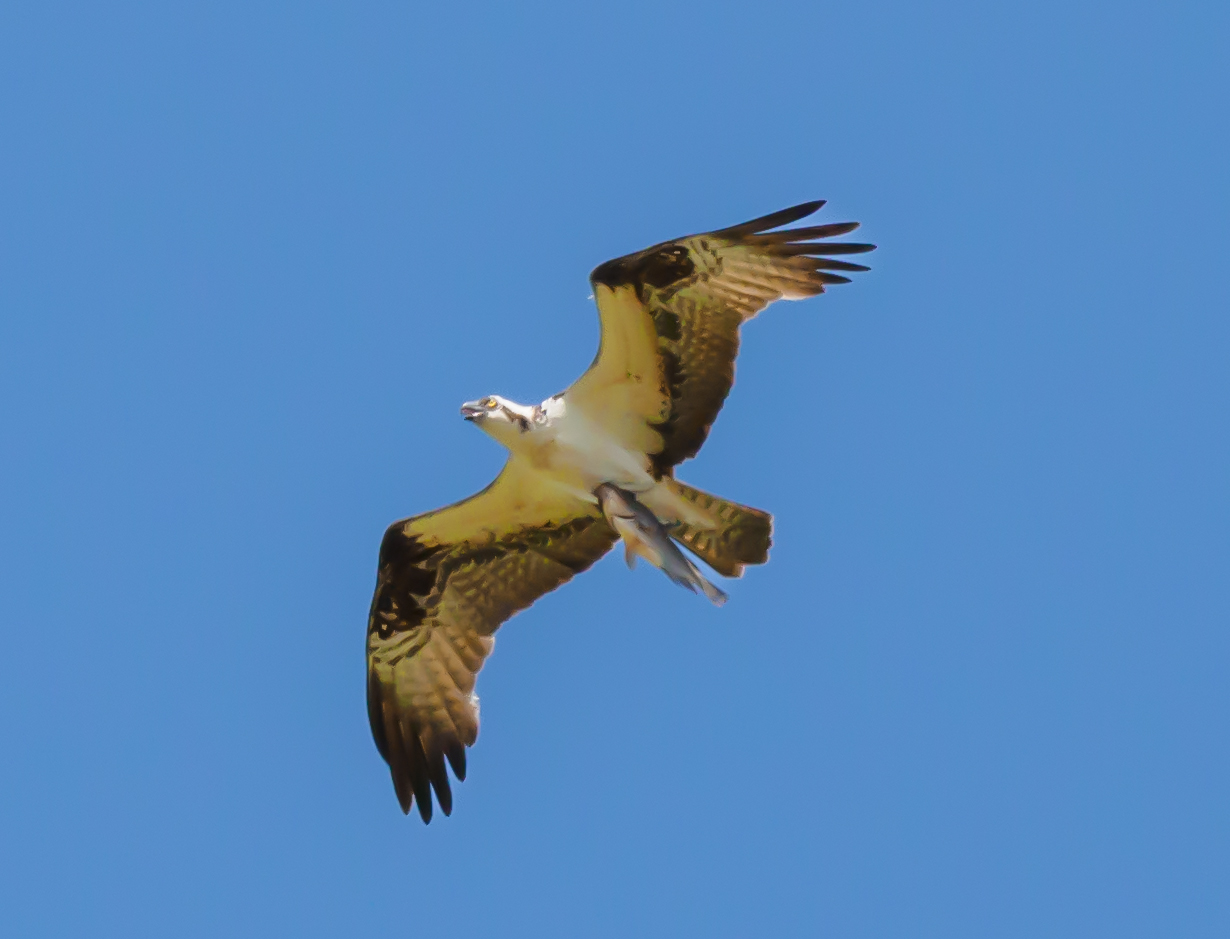
This afforded us glimpses of a variety of wildlife, including whistling ducks (which sound like songbirds!), a delightful green heron staring intensely at nothing, a nesting osprey, and some great blue herons.
Of course, there were alligators, too, mostly of whom stayed far away from us in the water.
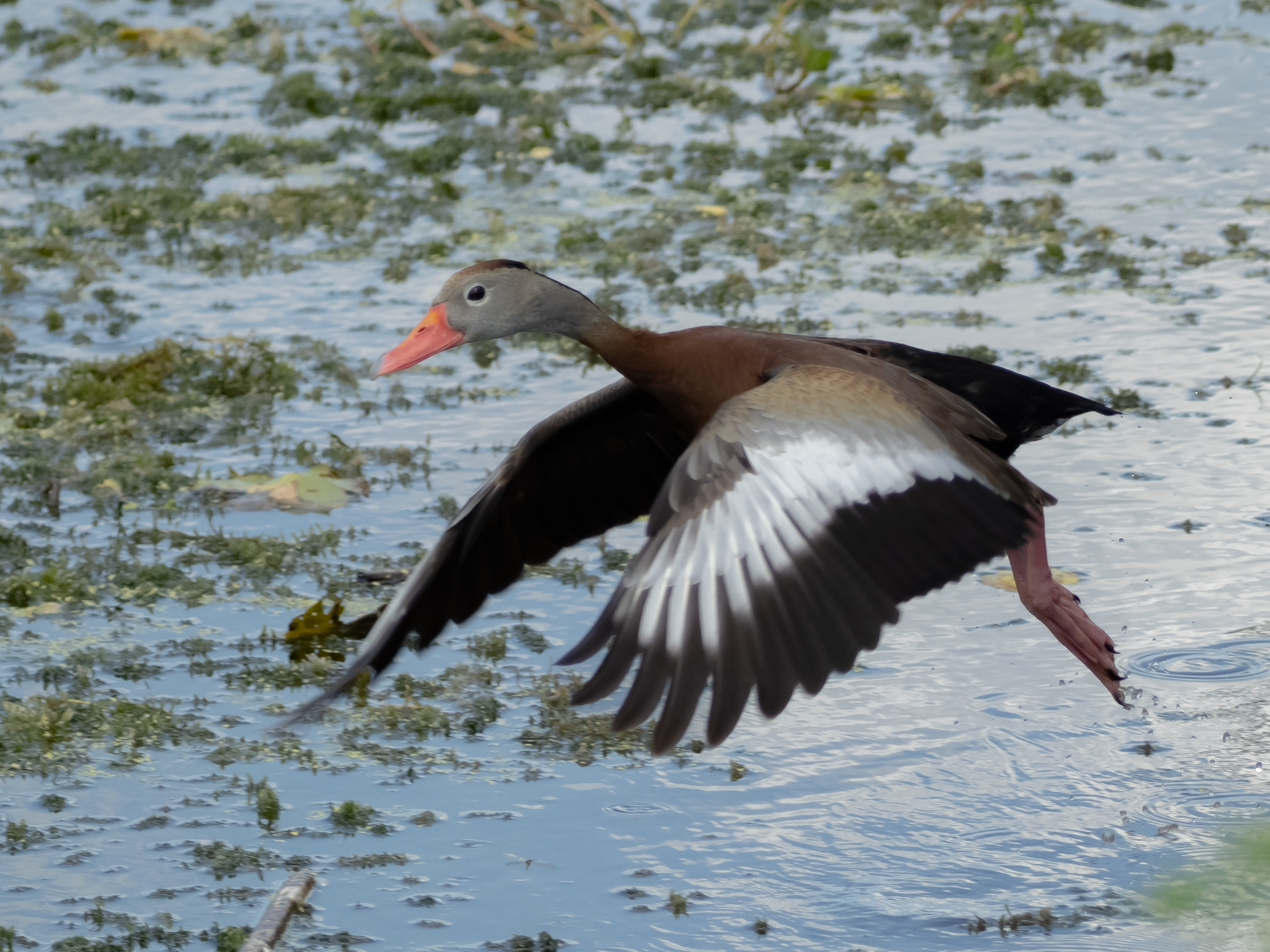 Birds-in-flight was still a challenge but I managed to get a few decent ones.
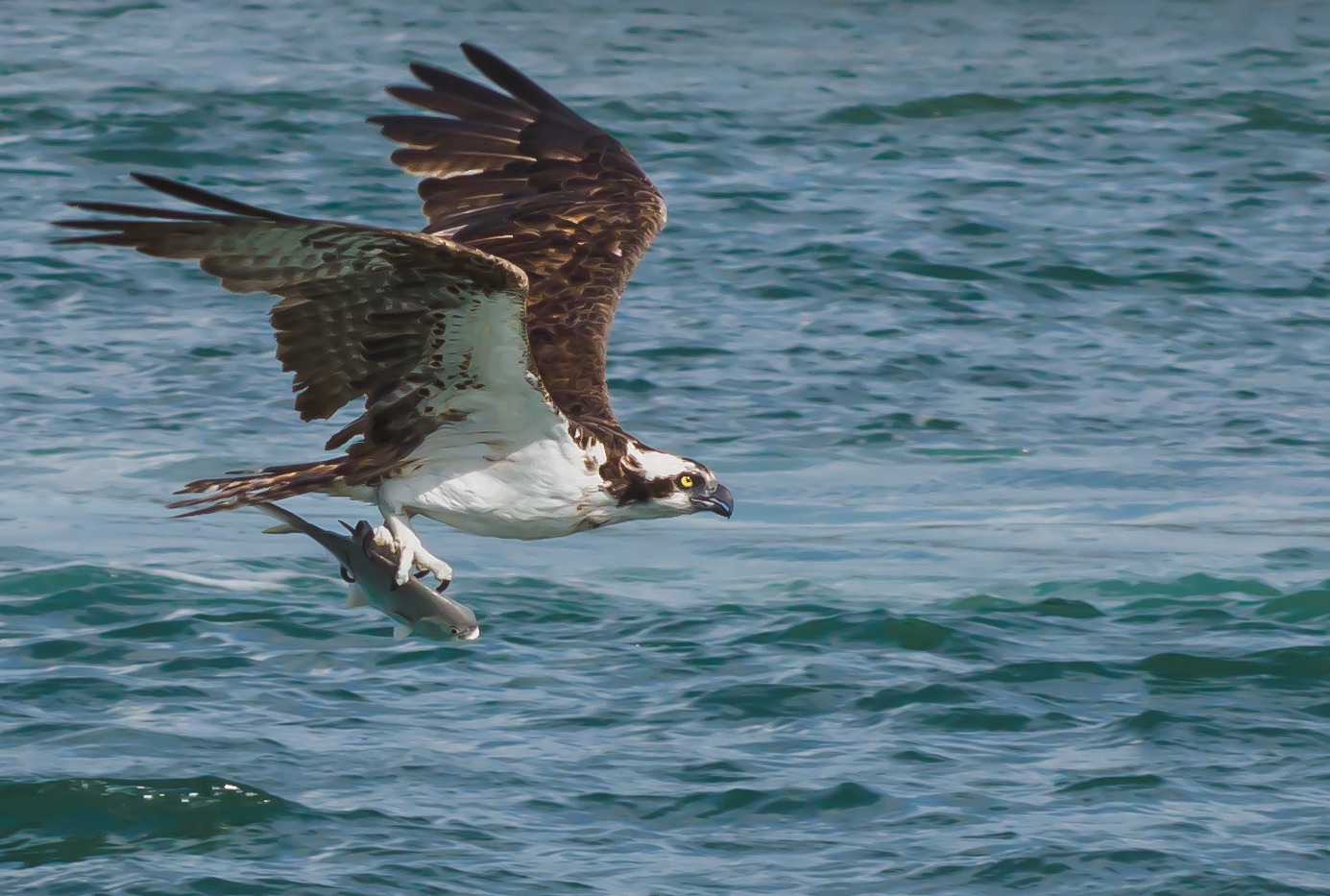
And I got some good stills, including the aforementioned osprey,
a couple of the whistling ducks,
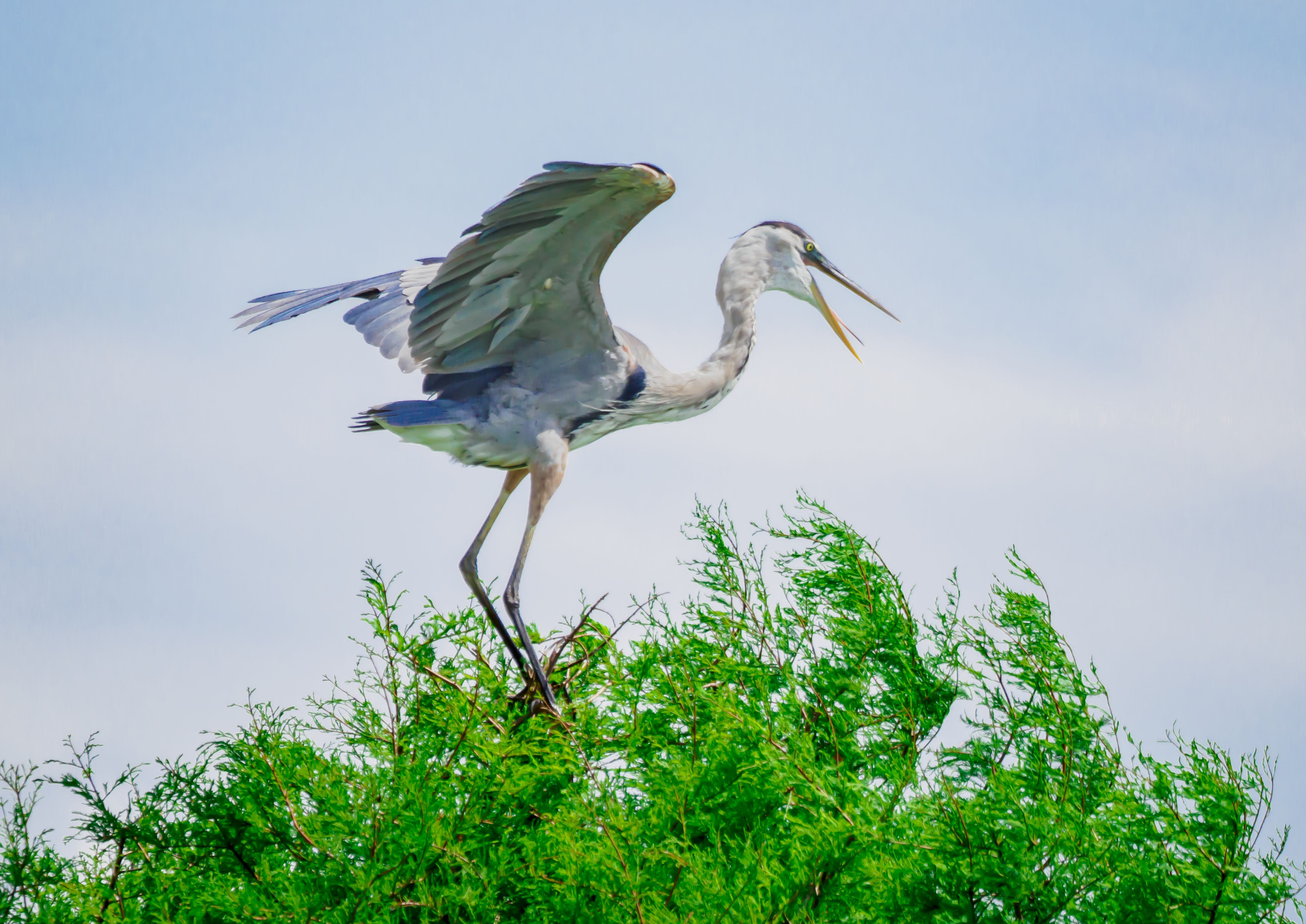
and a great blue heron struggling against the wind to stay safely perched in a tree top.
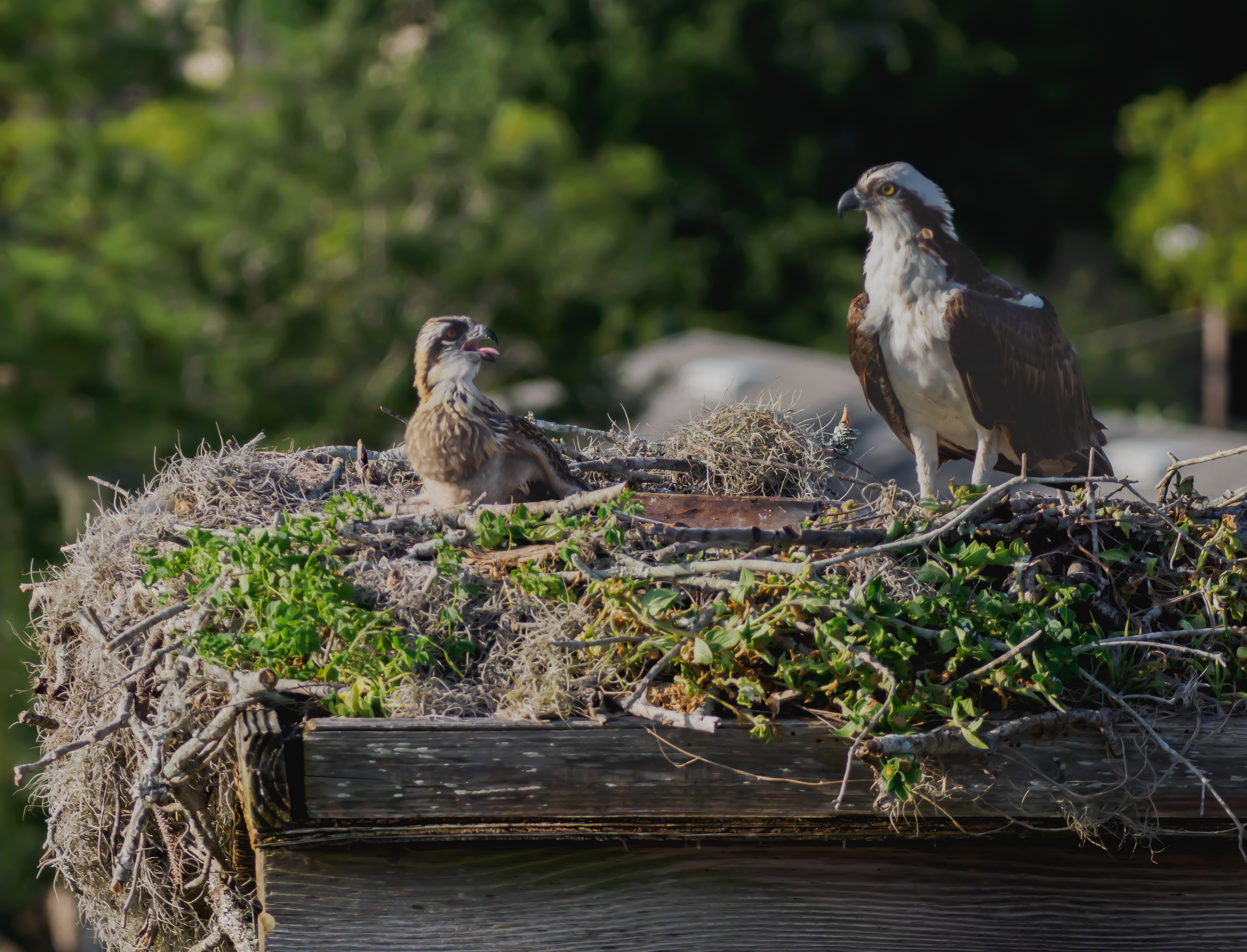
But the best was yet to come! SuperSaturday had a SuperConclusion — eye-level observation of an osprey nest!
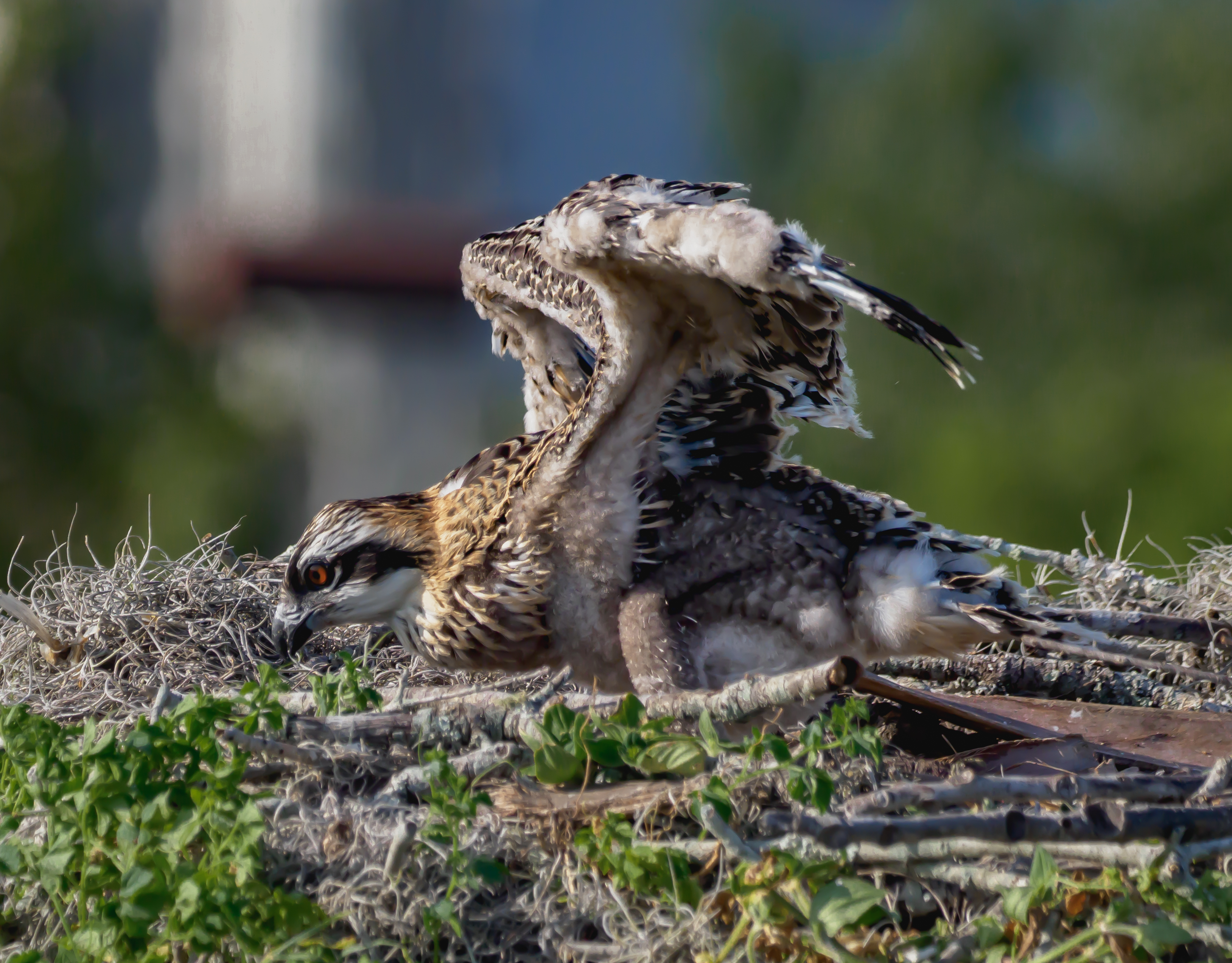 The young resident was quite engaging and joined the crane colts as The Star of the Day.
The light was disappearing fast, so we had to work quickly.
After napping a while, the young man awoke revived and refreshed.
He repeatedly called out to mom to bring him some fish.
He also did a few other things.
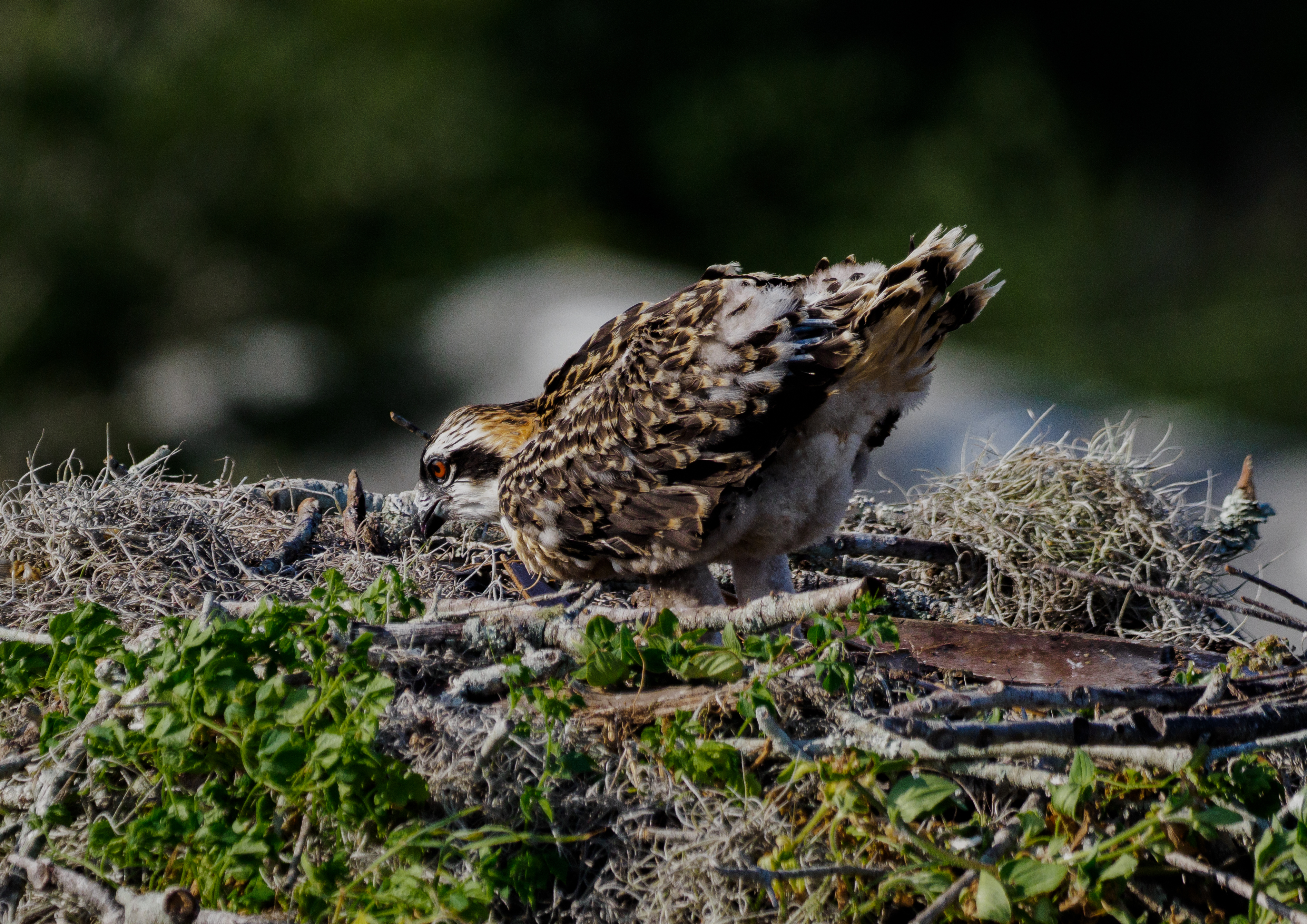 (Whenever you see a bird do this, you know what to expect next, right?)
I’ll spare you the photo of that.
Anyway.
Mom did her best, but no dinner arrived during our period of observation.
Eventually the light faded, and we had to leave.
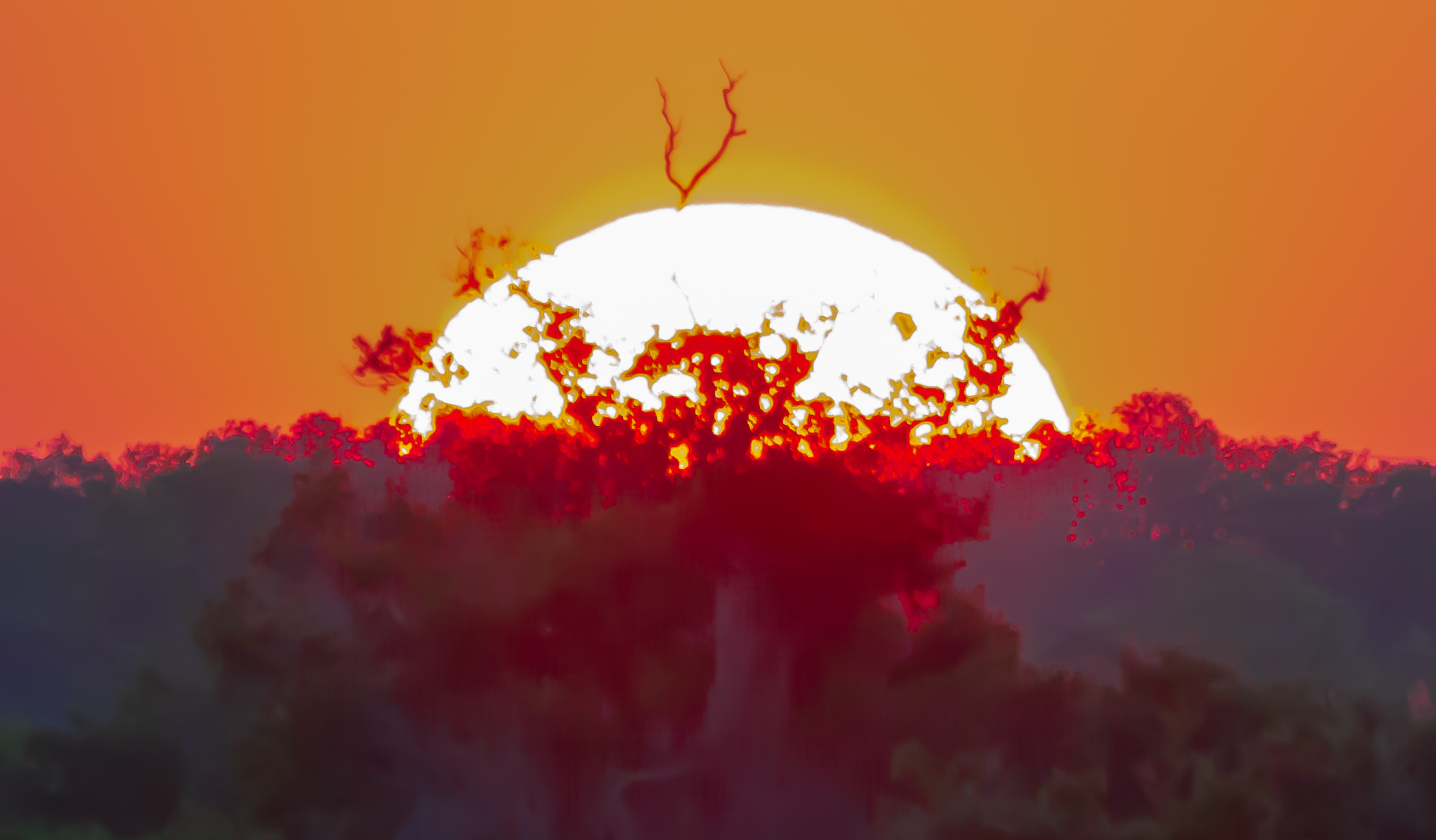 A brilliant end to a very brilliant SuperSaturday.
A few more from SuperSaturday, some good and some not-so-good:
The stilts were elegant:
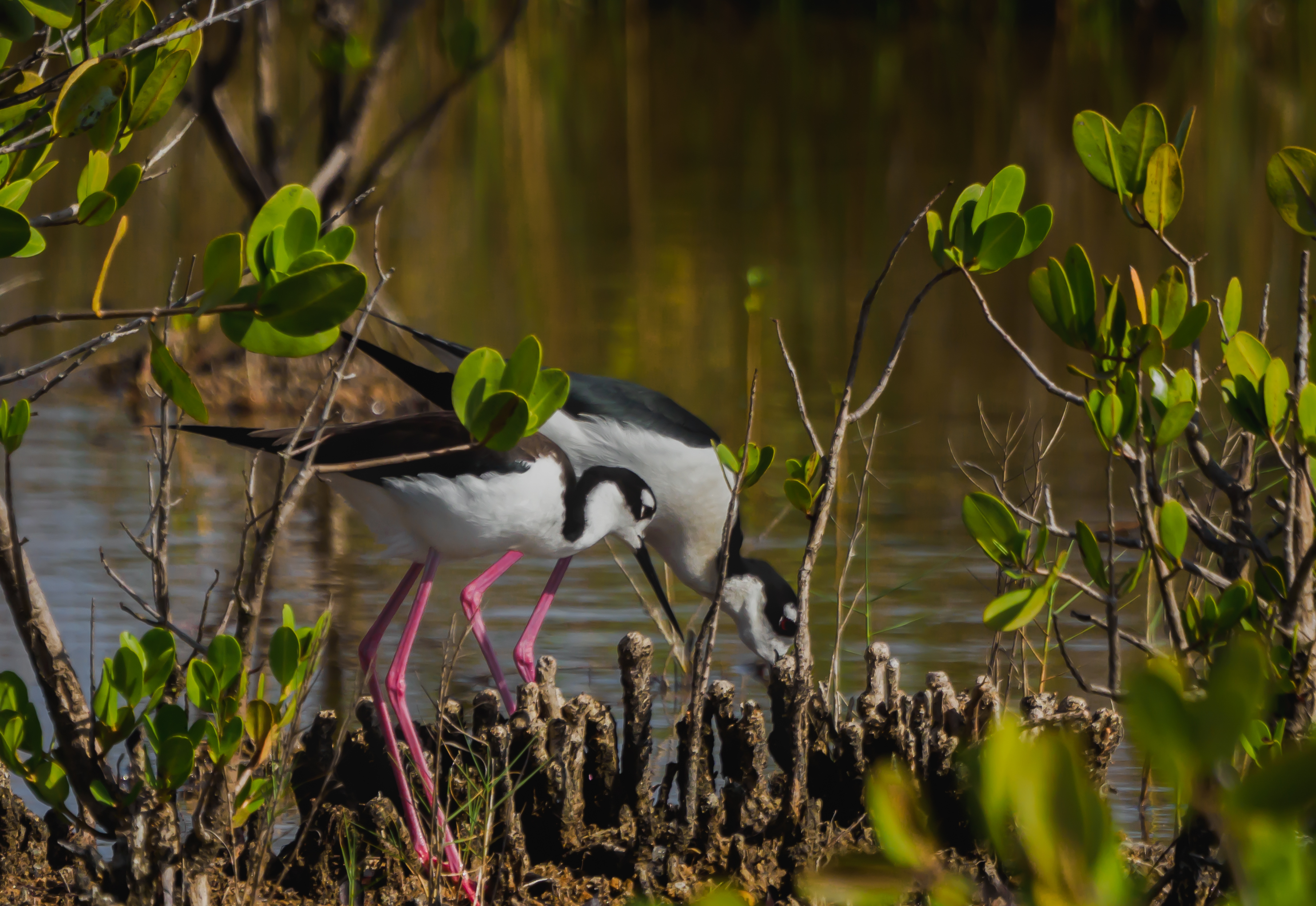
I tried to convince Andy that this was a mini-alligator without eyes, but he was having none of it. 🙂
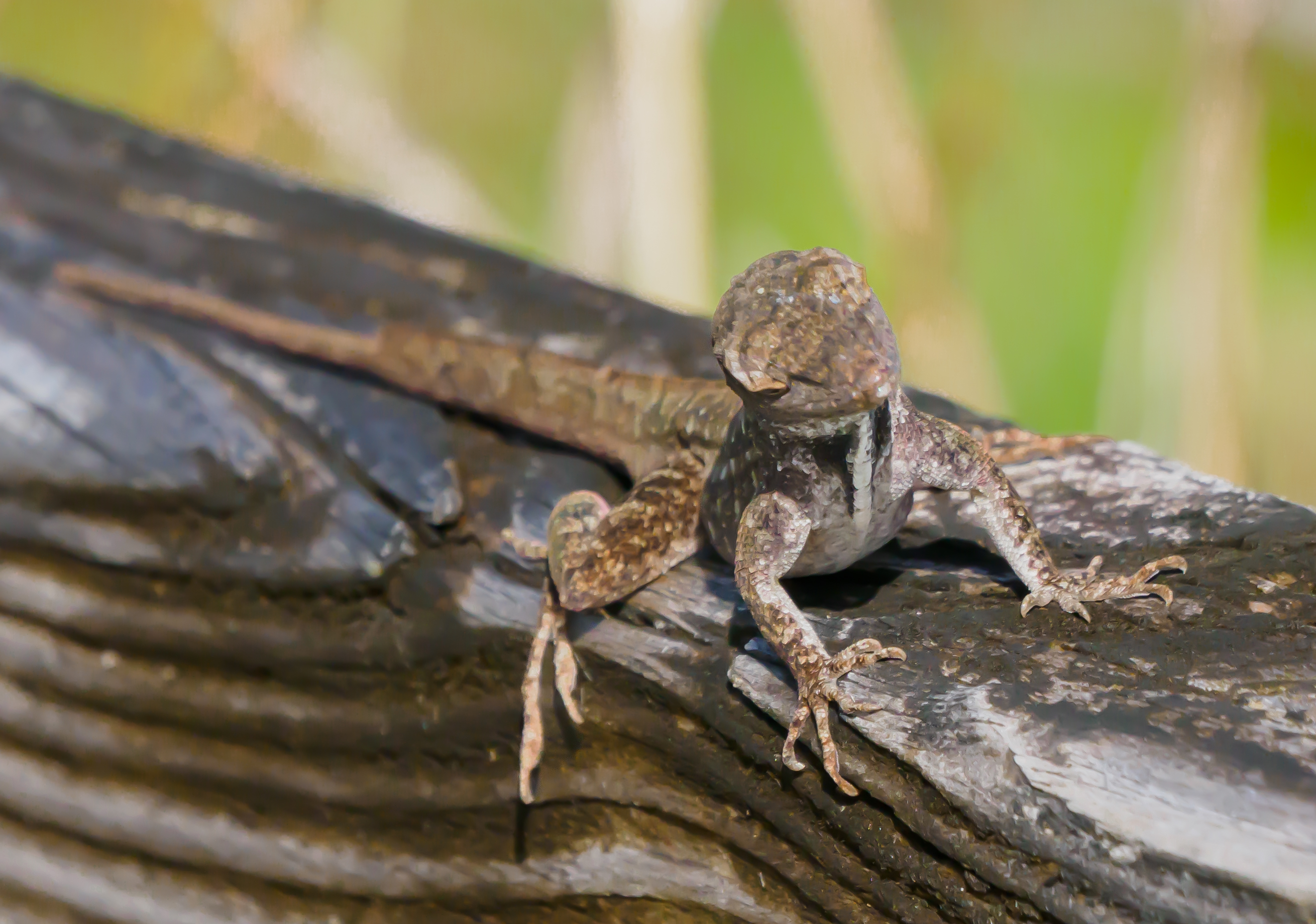
Oh, the cranes and their babies! Just fascinating!
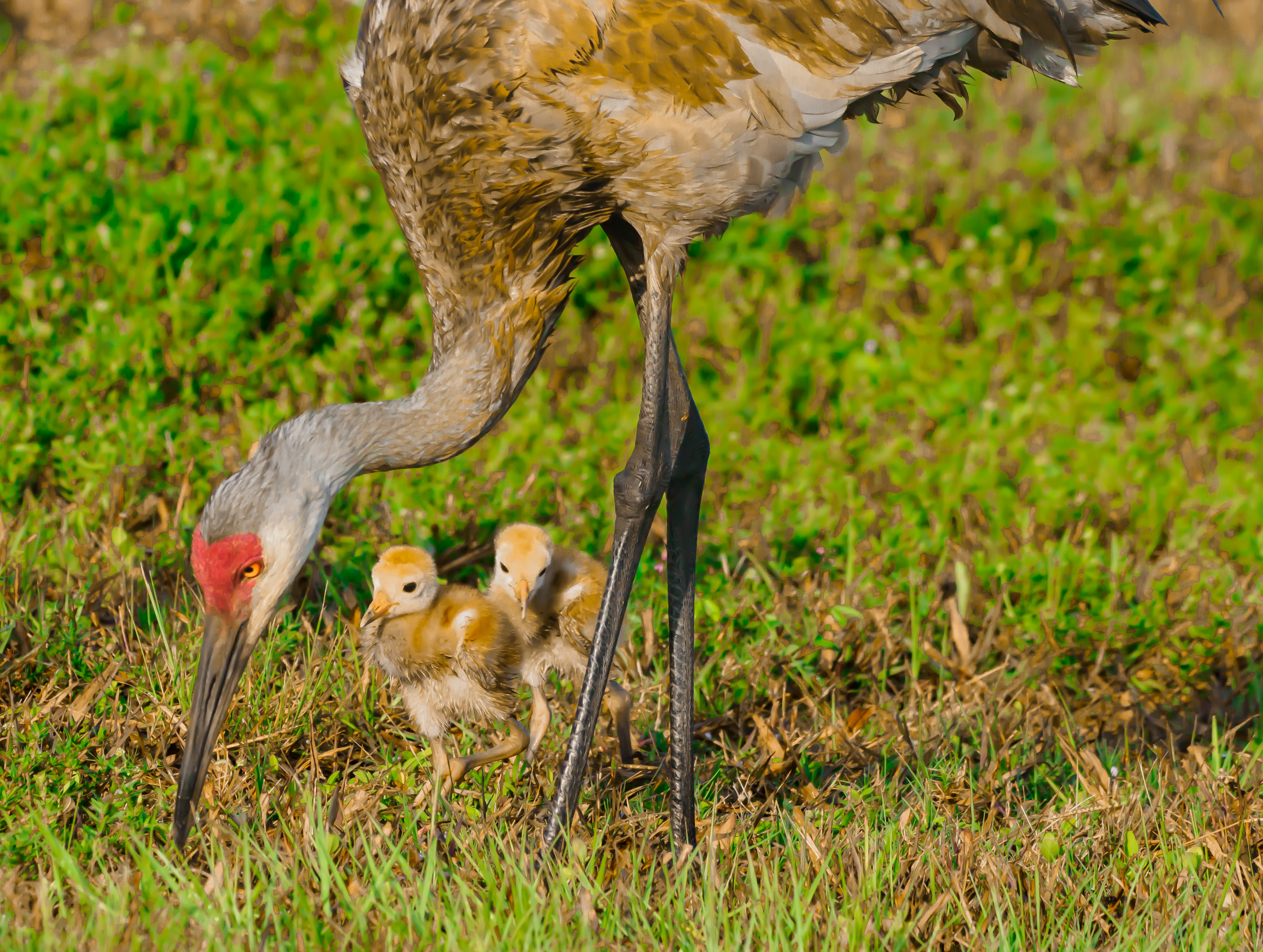
Hey! That’s no way to talk to your mother!
A decent (for me) capture:
Definitely unhappy about the wind but managing a pretty good balancing act, thanks to those wings:
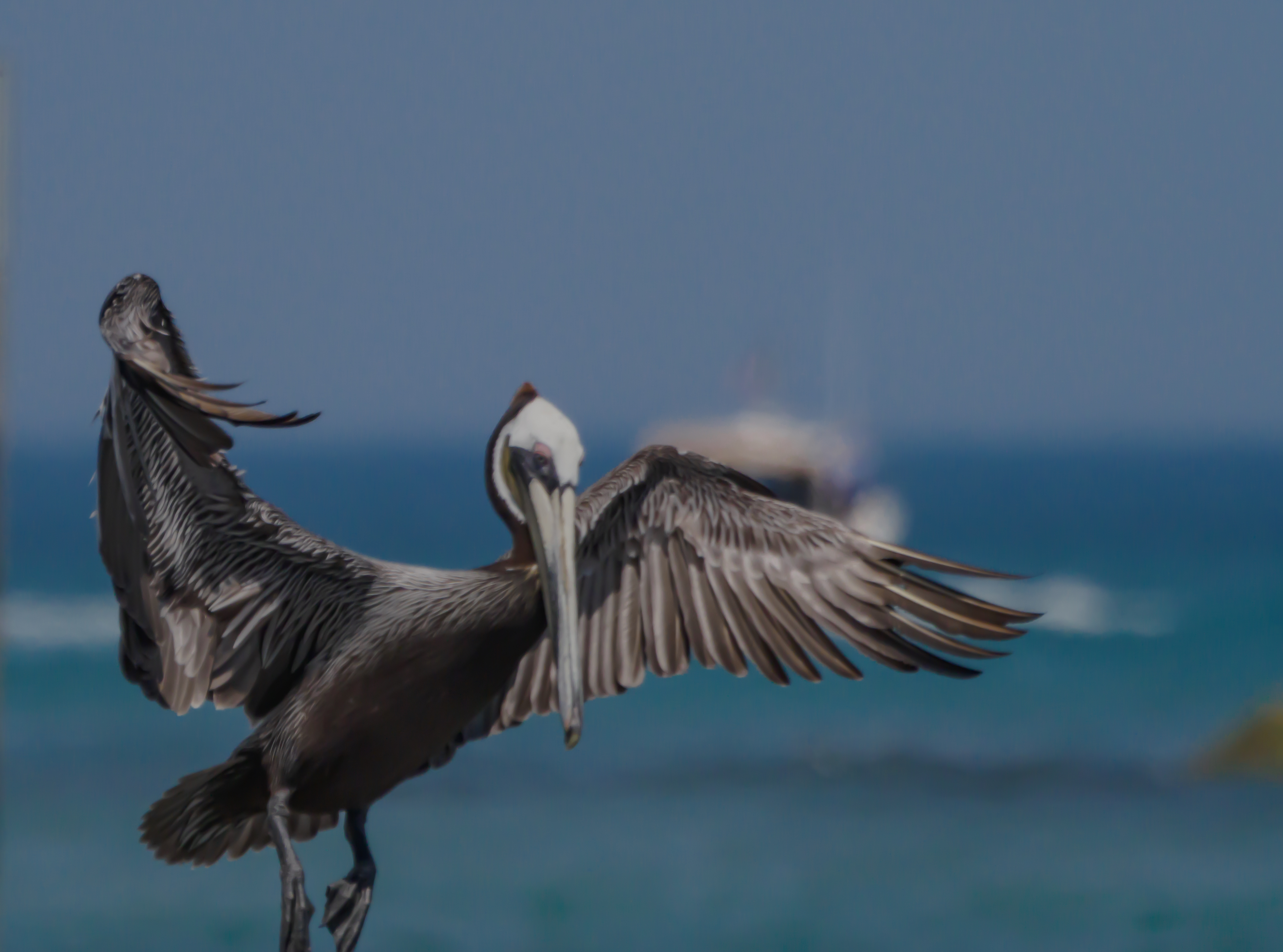
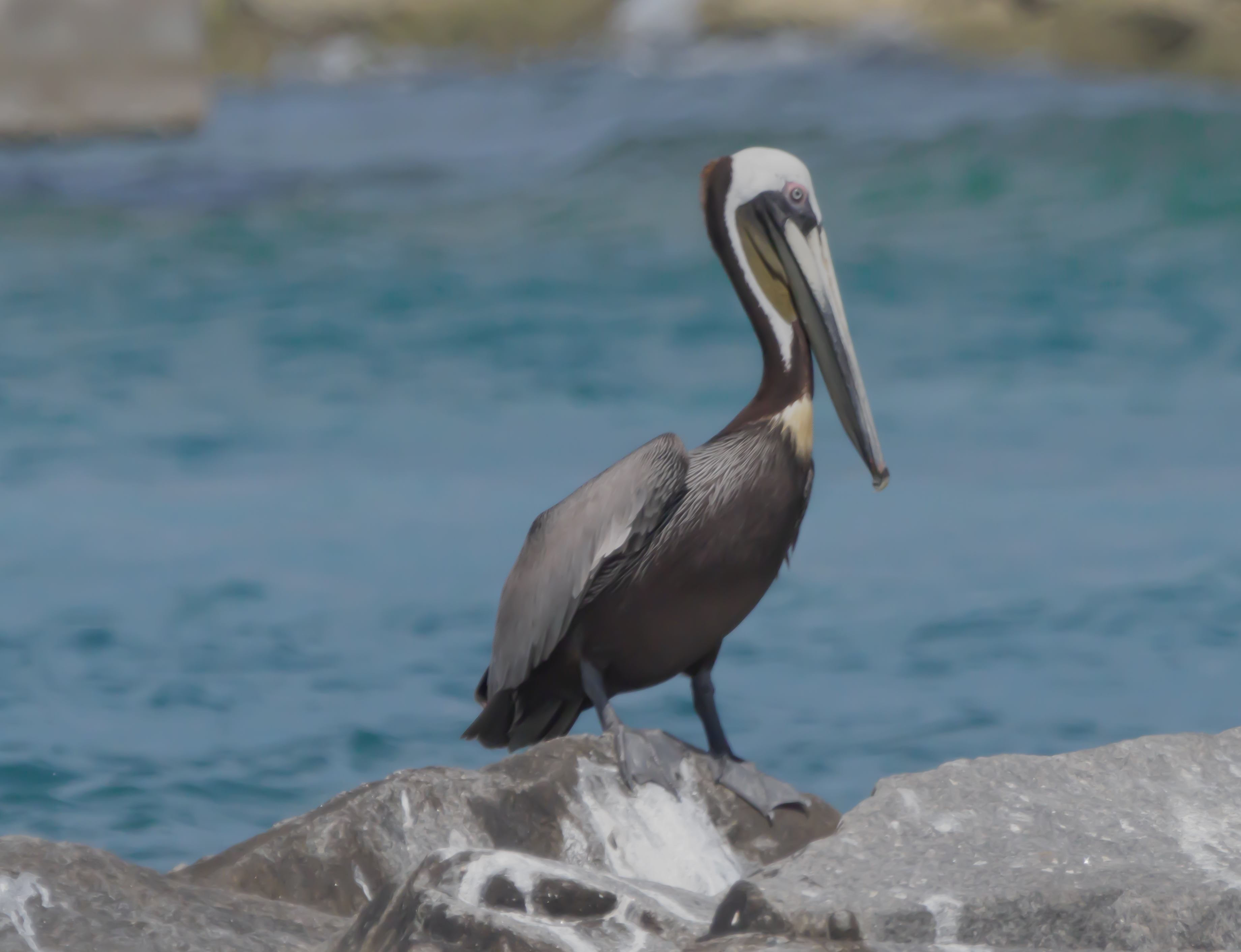
The Star of the Day today could have been the pelicans, which were quite photoworthy.
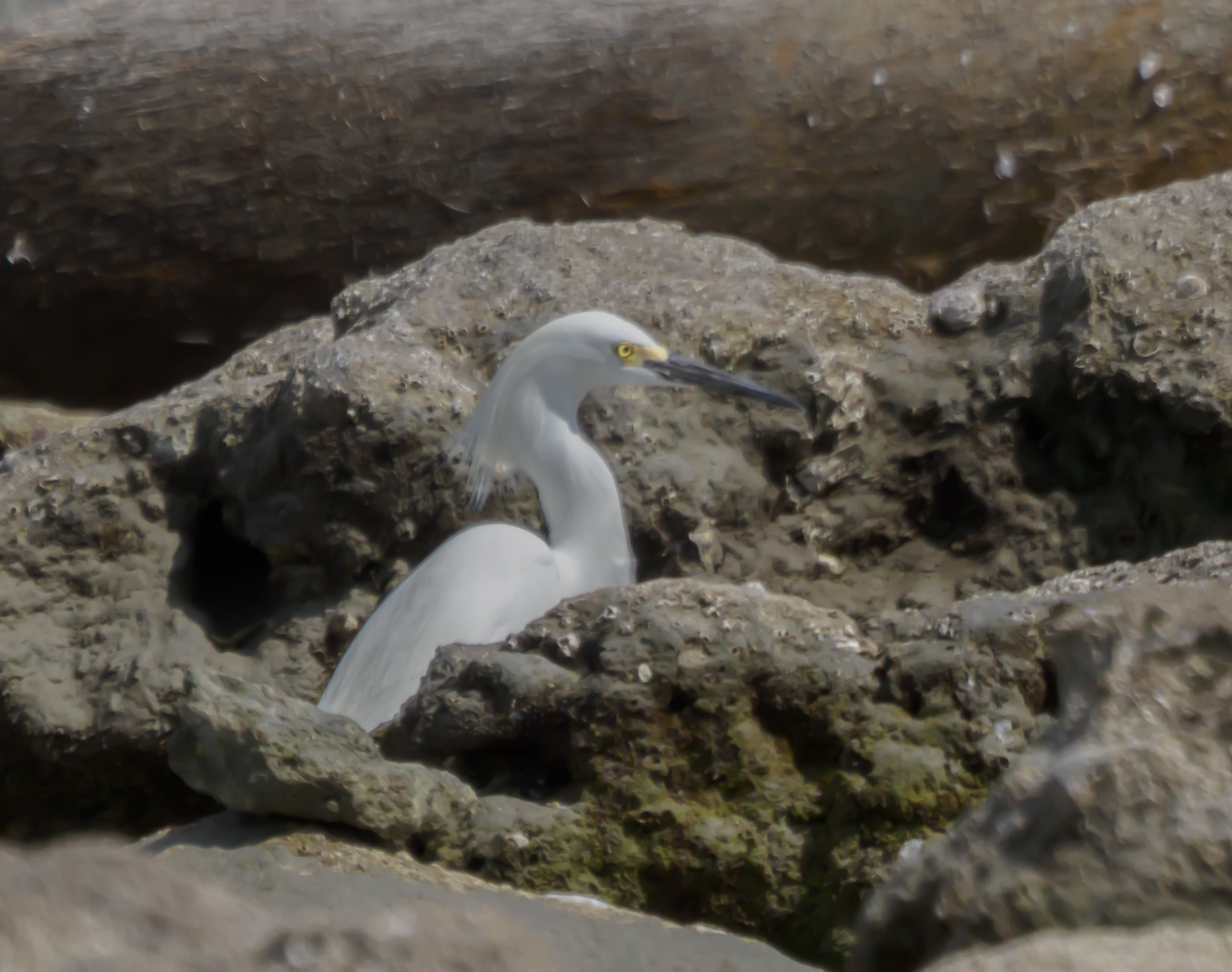
 Or it could have been any of the number of small waders that ran along the shore and entertained us by pestering each other.
But The Star of the Day was none of these.
It was definitely the wood stork.
And not just *any* wood stork.
It was THIS wood stork, whose personality outshone all the other birds we saw on Day 4.
However, we wouldn’t know that until the afternoon.
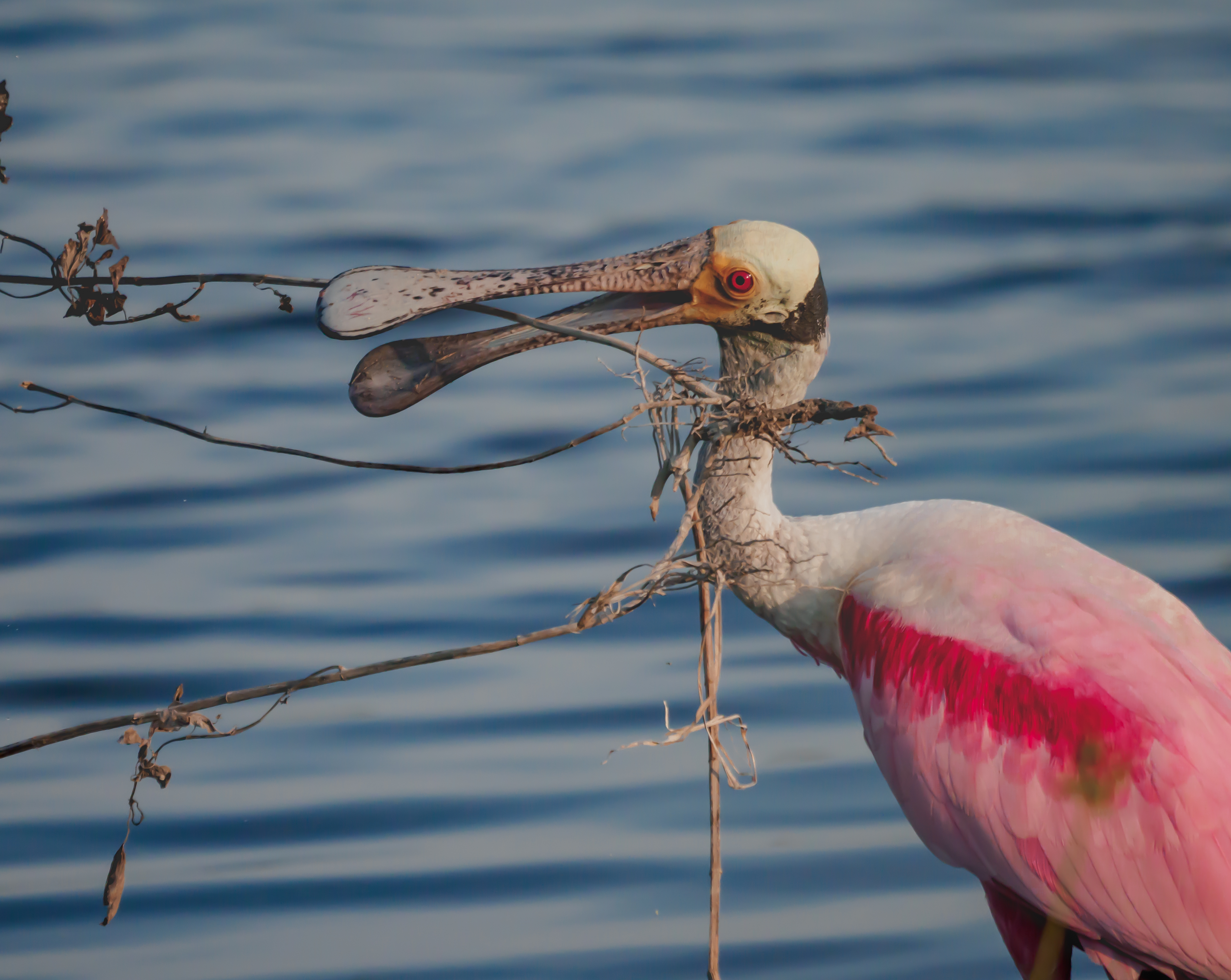 The morning of Day 4 was spent re-visiting the spoonbills at a nearby lake.
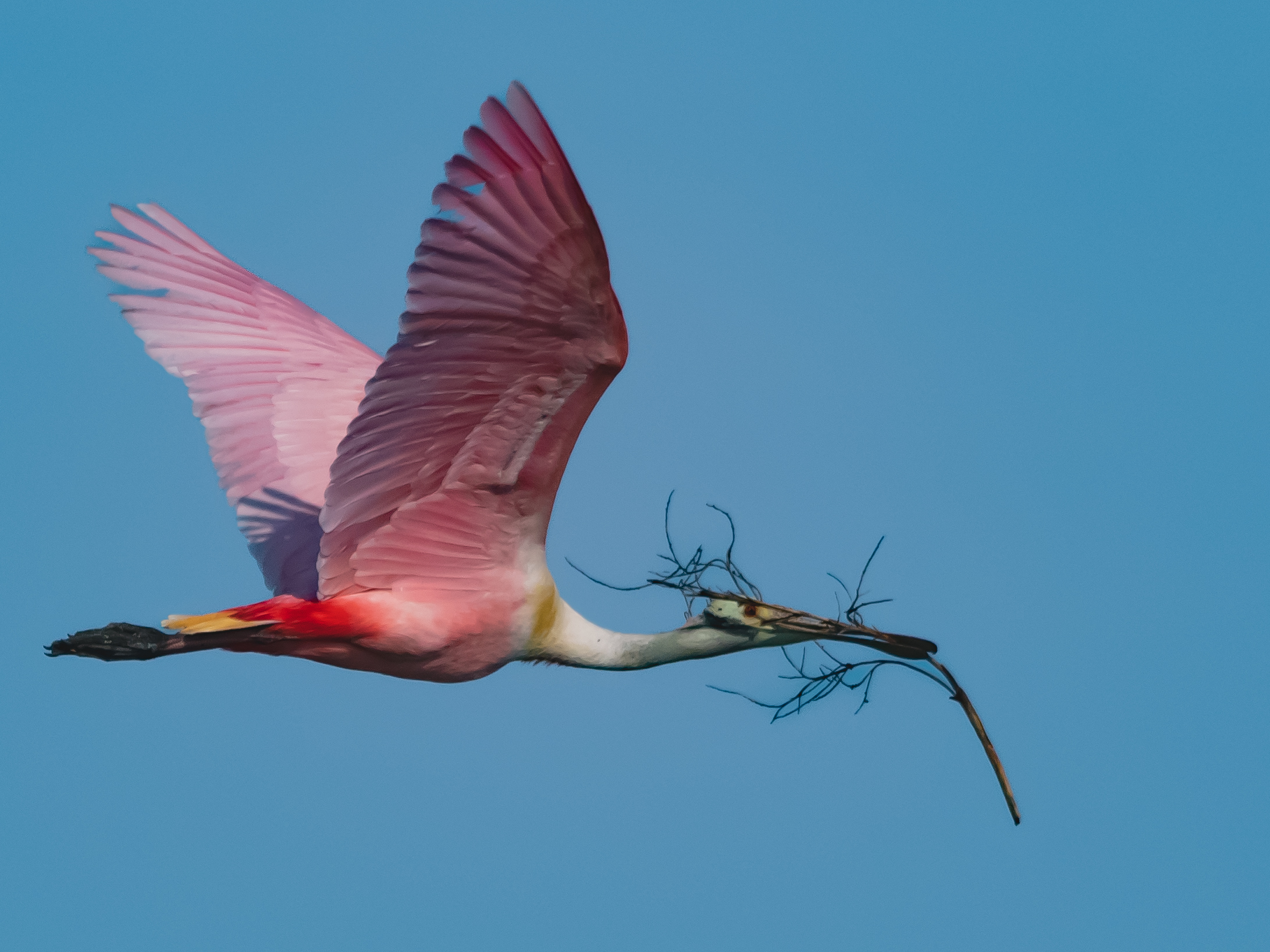
They were just as busy on Day 4 as they had been a few days earlier, gathering and delivering nesting materials.
There were other birds that caught my attention and stayed still long enough to allow me to practice and improve my focus-locking and tracking skills.
After these practice shots, I did much better on birds-in-flight, although it is clear I still have a long way to go.
At least the birds in these images are recognizable as birds! and not the fuzzy blobs that characterized my past attempts at BIF.
 The wifi table at McDonald’s allowed me to spend the harsh-light hours reviewing and post-processing my photos.
And it was during this time that I learned my next lesson. Noisy images.
Since the M4/3 sensor is small (17 x 13 mm) its photo receptors are also small, especially if there are more of them. They can absorb only so much light and not nearly as much as full-frame sensors. So, noise can be a problem. What I learned, though, in reviewing and post processing, was that this doesn’t have to be a problem if you use every single photon of available light.
Underexposed images will definitely harbor a lot of noise, even with cameras that have larger sensors, but images that utilize as much available light as possible (without overexposing, that is) — not so much.
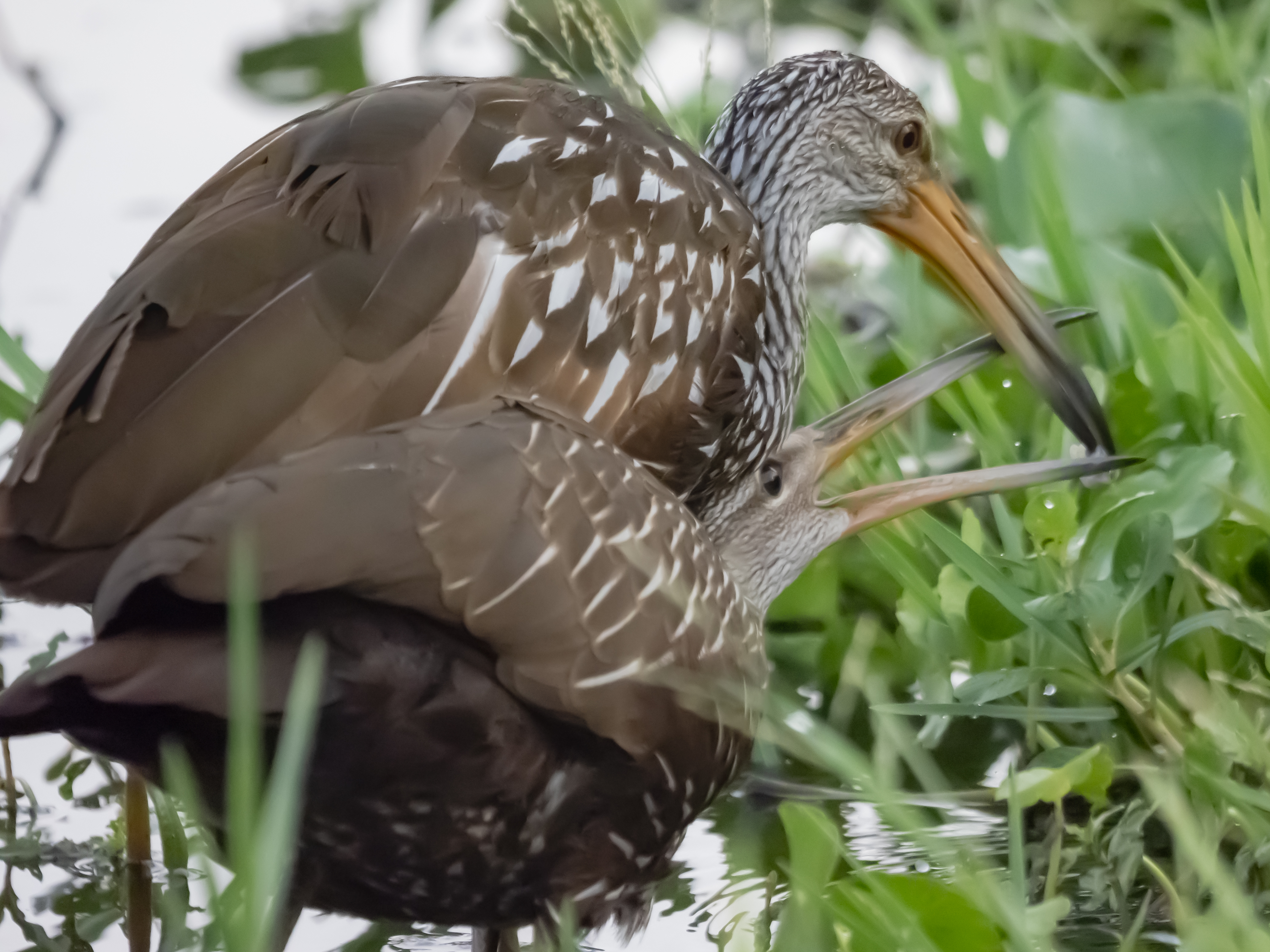 If noise is present, it will be found in the dark areas of the photo; hence, the importance of avoiding underexposure.
And it tends to affect the background more than the subject, if the subject is sharply focused.
At least, that’s what I found in my Day 4 photos.
The afternoon golden hours finally arrived, and with them the Star of the Day.
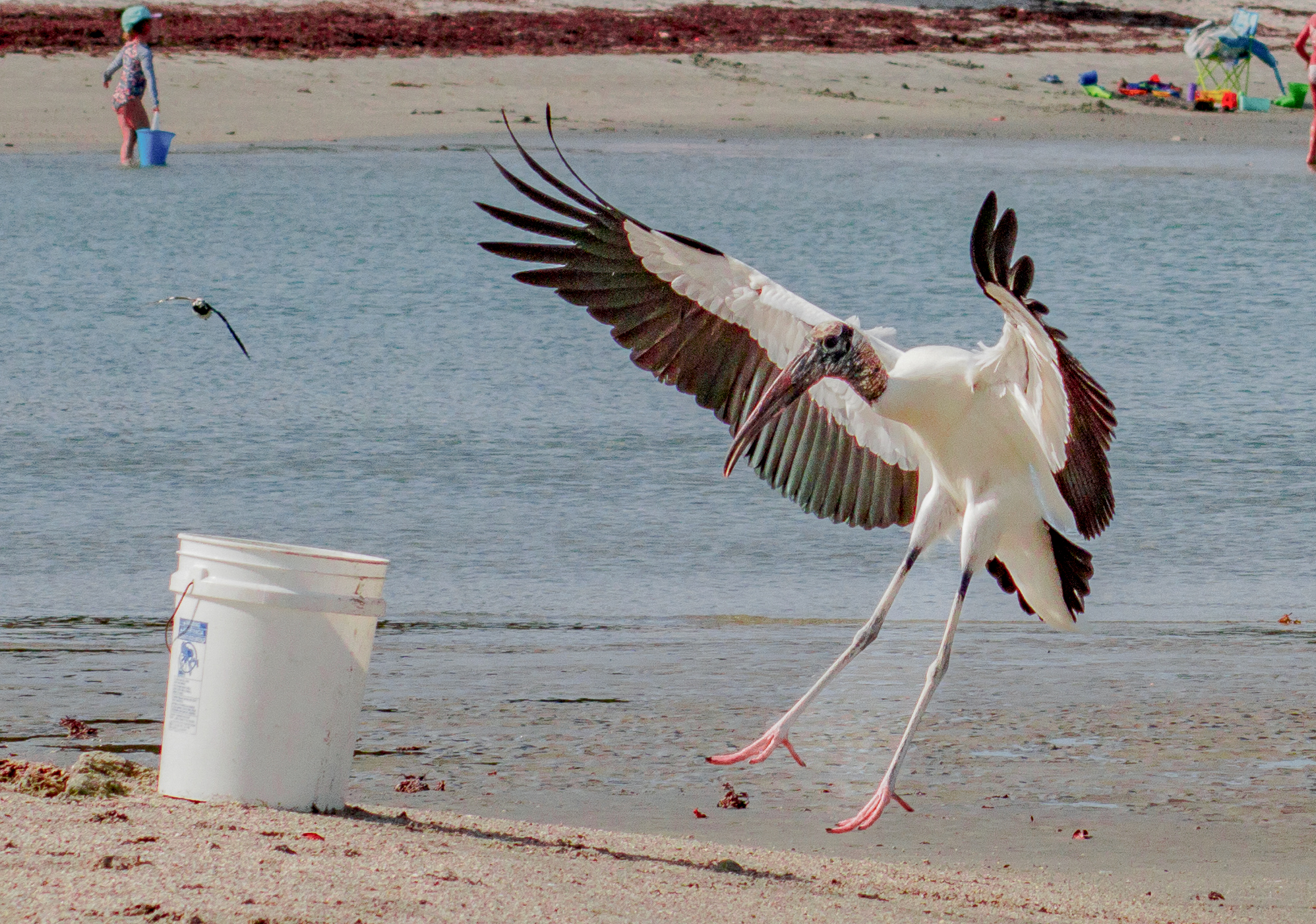
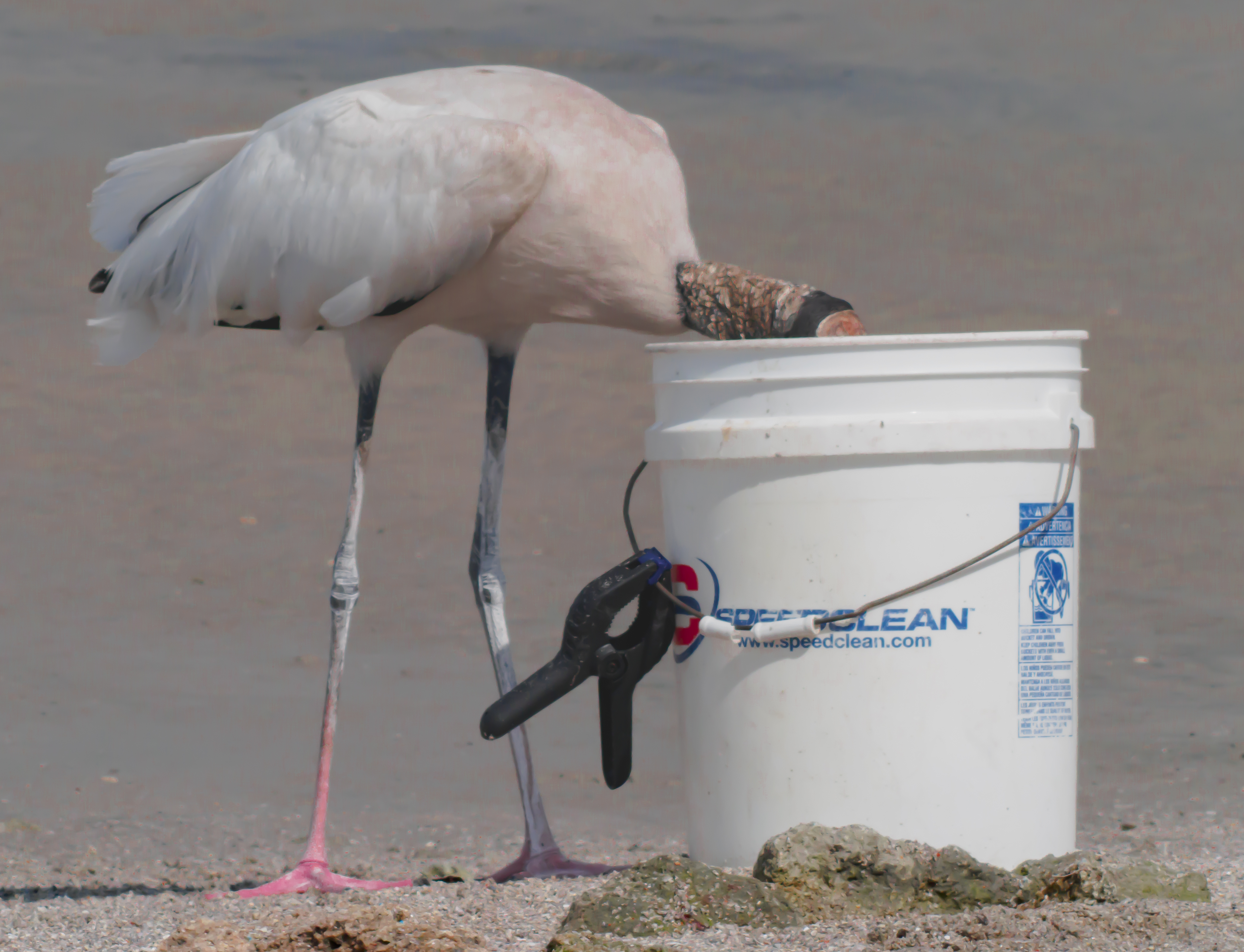
This wood stork had Personality (with a capital P!).
Not willing to expend energy in unnecessary hunting, it simply ambled up and down the shoreline looking for handouts.
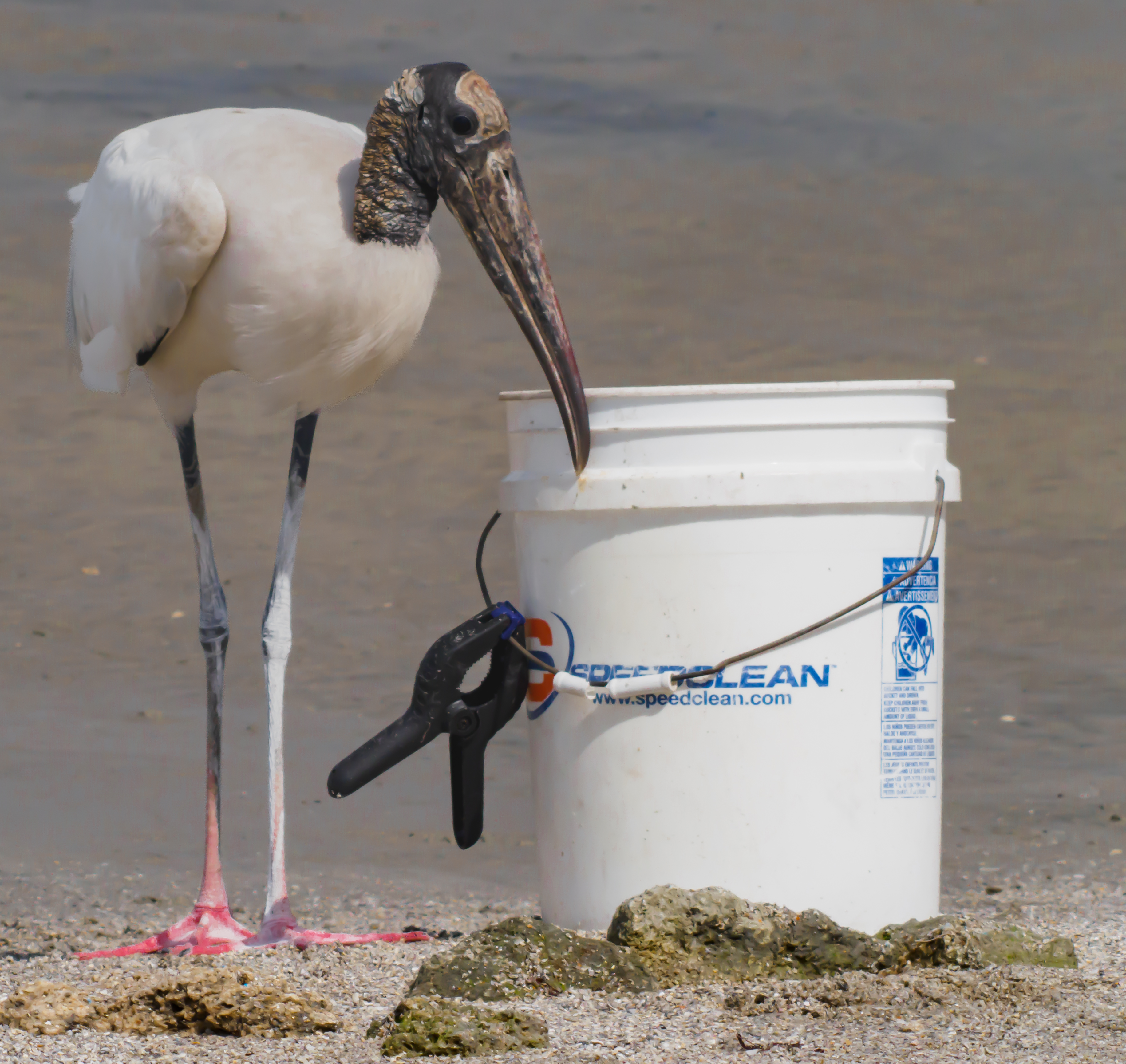 An empty bucket must have smelled of fish, because our wood stork kept checking it out. Disappointed, it looked for other buckets that might hold lunch. . .
. . .such as kids’ sand pails.
Disappointed again!
We turned our attention to activities of other birds, but the stork returned several times to check out the shoreline and any buckets left thereon.
It was both amusing and amazing to watch.
 Now, stork antics aside, I can’t forget the pelicans.
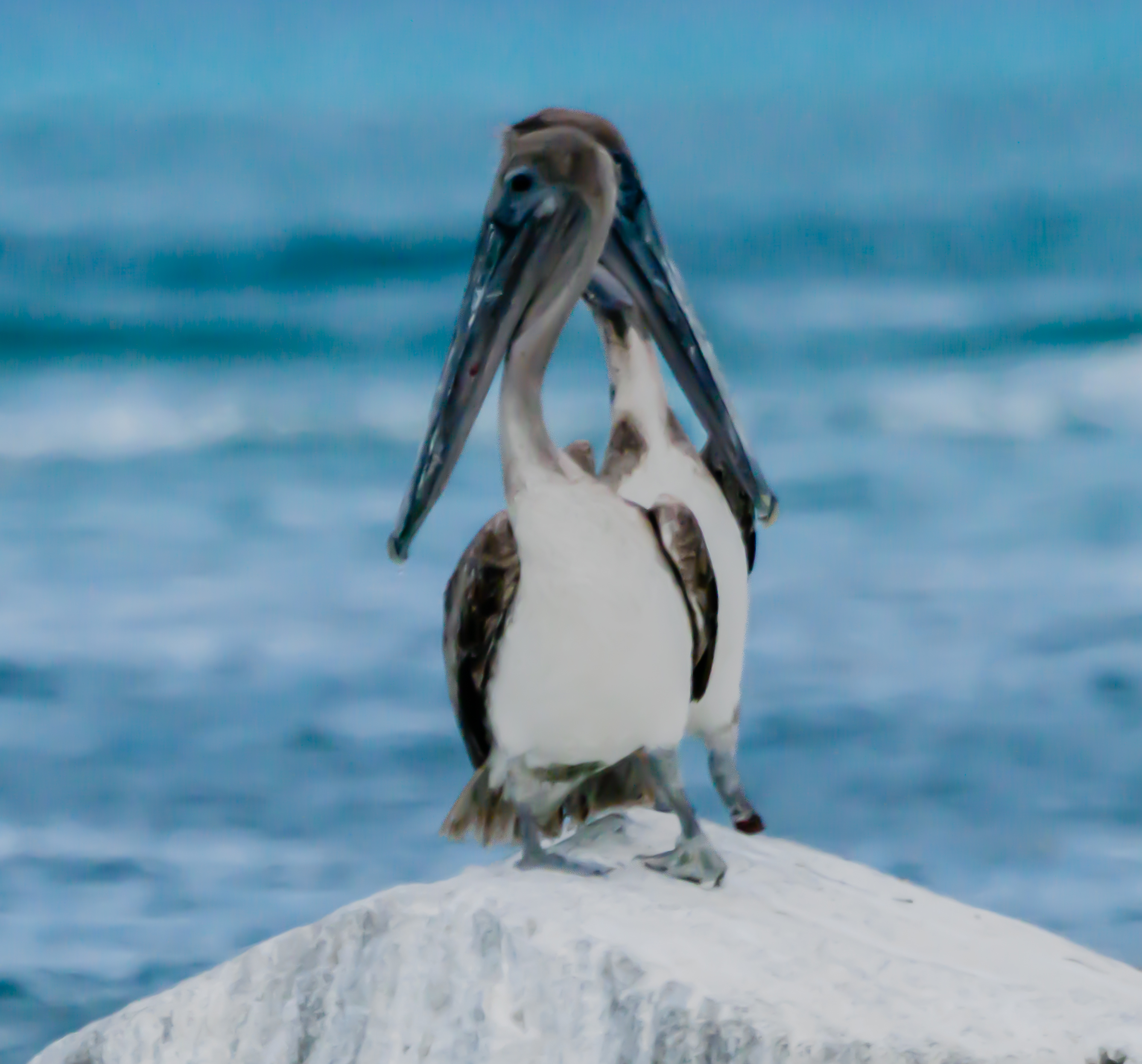
The pelicans were both numerous and interesting.
The rocks were painted with their whitewash, revealing which ones were favorite resting places.
They, too, declined to hunt for their dinner, but that’s okay. Instead, the begged for their dinner.
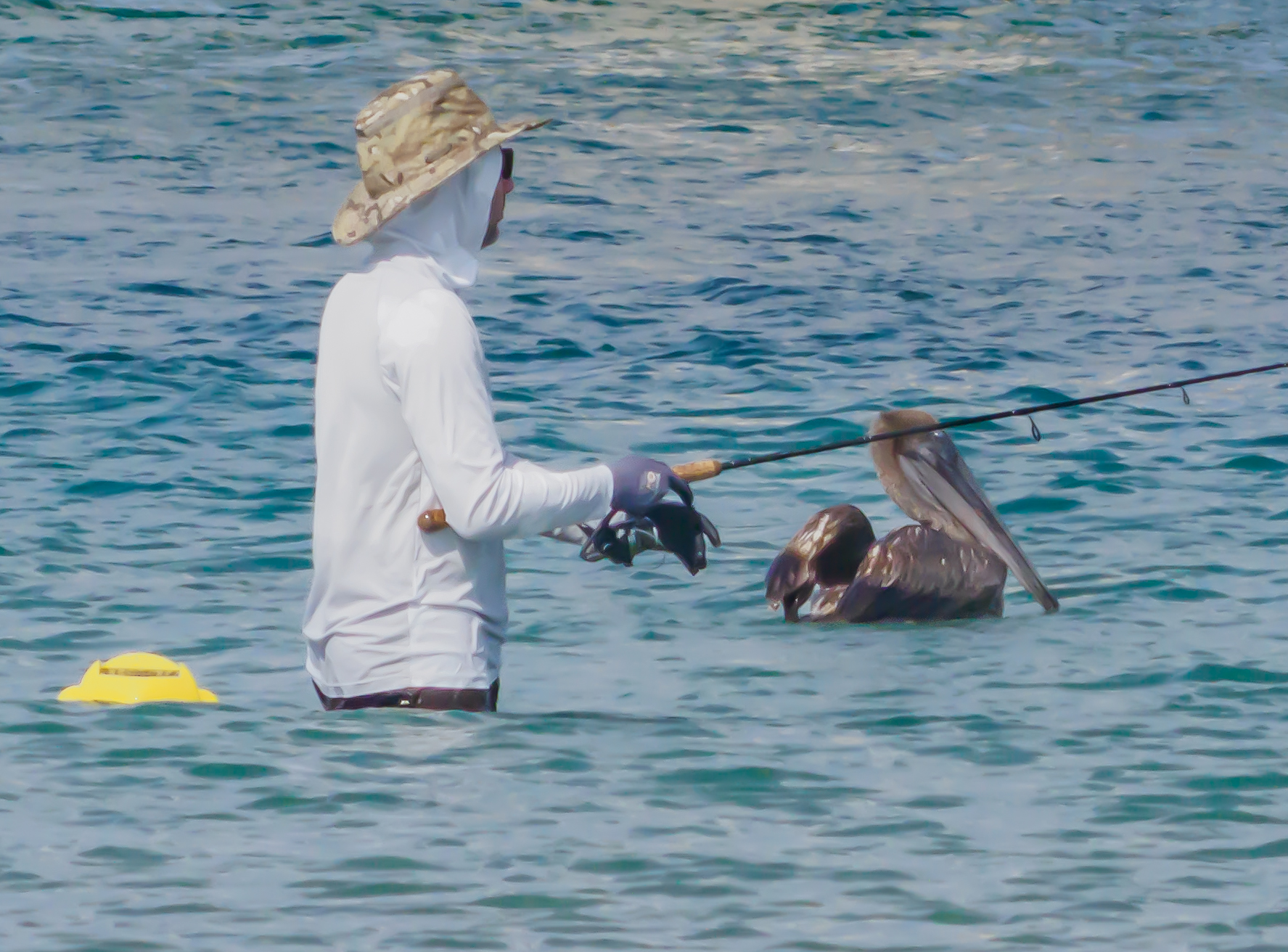
There was one who performed several tricks and displays trying to entice a fisherman to hand over some dinner.
The pelican was unsuccessful, but our friend the stork did catch the fish that the fisherman had tossed its way.
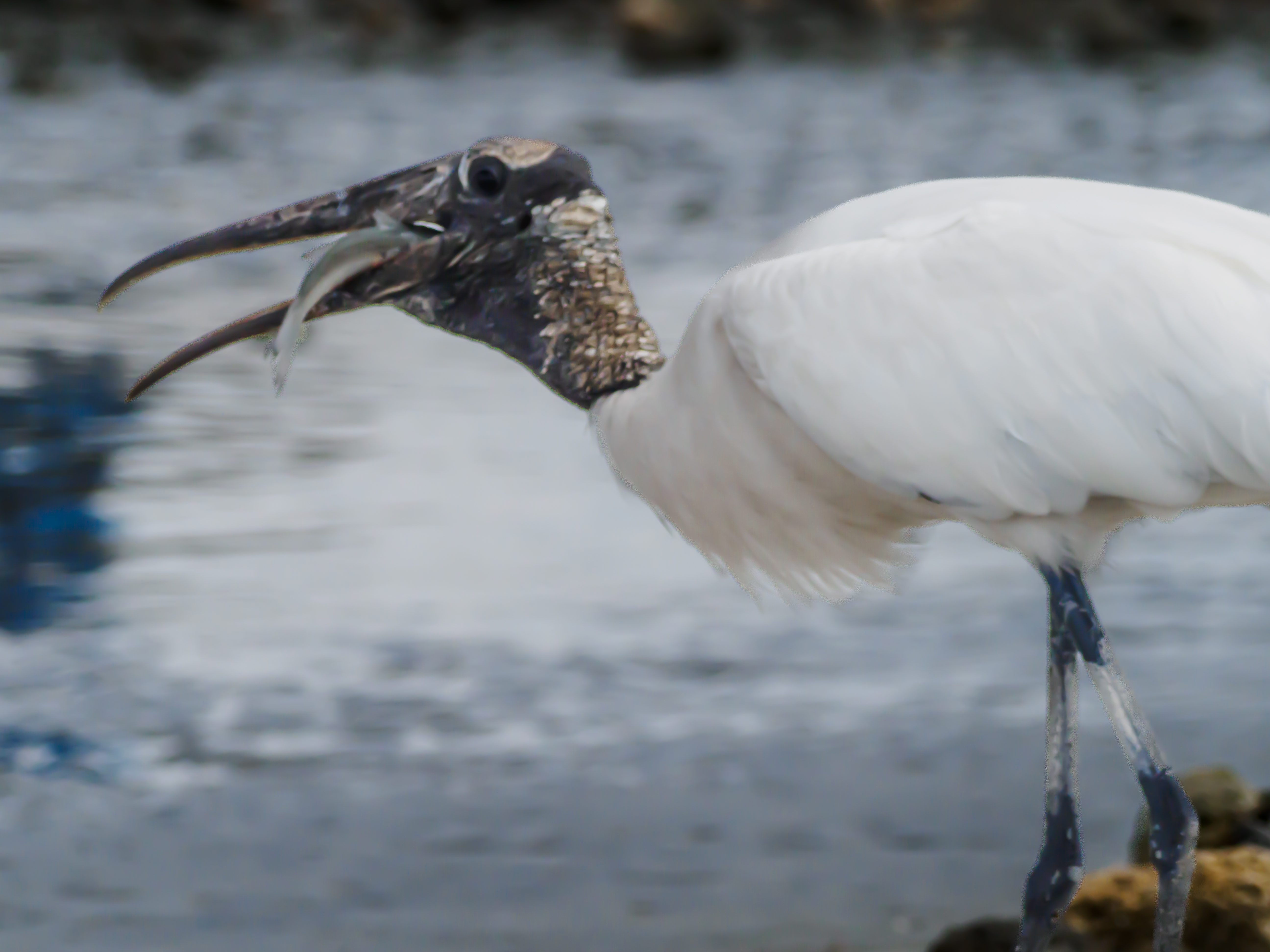 But that was it. If either the stork or the pelican was going to eat anything more, they had to do its own legwork.
More photos from Day 4.
Some good, some not so good, but all in all a great day of learning and practice.

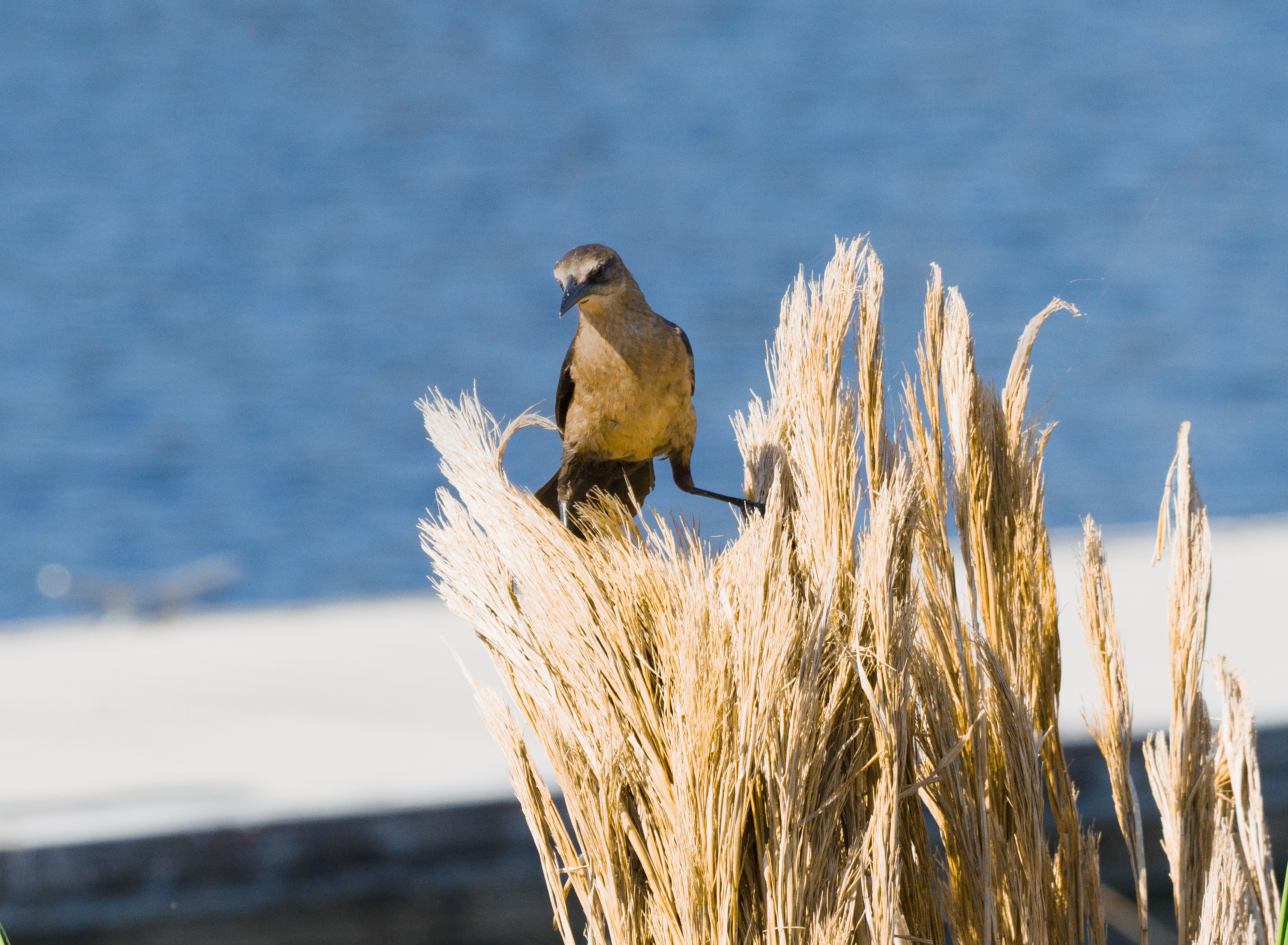
We went out twice on Day 3, once in the morning and once in the evening during the golden hours of sunrise and sunset.
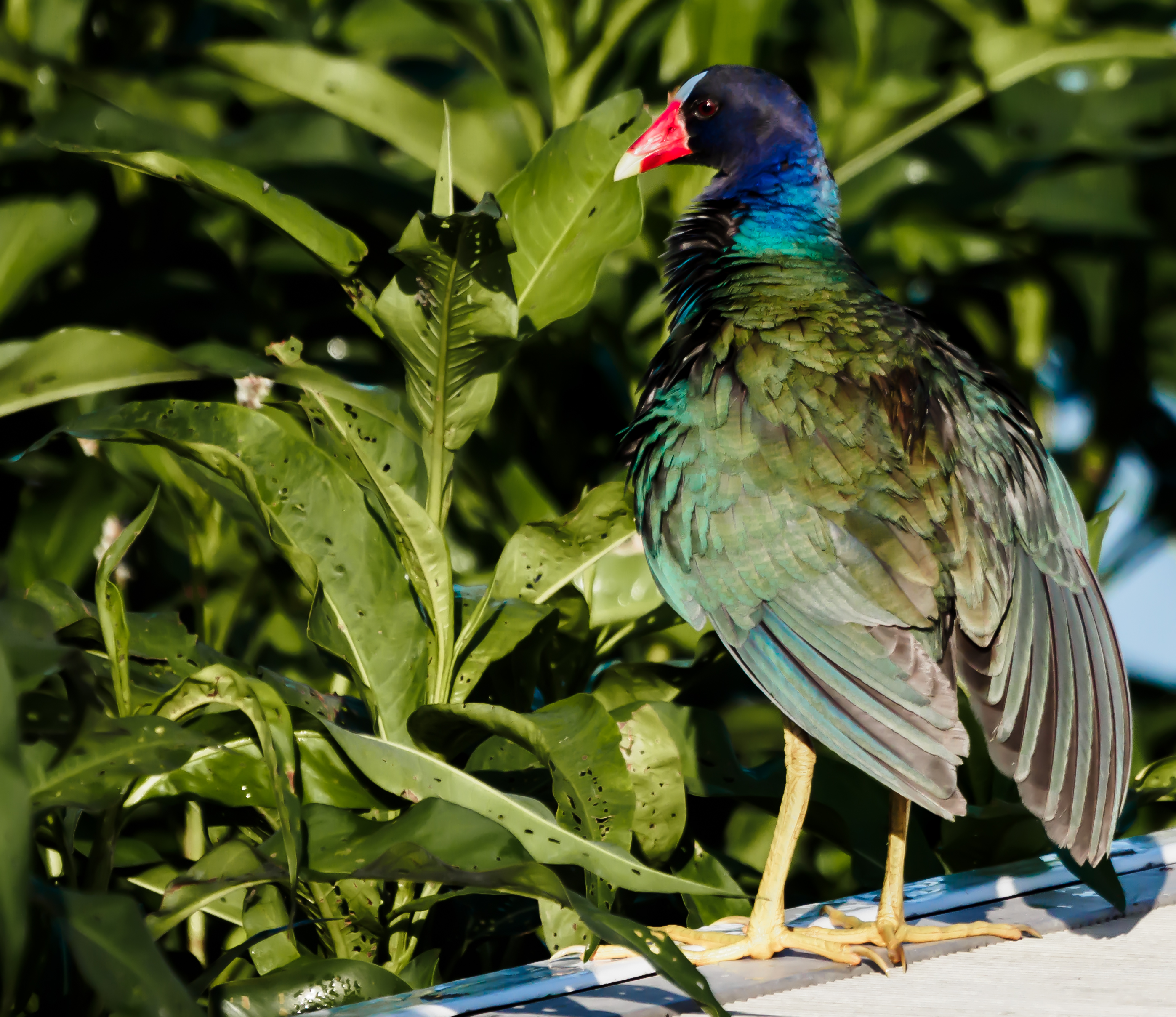 The choice of Star of the Day was actually quite difficult, as several lovely and not-so-lovely candidates had to be considered.
The first candidate would have to be the purple gallinule.
The morning light glistened off its iridescent feathers — definitely a contender for Star, even if it is a rather common animal.
This one entertained us by nosing around so close to us that we hardly needed a telephoto lens.
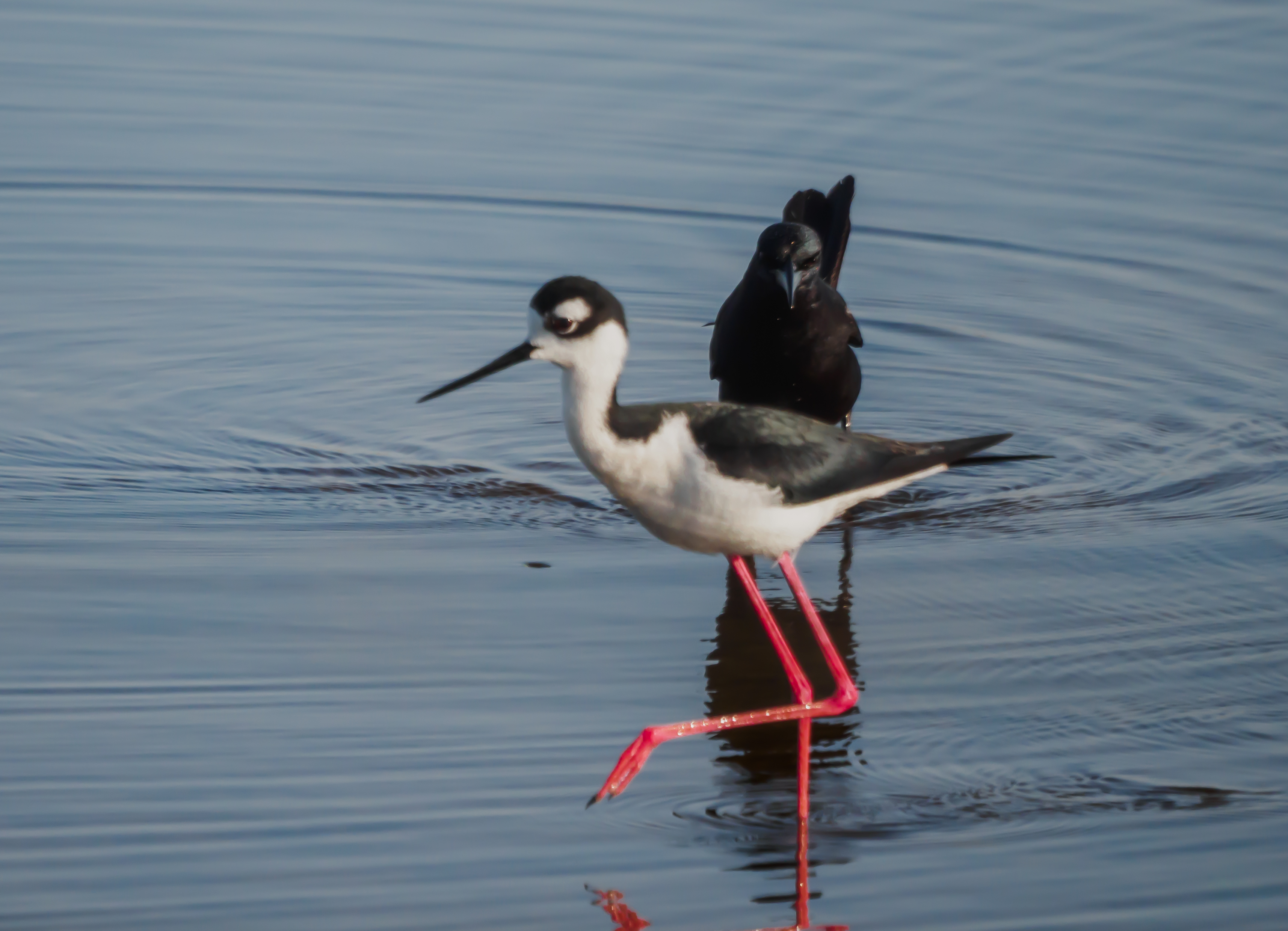 And then there was the black-necked stilt who traipsed through the water, undetered by fear of alligators or fear of boat-tailed grackles.
Actually, the grackles were more of a threat, but this little one didn’t seem to mind at all.
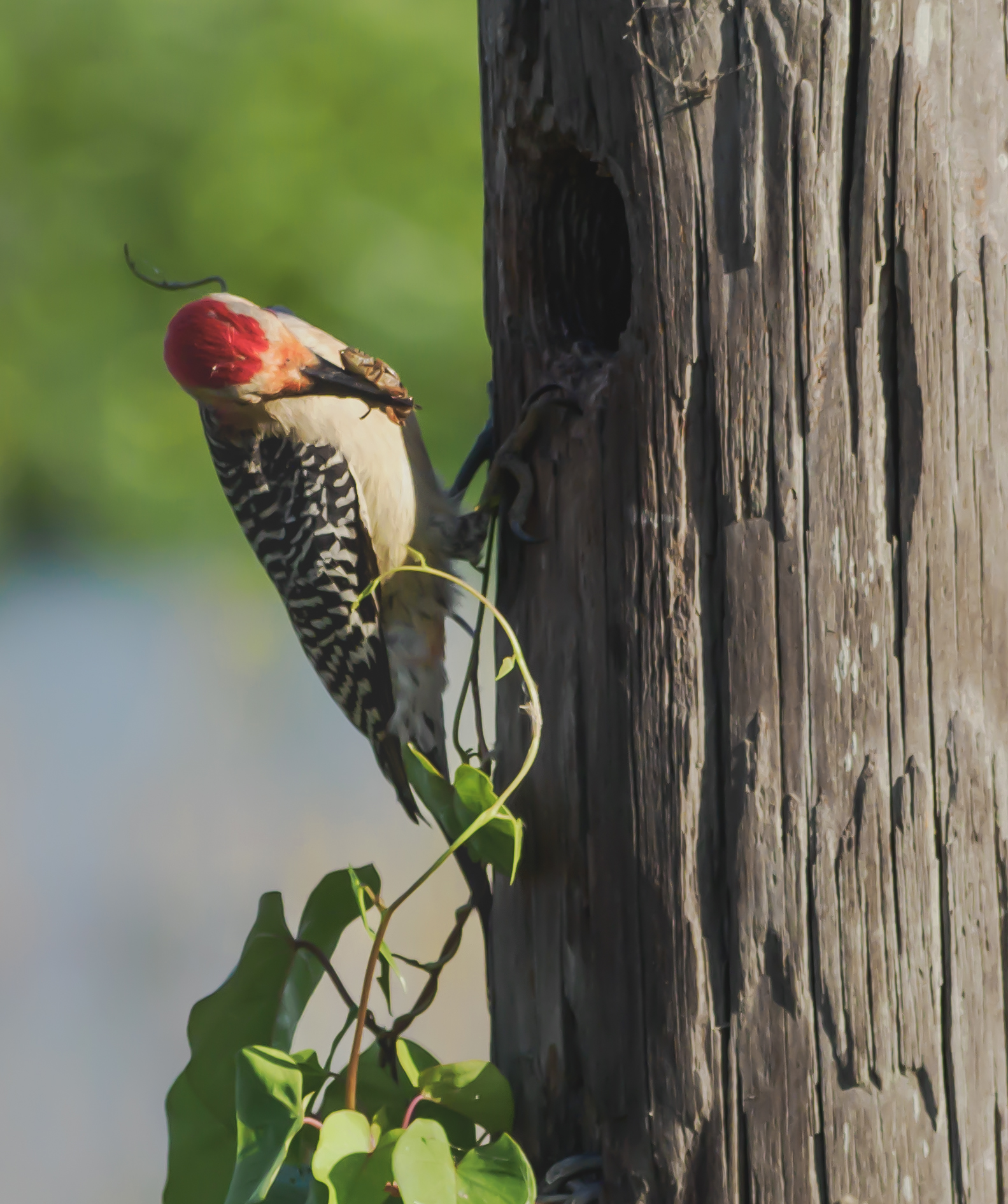
So, if I have to choose (and I realize I do), The Star would have to be the red-bellied woodpecker family.
Definitely. Their antics were so cute! and our nearness didn’t bother them at all.
We saw only two of them, the mom and the dad, but clearly there were young ‘uns nestled in their pole-home:
Mama: “Don’t make me come in there!”
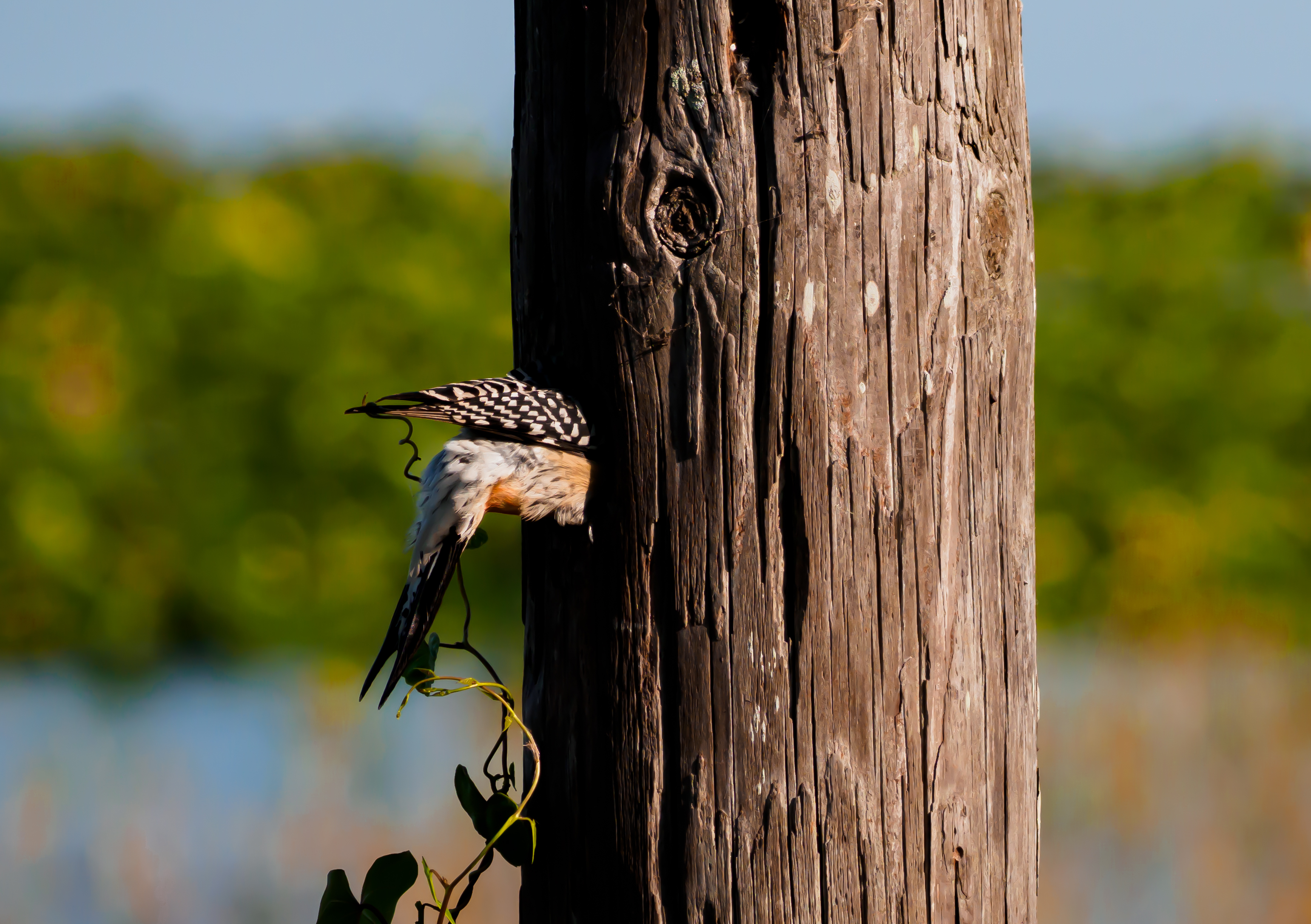
Papa with a tasty morsel for the kids:
Mama’s turn to feed the children and Papa’s turn to warn them that Mama was on her way:
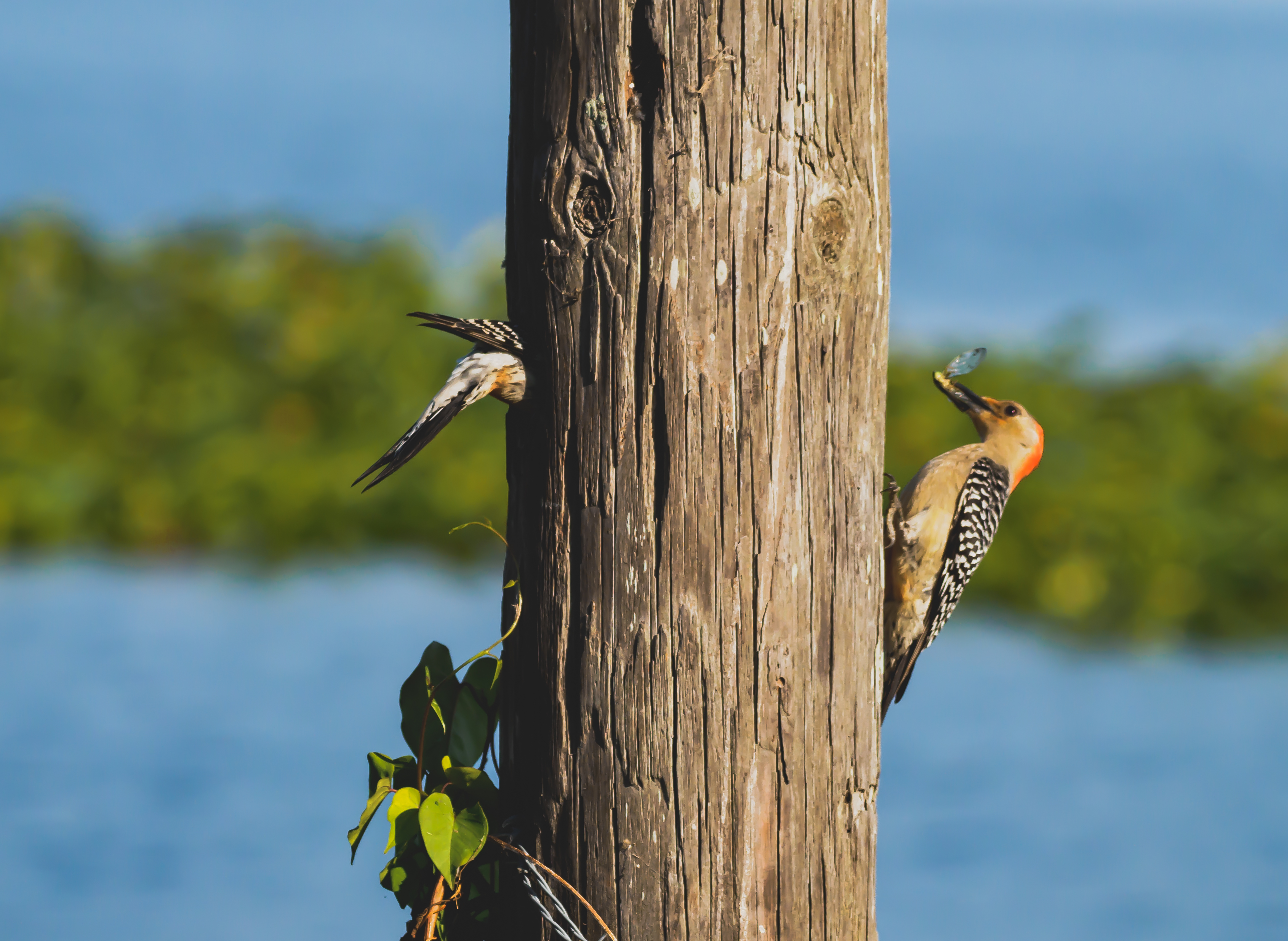
So, the red-bellied woodpeckers it is — congratulations!
 By 9:00 the light was getting harsh, and we headed back to the motel.
Andy spent some time showing me the wiles and ways of Adobe Camera Raw.
Another lesson: There is a difference between Camera Raw and Photoshop.
The former helps you reproduce what you saw, the latter helps you produce what you wish you saw. Using Camera Raw will enhance your photos. Using Photoshop will manipulate your photos. 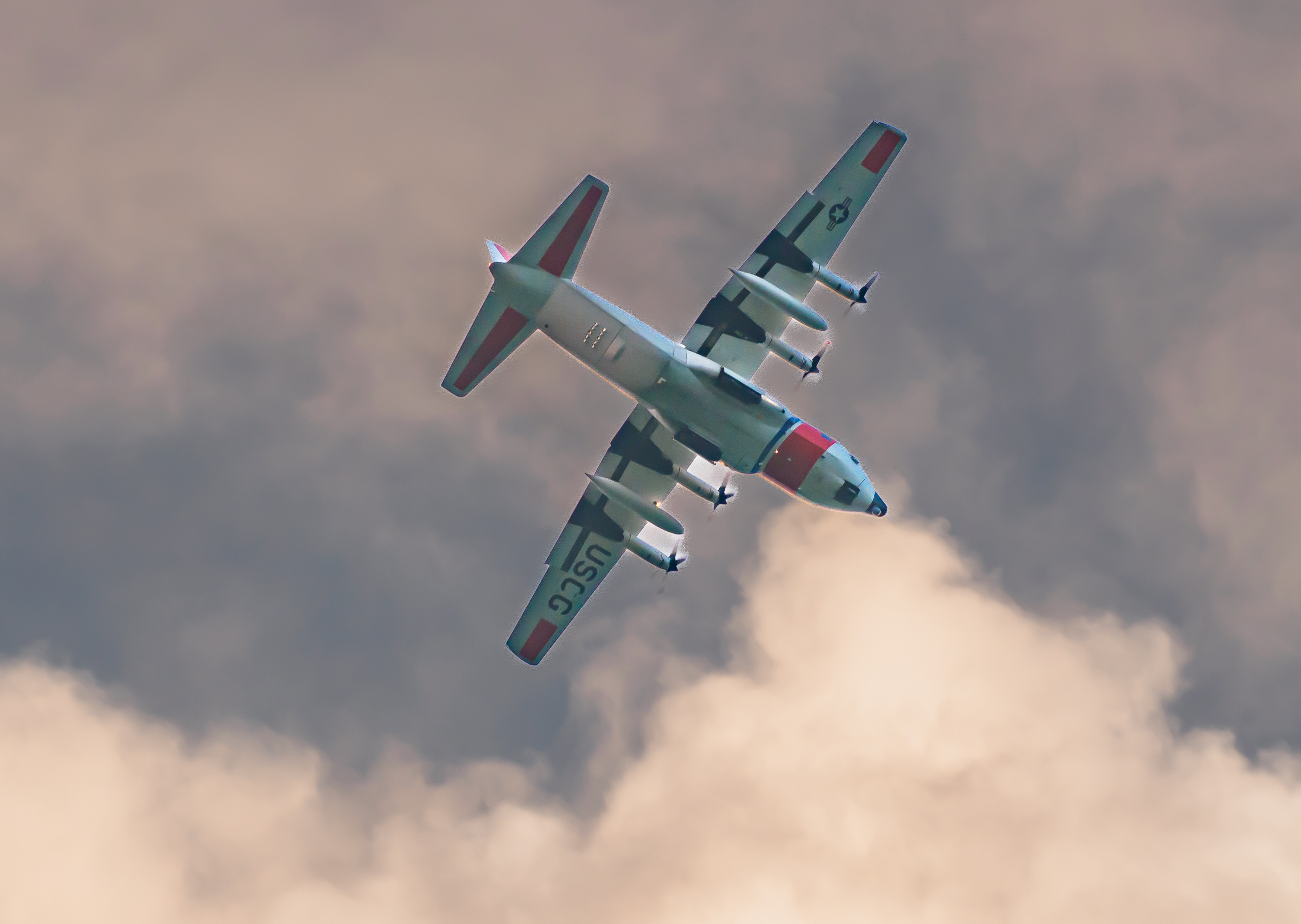
It’s a big difference.
Photoshopped images, Andy said, will be thrown out of any competition to which they are submitted.
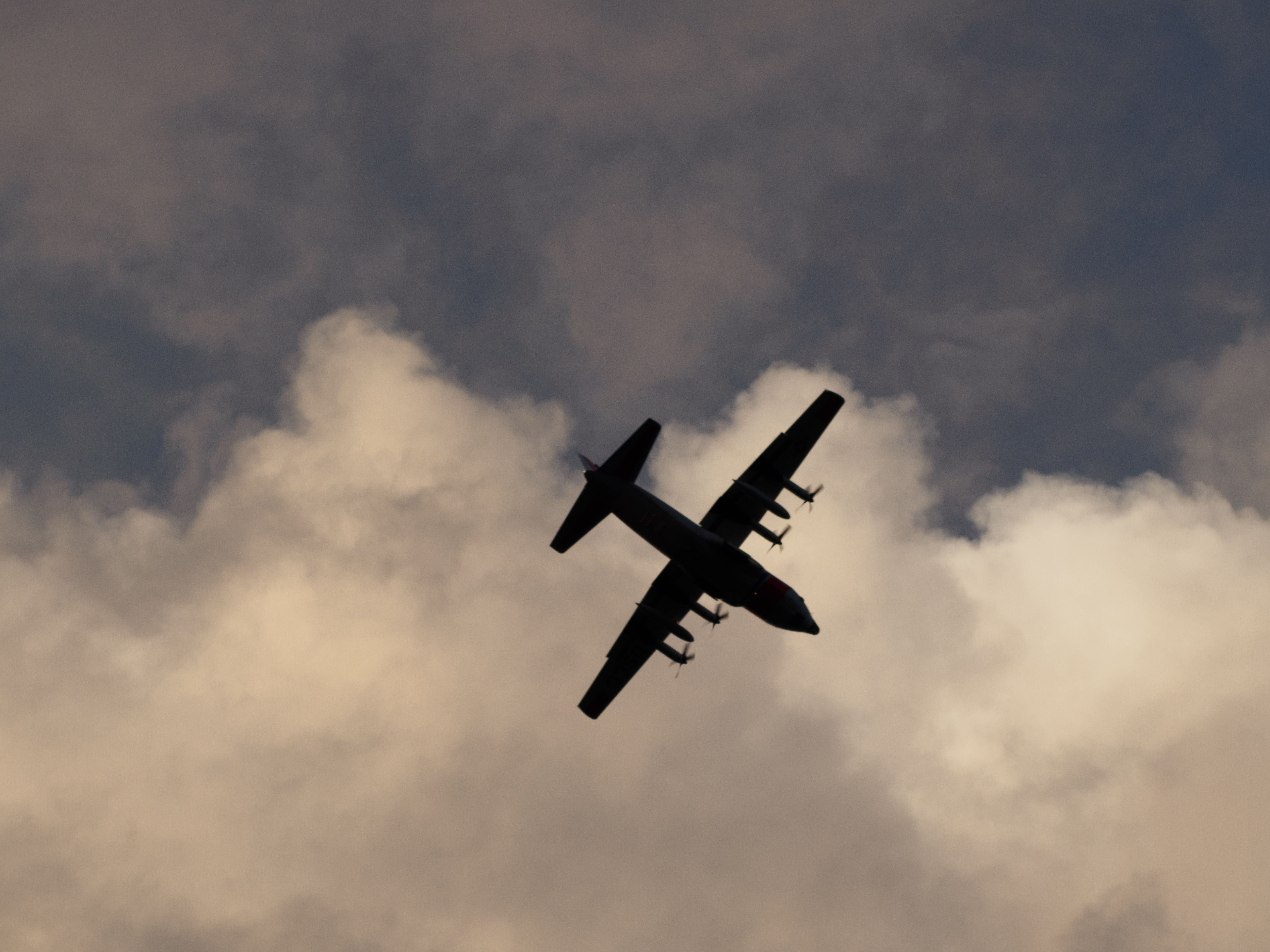
However, the enhancements and corrections provided by Camera Raw are perfectly acceptable. And it is a powerful program! Look how I was able to recover this backlit airplane!
But I digress.
 Our second expedition was to an out-of-the-way trail with the intention of finding alligators!
Which would have earned my vote for Star of the Day hands down.
However, the weather did not cooperate.
Too hot and humid, even for alligators. They stayed pretty much in the water.
Also, whatever illness I had contracted on the plane was taking hold.
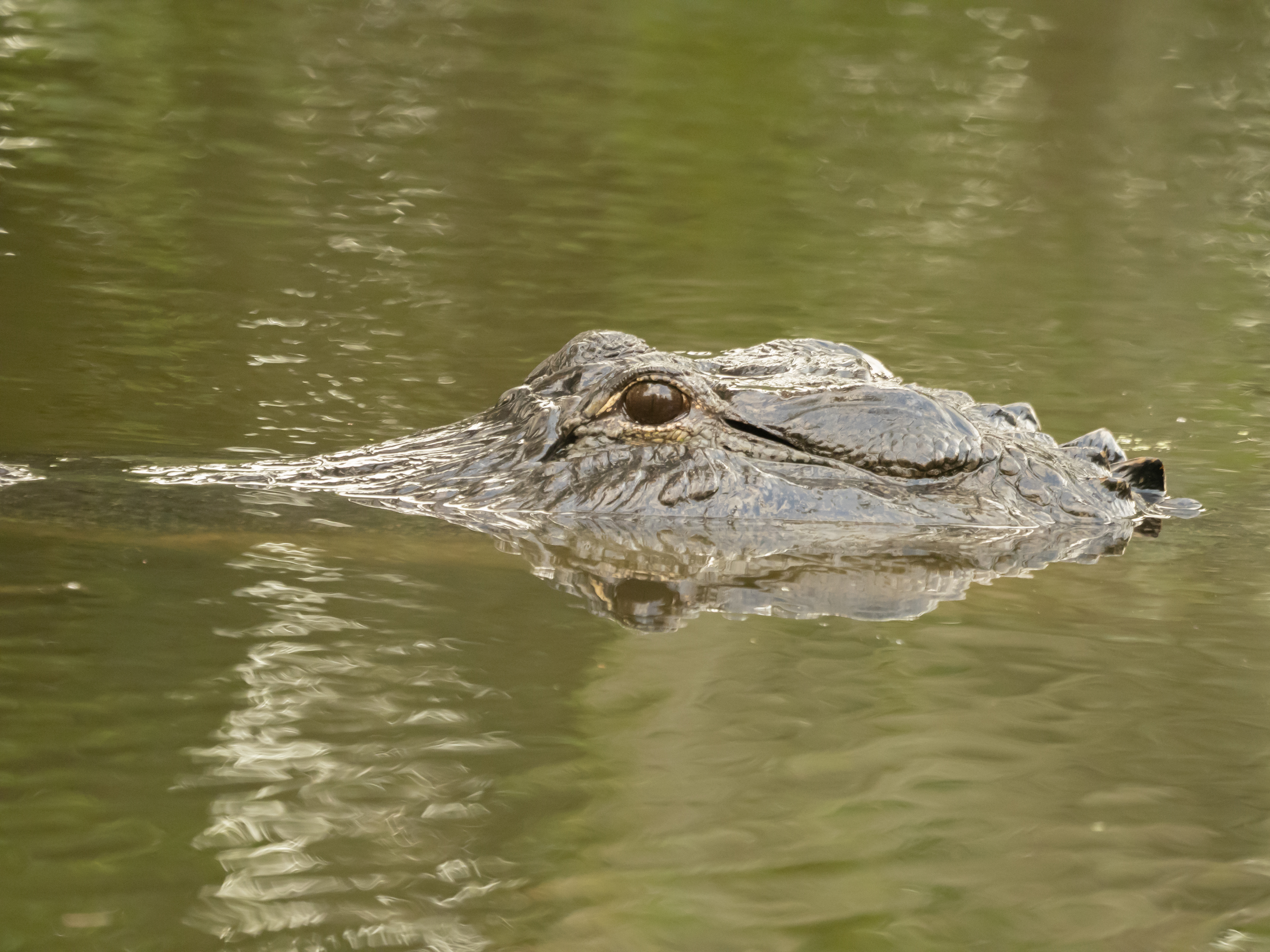
 I could hardly keep up with Andy as he raced (or so it seemed to me) to the best alligator spots.
Dang. Stupid weather! Stupid upper respiratory symptoms!
Anyway.
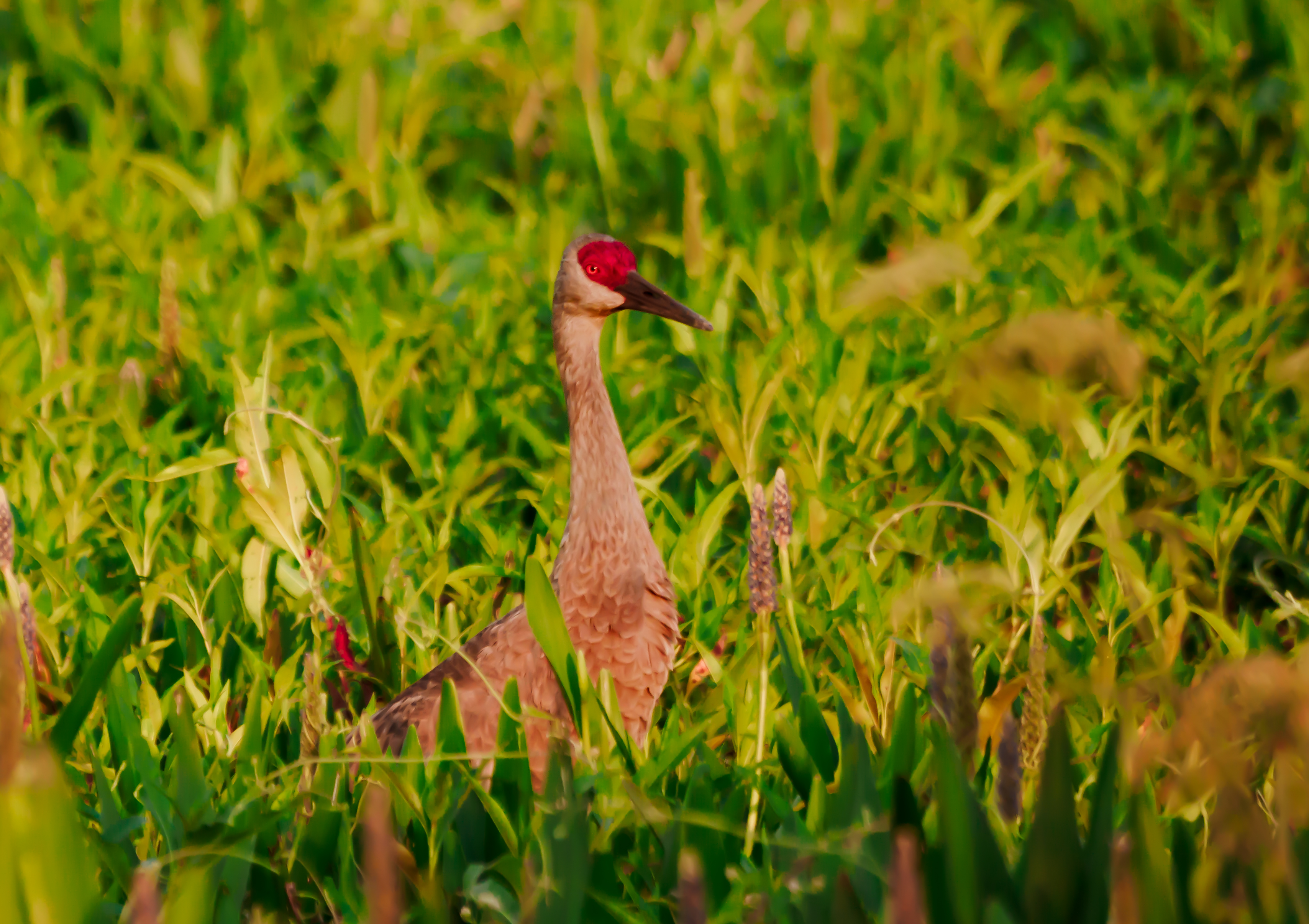
We did see some great things, like sandhill cranes.
They looked beautiful in the receding golden light.
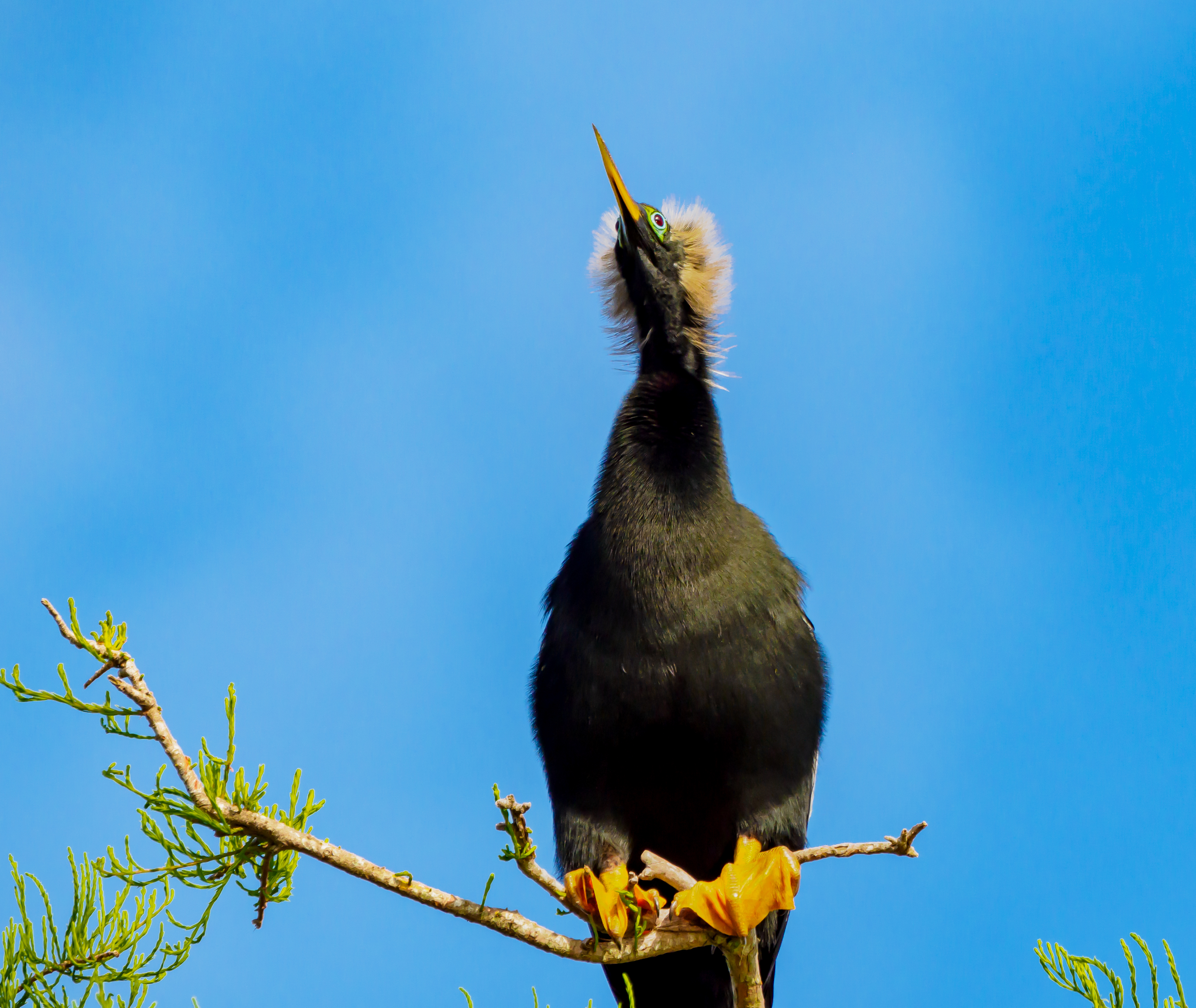
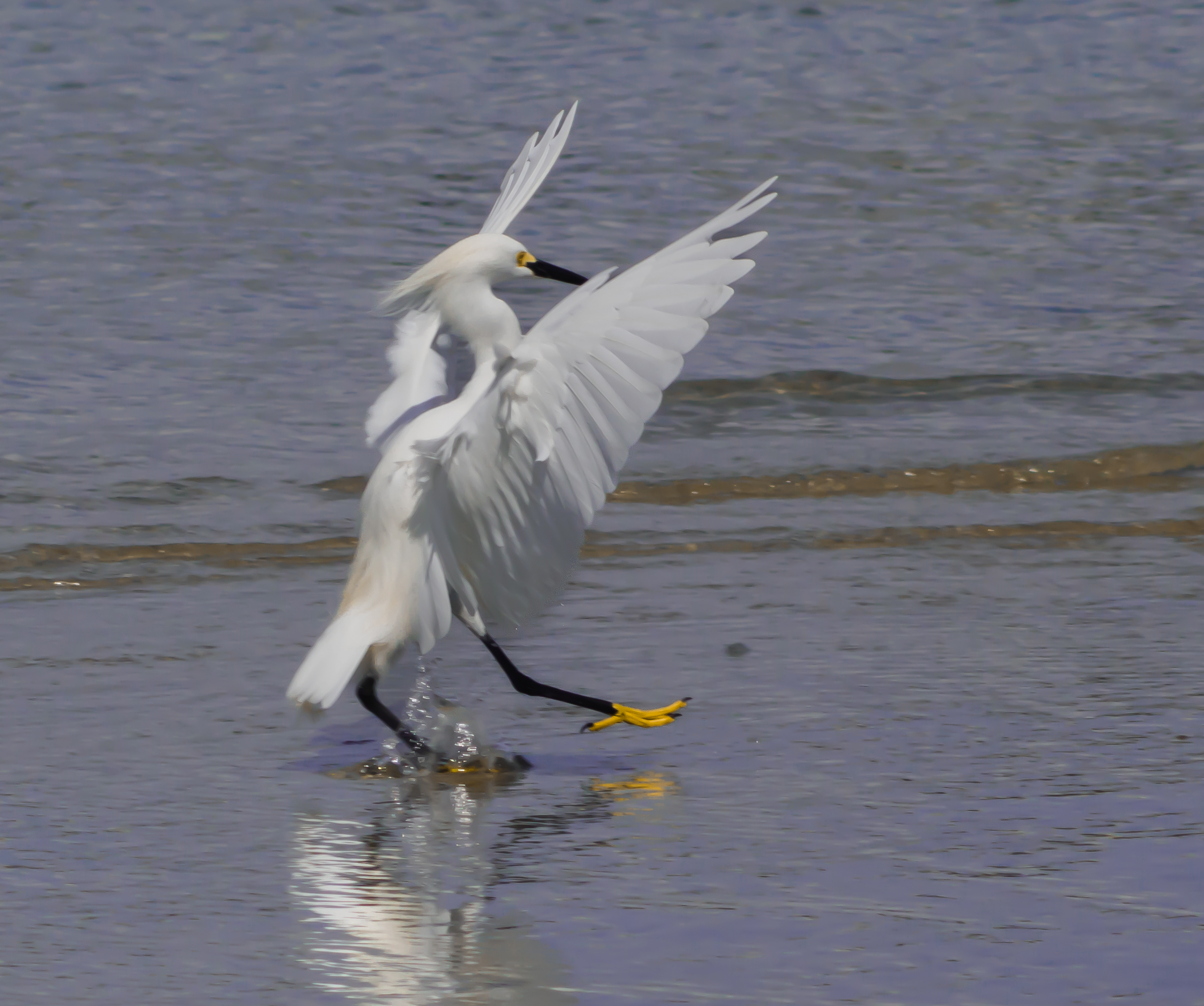
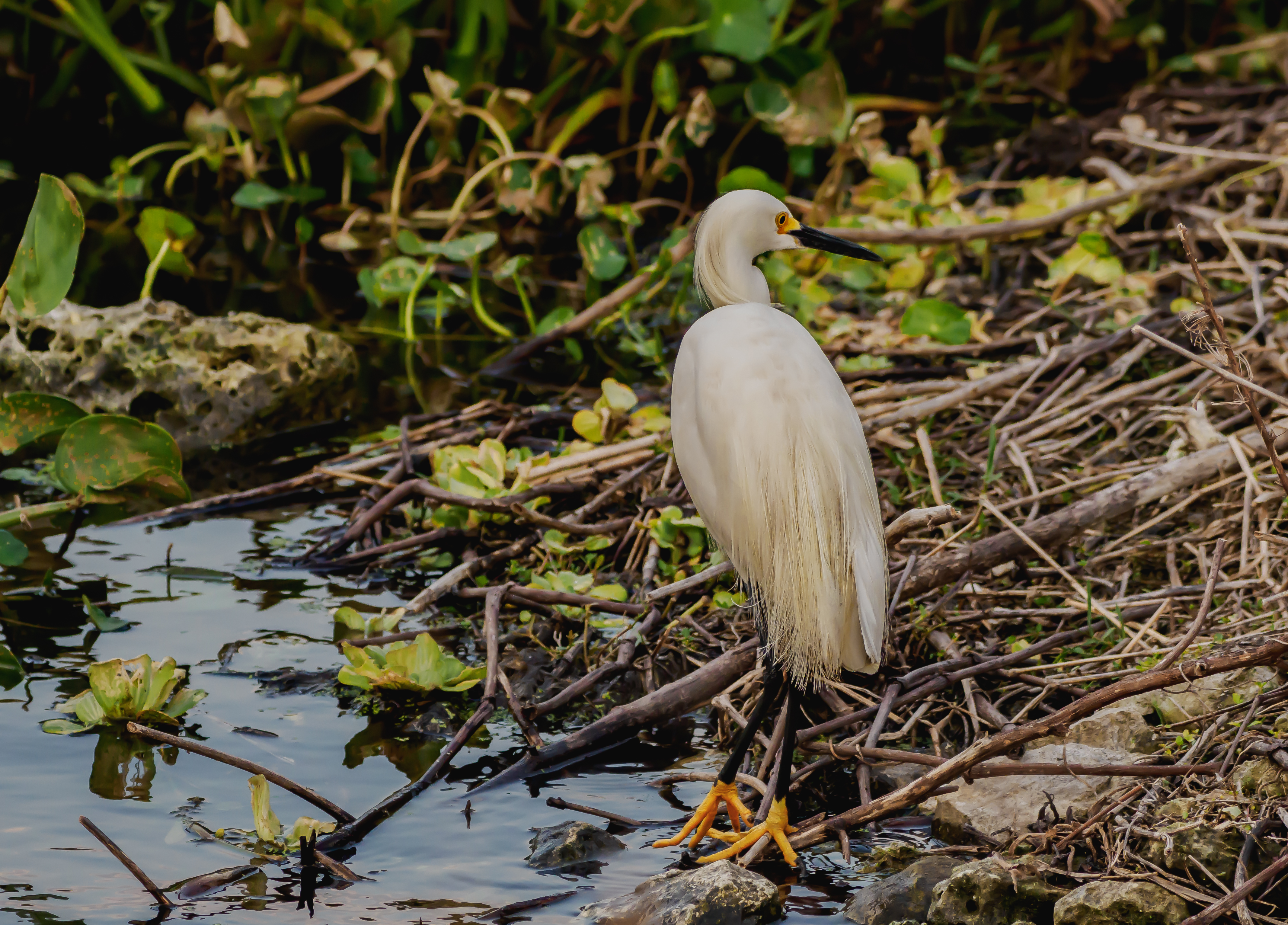
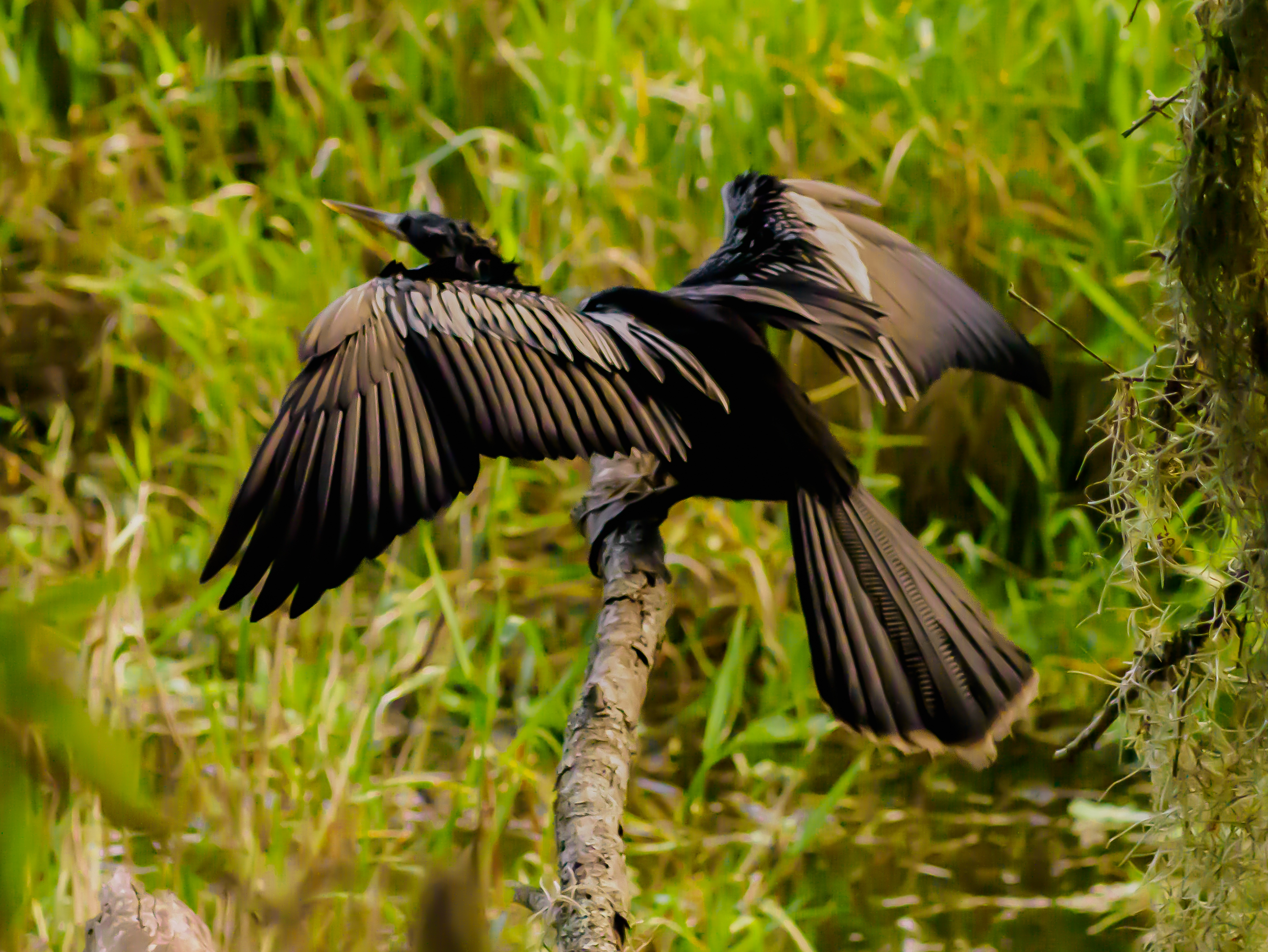
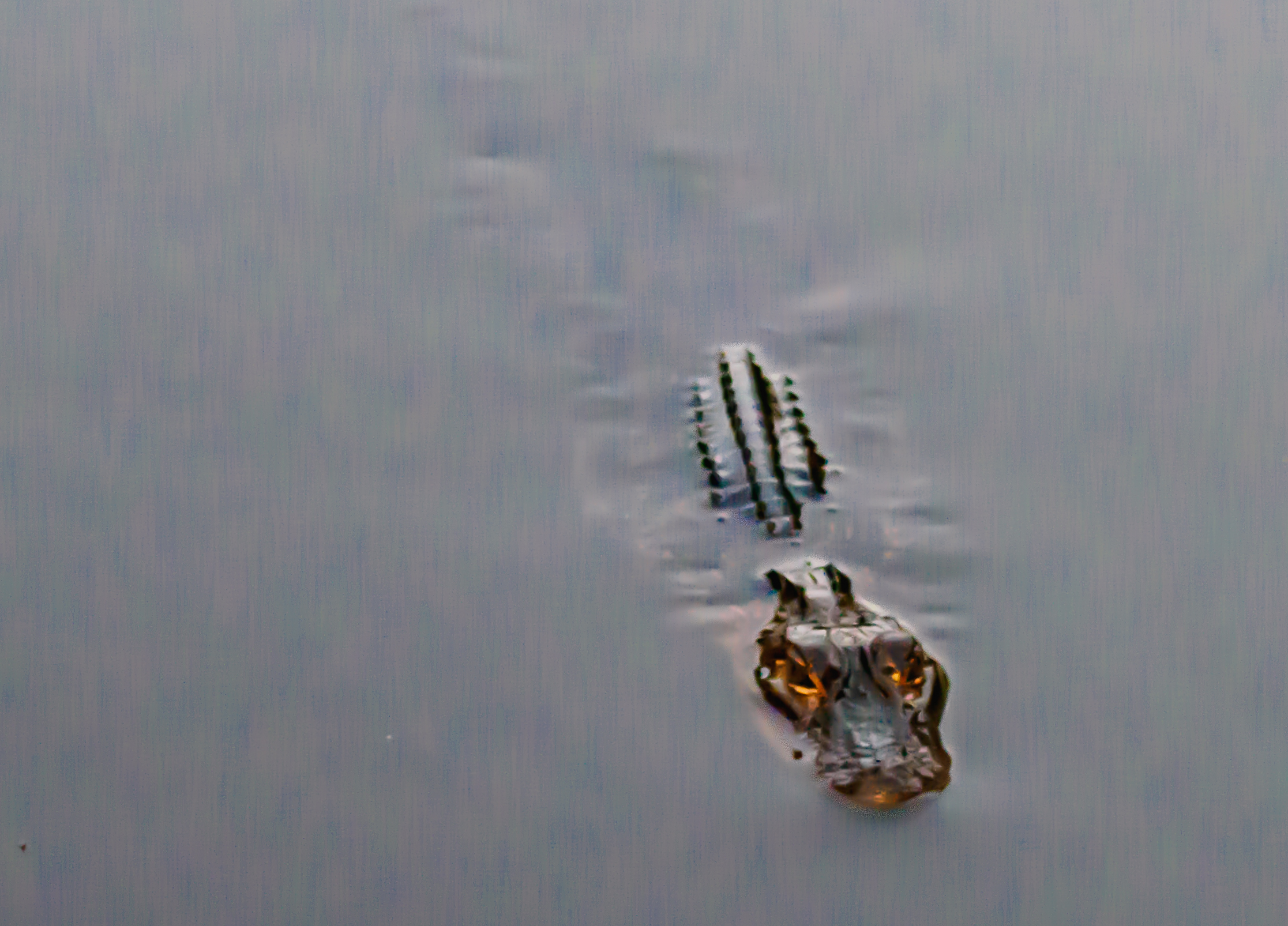
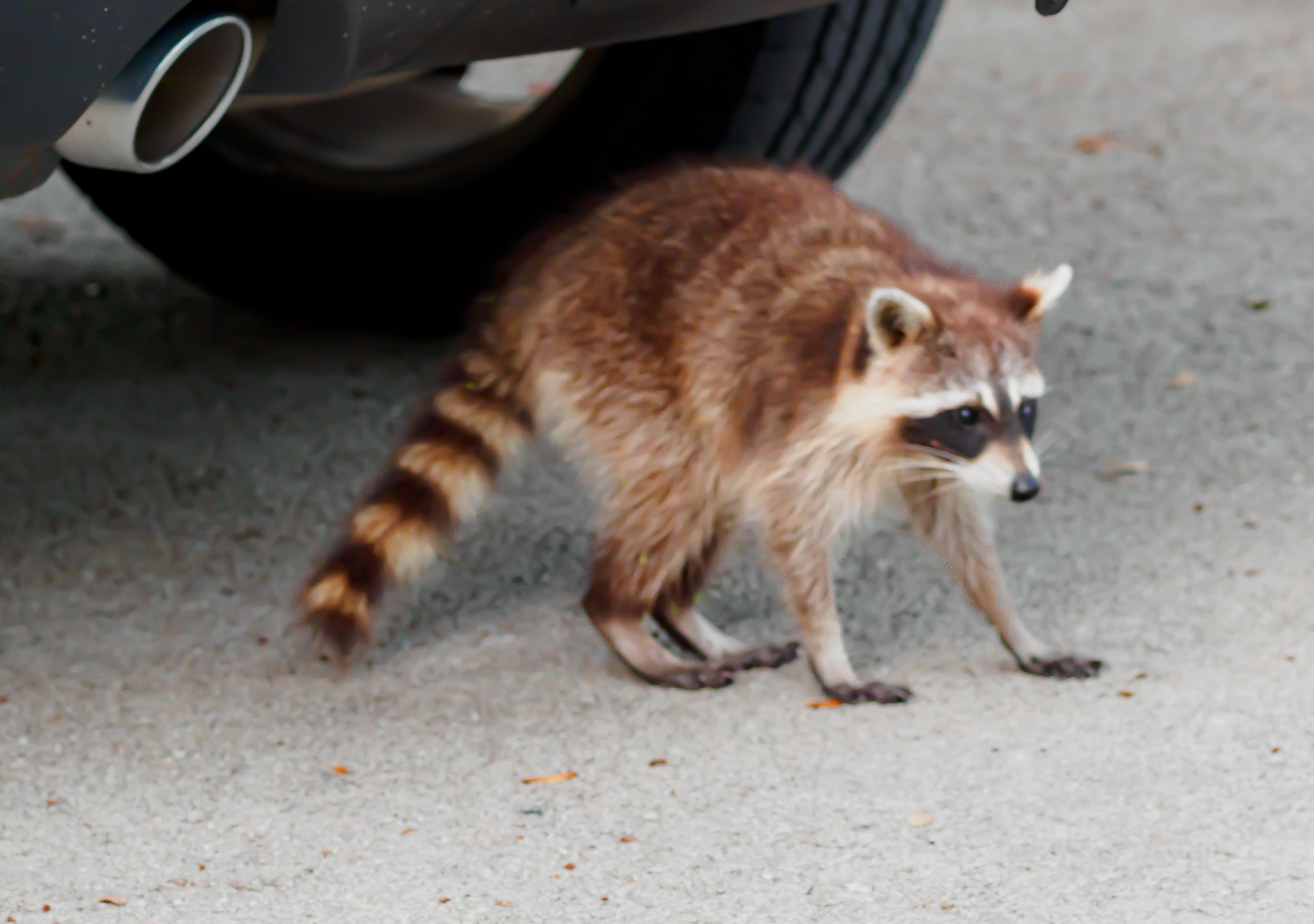
 We also saw some anhingas, some snowies, and even a raccoon.
Then we saw something on the side of the road.
It could be a log.
Or it could be an alligator.
We approached as slowly and quietly as we could, just in case.
With our very looooooooooooooooong lenses.
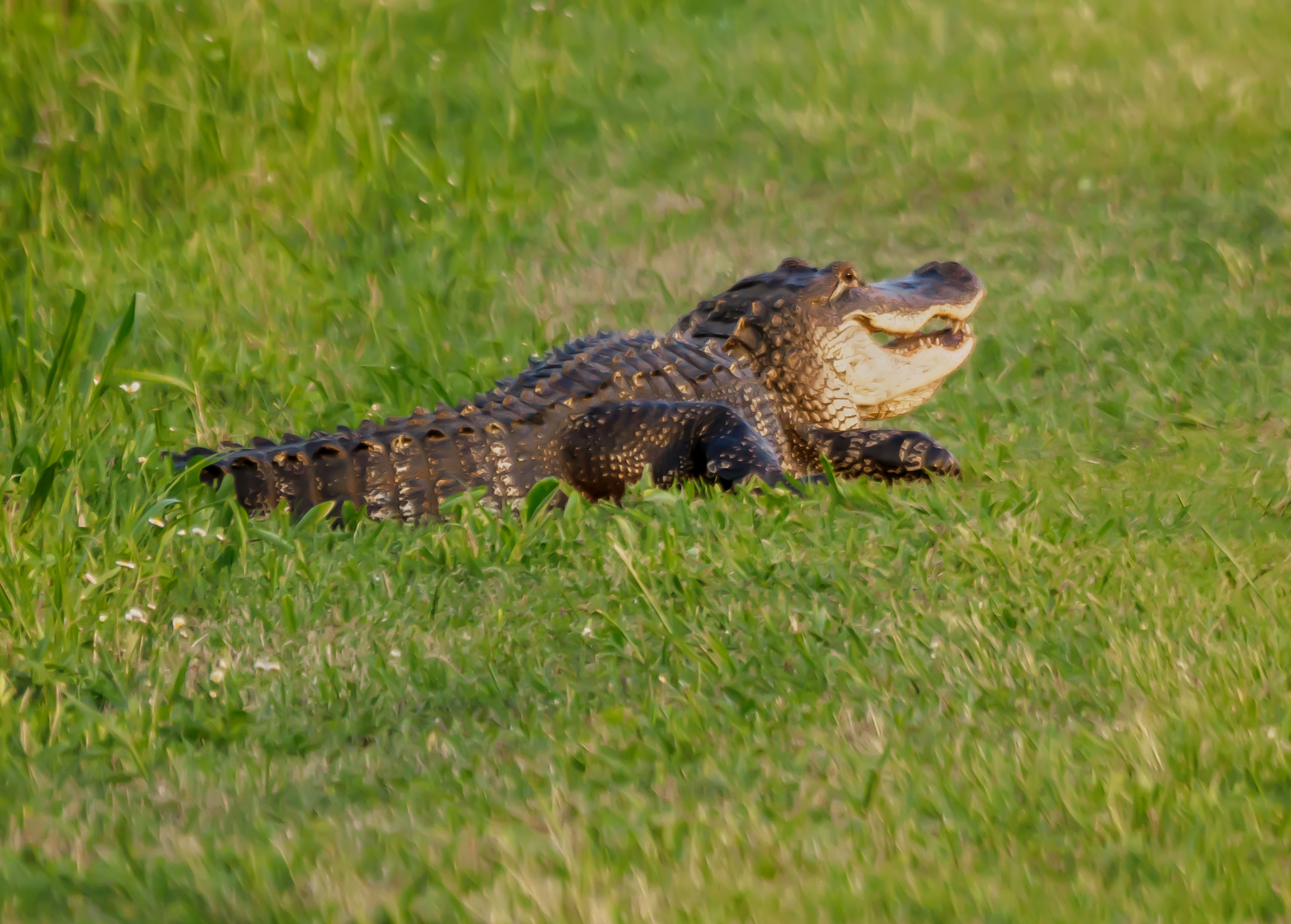 It was an alligator! which hurried back into the bush as soon as it sensed our footsteps.
As scary as it was seeing an alligator so close, I couldn’t help but think it was smiling in this photo.
However, even though it was a thrilling sight, the alligator simply could not compete with the little red-bellied family for Star of the Day.
Some more photos from Day 3:
![P5051568 - ]path](https://straightfromthecamera.blog/wp-content/uploads/2022/05/p5051568-path.jpg)

 Seen by Susan: Fun with Flora and Fauna
Recent Comments